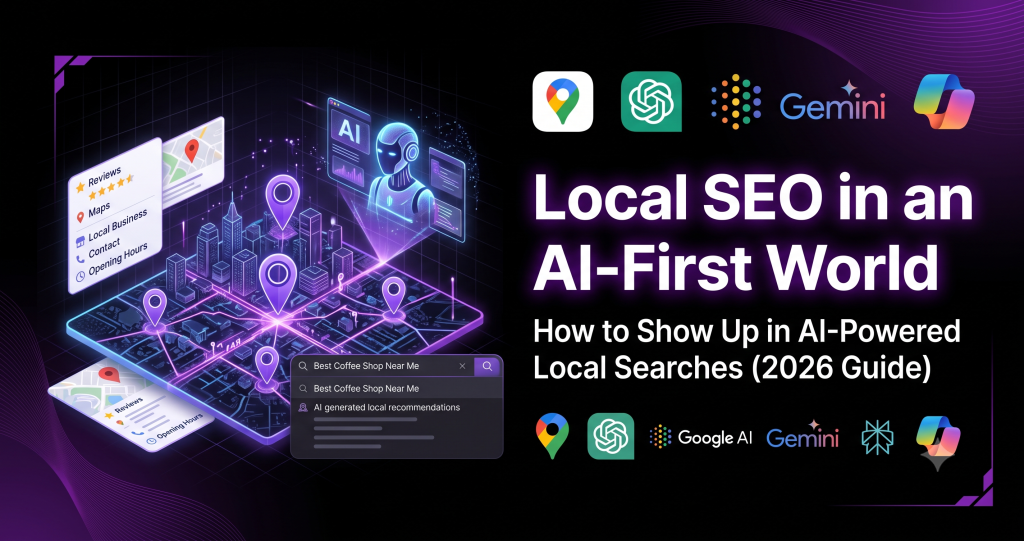
Local SEO in an AI-First World: How to Rank in AI-Powered Local Searches (2026 Guide)
A customer used to Google a business, scroll past a few ads, and click into the map pack. Now they might just ask ChatGPT Search “which Italian place near me is good for a first date” and get one confident answer — no scrolling required. That shift is what Local SEO in an AI-First World is really about. Google AI Overviews, ChatGPT Search, Gemini, and Perplexity AI aren’t just new places to show up — they’re new judges deciding which businesses even get mentioned. Add voice search and AI assistants booking appointments on someone’s behalf, and it’s clear why traditional Local SEO alone can’t carry a business through 2026. This doesn’t mean everything you already know is wrong. It means it’s incomplete. In this guide, you’ll learn what AI-powered local search actually looks like, how the major AI platforms decide which businesses to recommend, and the exact steps to make your business the one they choose. What is AI-Powered Local Search? AI-Powered Local Search is the shift from search engines returning a list of links to AI systems generating a direct, conversational answer — often naming just one or two businesses. A few concepts define this new environment: AI-generated answers that summarize and recommend, rather than simply list results Conversational search, where users ask full, natural-language questions Entity-based search, where your business is understood as a distinct, verifiable “thing” rather than just a webpage Personalized search, shaped by a user’s location, history, and stated preferences Context-aware recommendations, where intent matters — “quick bite” versus “date night” changes the answer AI citations, where the AI names its source, giving cited businesses direct visibility inside the answer itself The practical implication: your business needs to be machine-readable, not just human-appealing. AI systems need to quickly confirm what you do, where you are, who you serve, and whether you’re trustworthy. Pro Tip: Search your own business type and city inside ChatGPT Search or Perplexity. What comes back — or doesn’t — tells you exactly where your gaps are. How AI Search Engines Choose Local Businesses Each platform draws from different data, but they converge on the same principle: verify before recommending. ChatGPT Search browses live web data and favors businesses with consistent details across multiple trusted sources, plus solid review volume. Google AI Overviews leans heavily on Google’s own ecosystem — Business Profile data, Maps reviews, and structured data — so your existing Local SEO foundation carries real weight here. Gemini benefits from tight integration across Search, Maps, and Workspace, rewarding businesses with complete, accurate Google Business Profile information. Perplexity AI is citation-first, explicitly showing where its information came from, which means a strong, credible web presence directly increases your odds of being named. Microsoft Copilot draws from Bing’s index and local data partners, rewarding many of the same signals: consistency, structured data, and review strength. The pattern across all five: AI systems recommend what they can verify. A single glowing review isn’t enough — they’re looking for corroboration across your website, listings, and third-party mentions. Traditional Local SEO vs AI Search Optimization Aspect Traditional Local SEO AI Search Optimization (AISO/GEO) Primary Goal Rank in the map pack and organic results Get named directly inside an AI-generated answer Core Focus Keywords, backlinks, on-page SEO Entities, structured data, cross-platform trust Content Style City and service landing pages Conversational, question-answering content Data Sources Used Mostly Google Search and Maps Google, Bing, review platforms, directories, news Reviews A ranking factor among many A primary trust signal driving recommendations Visibility Outcome One listing among ten results Often a single named business Structured Data Beneficial, sometimes skipped Increasingly essential Success Metric Clicks and map pack position AI citations and direct mentions How to Rank in AI-Powered Local Searches 1. Optimize Your Google Business Profile This remains one of the strongest signals feeding Google AI Overviews and Gemini directly. Select the most precise primary category, plus relevant secondary categories List every service and product with clear, specific details Upload real, current photos regularly — skip the stock imagery Actively collect and respond to reviews Publish business posts for offers, updates, and events Complete the FAQs section with real customer questions Fill out all relevant attributes (wheelchair accessible, outdoor seating, women-owned, and so on) 2. Build Strong Local Entity Signals Entity SEO helps AI systems understand your business as a defined entity connected to a location, industry, and Knowledge Graph node — not just a random website. Keep your business name identical across every platform Clearly state your business identity and specialty on your “About” page Get mentioned consistently across industry directories and local press Align your messaging so every online mention reinforces the same identity 3. Maintain NAP Consistency Your Name, Address, and Phone Number must match exactly everywhere — website, Google Business Profile, social media, and every directory. Even small discrepancies (a suite number here, an abbreviated street name there) create doubt. If an AI system can’t confirm which version of your details is accurate, it’s more likely to skip you entirely and recommend a competitor with cleaner data. 4. Implement Local Schema Markup Structured data removes guesswork for AI systems reading your site. LocalBusiness Schema for business type, location, and hours Organization Schema to reinforce brand identity Review Schema to surface ratings directly FAQ Schema to help AI extract clean, direct answers Product Schema for anything you sell Event Schema for local events and promotions Breadcrumb Schema to clarify site structure and hierarchy A simple LocalBusiness JSON-LD example looks like this: { “@context”: “https://schema.org”, “@type”: “LocalBusiness”, “name”: “Your Business Name”, “address”: { “@type”: “PostalAddress”, “streetAddress”: “123 Main Street”, “addressLocality”: “Your City”, “addressRegion”: “State”, “postalCode”: “00000” }, “telephone”: “+1-000-000-0000”, “openingHours”: “Mo-Fr 09:00-18:00” } Best Practice: Validate every schema type you implement. Broken or incomplete markup can do more harm than having no markup at all. 5. Earn High-Quality Customer Reviews Reviews are one of the clearest trust signals AI platforms use. Google Reviews carry the most weight for Google AI Overviews and Gemini Trustpilot and industry-specific platforms