
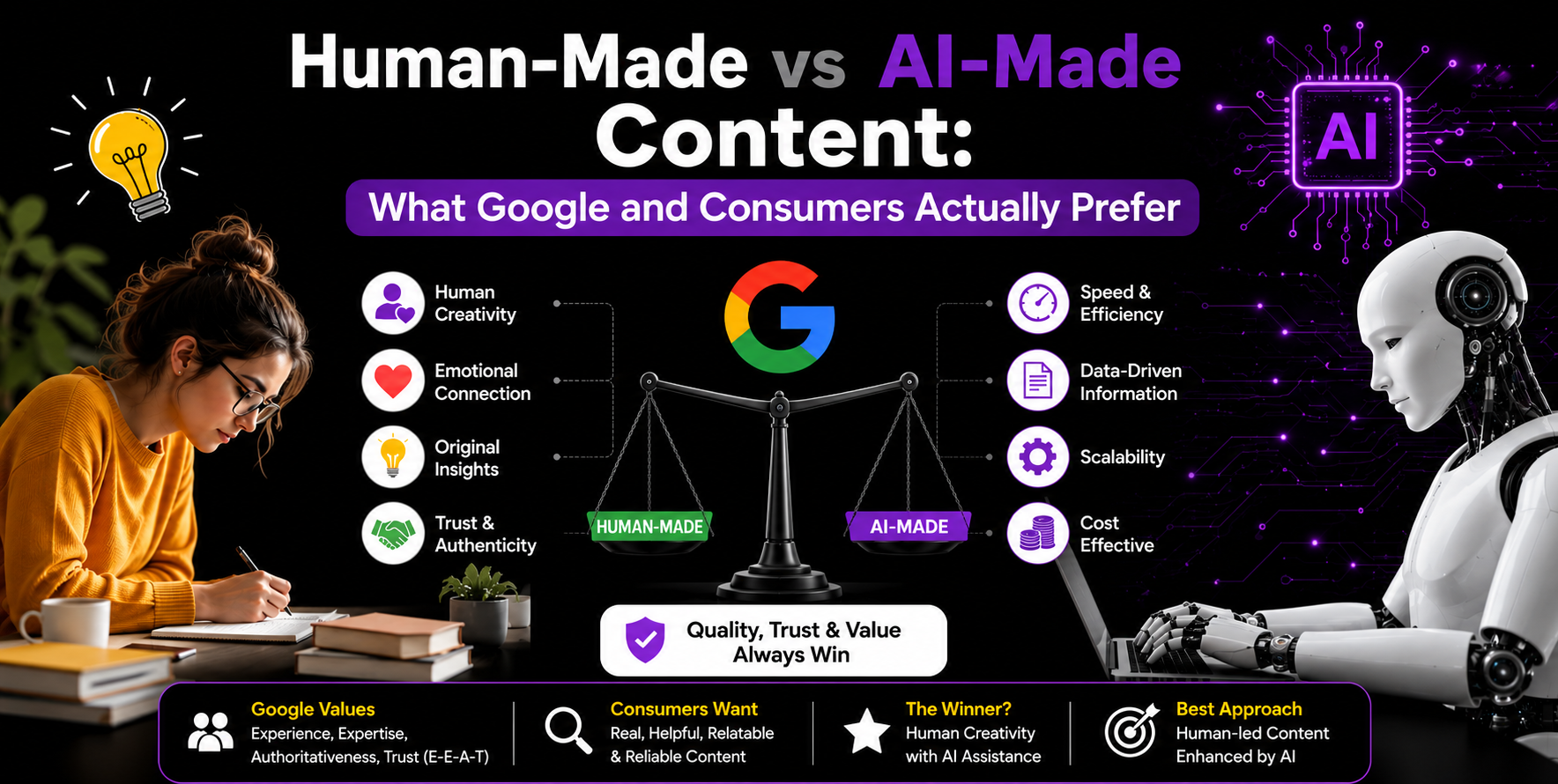
Human-Made vs AI-Made Content: What Google and Consumers Actually Prefer
Ask ten marketers whether AI content hurts SEO, and you’ll get ten different answers. Some swear their AI-generated pages rank just fine. Others have watched traffic quietly decline after publishing a hundred AI articles in a month. Both are telling the truth. That’s what makes this topic genuinely confusing.
So let’s settle the human vs AI content debate with a clearer lens: what Google actually rewards, what readers actually respond to, and where the real difference lies.
The Rise of AI Content
AI writing tools didn’t just get better — they got fast. What used to take a content team a week can now be drafted in minutes. Unsurprisingly, publishing volume across the web has exploded. Entire sites now run on AI-generated content with little to no human editing.
That volume created a problem search engines couldn’t ignore: a flood of technically fluent, often shallow content saying the same thing in slightly different words. Google’s response wasn’t to ban AI writing. It was to double down on rewarding helpful content, no matter who — or what — wrote it.
How Google Evaluates Content Quality
Google has been fairly consistent on this point: it doesn’t evaluate content by who or what created it. It evaluates content by whether it’s genuinely useful to the person reading it.
That evaluation leans heavily on E-E-A-T — Experience, Expertise, Authoritativeness, and Trust. In practice, this means Google is asking:
- Does this content show real understanding of the topic?
- Does it reflect first-hand experience where relevant?
- Would a knowledgeable person find this accurate and useful?
- Is there any reason to distrust this source?
AI-generated content can technically check some of these boxes. But it consistently struggles with the first one — genuine experience — because it’s built from patterns in existing text, not lived knowledge
Human Content vs AI Content
Here’s the honest comparison, without the hype in either direction.
Human-written content tends to include specific detail, personal judgment, and the small imperfections that come with real experience. It’s slower to produce, but harder to replicate.
AI-generated content tends to be fast, consistent, and well-structured, but often generic. It reads well on the surface, yet rarely says anything a competitor’s AI-generated article couldn’t also say.
Neither is inherently good or bad. The real variable is depth — and that’s often more about editing than authorship.
Advantages of Human-Written Content
- Reflects real experience, opinions, and nuance
- Naturally aligns with Google’s E-E-A-T expectations
- Builds a distinct brand voice over time
- Handles complex, sensitive, or emotionally nuanced topics well
- More likely to earn organic backlinks and citations
Advantages of AI-Assisted Content
- Speeds up research, outlining, and first drafts significantly
- Helps maintain consistency across large content libraries
- Useful for repetitive, structured content like product descriptions or FAQs
- Frees up human writers to focus on original insight instead of formatting
When AI Works Best
AI content performs well in situations where speed and structure matter more than originality — internal documentation, product descriptions, meeting summaries, or first-draft outlines that a human will refine. It’s also useful for scaling formats that don’t require deep personal insight, like basic definitions or how-to steps for simple tasks.
When Human Expertise Is Essential
Some content simply cannot be faked. Topics involving health, finance, legal advice, or high-stakes decisions require real accountability — something AI can’t provide on its own. The same goes for brand storytelling, opinion pieces, and anything meant to build an emotional connection with an audience. Readers can usually sense the difference, even if they can’t always articulate why.
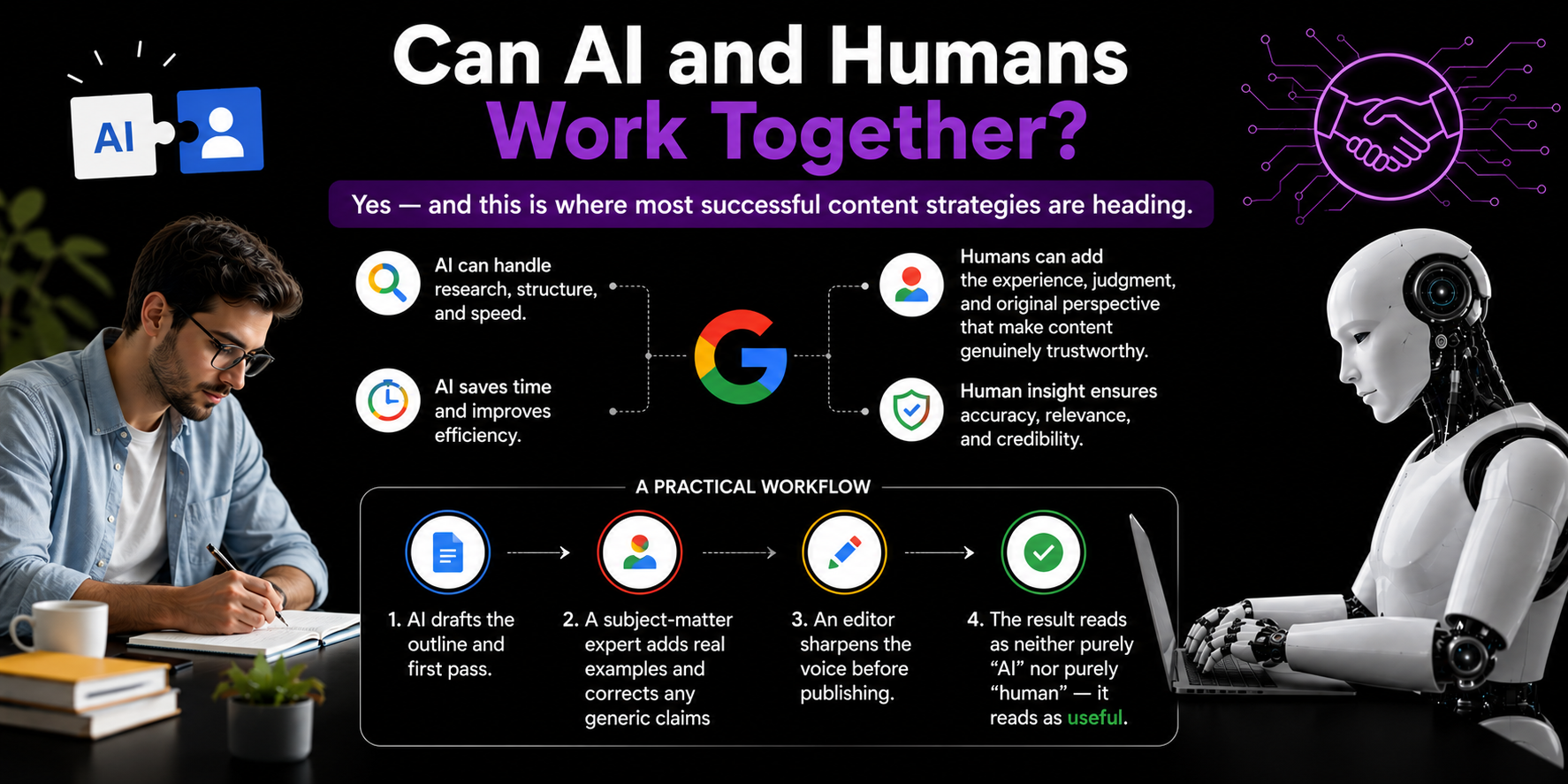
Can AI and Humans Work Together?
Yes — and this is where most successful content strategies are heading. AI can handle research, structure, and speed. Humans can add the experience, judgment, and original perspective that make content genuinely trustworthy.
A practical workflow looks like this: AI drafts the outline and first pass, a subject-matter expert adds real examples and corrects any generic claims, and an editor sharpens the voice before publishing. The result reads as neither purely “AI” nor purely “human” — it reads as useful
Best Practices for Creating High-Quality Content
- Always have a human expert review and edit AI-assisted drafts
- Add original data, case studies, or first-hand examples
- Avoid publishing AI content at scale without meaningful edits
- Credit real authors with visible expertise
- Focus on answering the reader’s actual question, not just matching a keyword
Real Examples
A SaaS company using AI to draft blog outlines, then having product managers add real customer feedback and screenshots, tends to outperform competitors publishing unedited AI content at volume. Similarly, a health and wellness brand that pairs AI-generated first drafts with review from a licensed professional builds far more trust than one relying on AI alone — both with Google and with readers who are searching for genuinely reliable advice.
Future Of Content Marketing
As Generative Engine Optimization becomes more central to SEO in 2026, the businesses that succeed won’t be the ones avoiding AI entirely, nor the ones publishing AI content unchecked. They’ll be the ones using AI as a tool for speed, while relying on human expertise for the substance that earns trust — from both search engines and the people they’re writing for.
Conclusion
The human vs AI content debate isn’t really about picking a side. It’s about understanding what each does well, and being honest about where AI falls short. Google rewards helpfulness. Readers reward authenticity. Right now, the content that wins both is usually AI-assisted, but human-led.
Want content that actually earns trust and rankings?
Start by auditing your last ten published articles. If you can’t tell who wrote them — or worse, if they all sound the same — it’s time to bring more human expertise back into the process.
Key Takeaways
- Google evaluates helpfulness, not authorship — but AI content often struggles to meet E-E-A-T standards alone.
- Human content excels at genuine experience, nuance, and trust.
- AI content excels at speed, consistency, and structure.
- The strongest results come from combining AI efficiency with human expertise and editing.
- Unedited AI content published at scale is a growing SEO risk, not a shortcut.
FAQs
1. Does Google penalize AI-generated content? Google doesn’t penalize content simply for being AI-assisted. It penalizes content that’s unhelpful, inaccurate, or lacks real expertise — a risk that’s higher with unedited AI content.
2. Is human-written content always better for SEO? Not automatically, but human involvement generally strengthens the experience and expertise signals Google rewards.
3. Can I use AI content and still rank well? Yes, if it’s reviewed, fact-checked, and enriched with real expertise and original insight before publishing.
4. What is Generative Engine Optimization (GEO)? GEO is the practice of optimizing content so AI search tools and chatbots are more likely to cite or reference it in generated answers.
5. How can I tell if my content is too generic? If a competitor could publish the exact same article with their logo swapped in, it likely lacks the original insight search engines and readers now expect.