
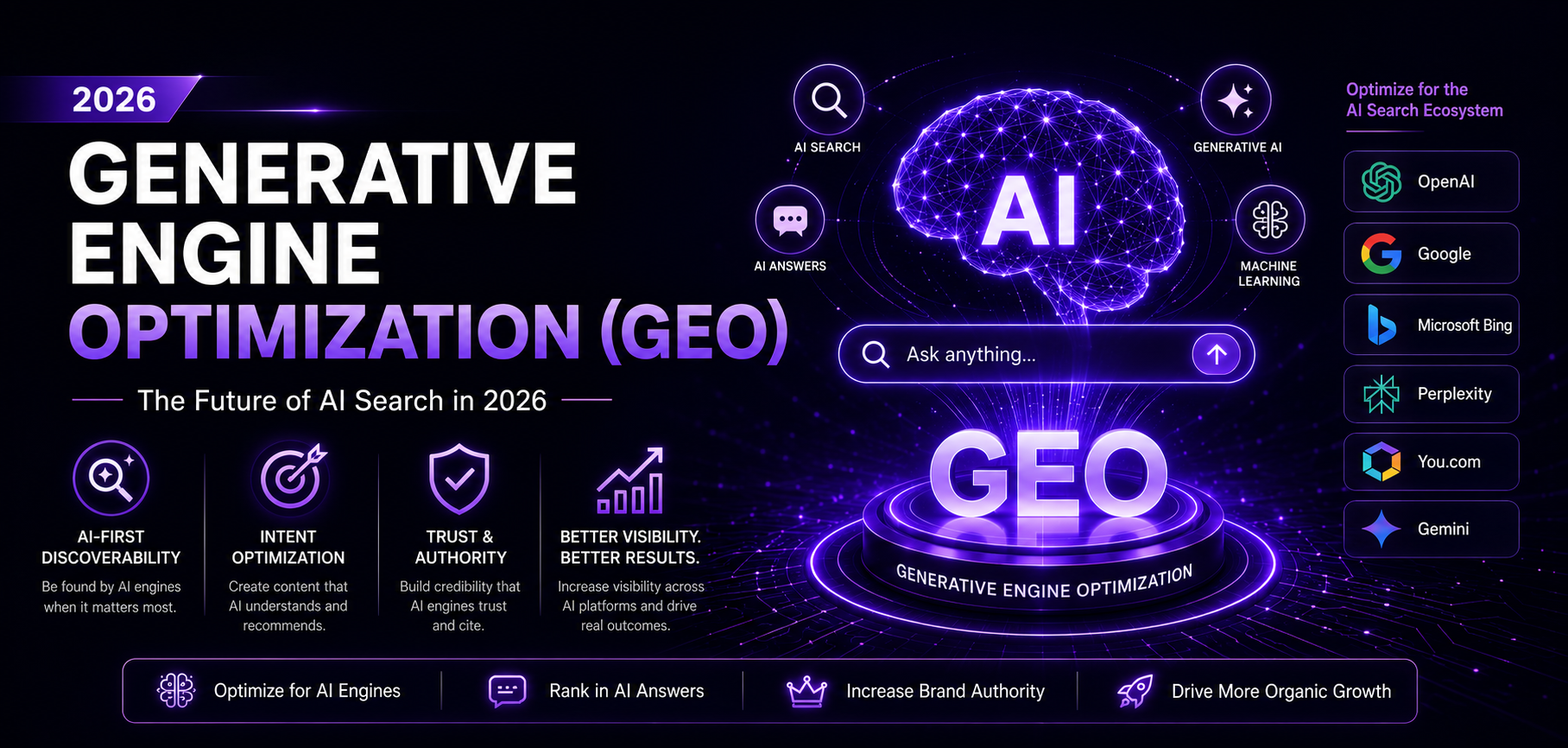
Generative Engine Optimization (GEO): The Future of AI Search in 2026
Search doesn’t look anything like it did five years ago. If you typed a question into Google in 2019, you got ten blue links and maybe a featured snippet if you were lucky. Today, you’re just as likely to get a fully written answer — assembled in real time, citing multiple sources, with no clicking required.
That shift has a name: Generative Engine Optimization, or GEO.
Whether you run a small business, manage marketing for a startup, or work at an agency juggling a dozen client websites, this shift affects you. Tools like ChatGPT, Google AI Overviews, Gemini, Perplexity, and Microsoft Copilot are no longer novelties — they’re becoming the front door to the internet for millions of people every single day. And the way these AI Search Engines find, understand, and cite content is fundamentally different from how traditional search engines rank a webpage.
This guide breaks down exactly what GEO is, how it works, why it matters right now, and — most importantly — what you can actually do about it. No fluff, no recycled definitions. Just a practical, honest look at the future of search.
Quick Definition: Generative Engine Optimization (GEO) is the practice of structuring, writing, and promoting content so that AI-powered answer engines — like ChatGPT, Google AI Overviews, Gemini, and Perplexity — can understand it, trust it, and cite it in their generated responses.
What is Generative Engine Optimization (GEO)?
Generative Engine Optimization (GEO) is the process of optimizing digital content so it gets discovered, understood, summarized, and cited by AI-driven search and answer engines rather than just ranked on a traditional search results page.
Think of traditional SEO as trying to earn a spot on a shelf. GEO is different — you’re trying to become part of the answer itself.
When someone asks ChatGPT, “What’s the best CRM for a small real estate agency?” the model doesn’t return a list of links. It generates a direct, conversational answer, often pulling in facts, comparisons, and sometimes citations from a handful of trusted sources. If your content isn’t structured or trusted in a way the AI model can use, you simply don’t exist in that answer — no matter how well you’d rank on page one of Google.
What is GEO SEO?
People often search “GEO SEO” wondering if it’s a separate discipline from regular SEO. It isn’t — GEO is best understood as an evolution and extension of SEO, not a replacement. Good technical SEO, strong content quality, and authoritative backlinks still matter. GEO simply adds a new layer on top: making sure your content is machine-readable, semantically clear, and citation-worthy for large language models (LLMs).
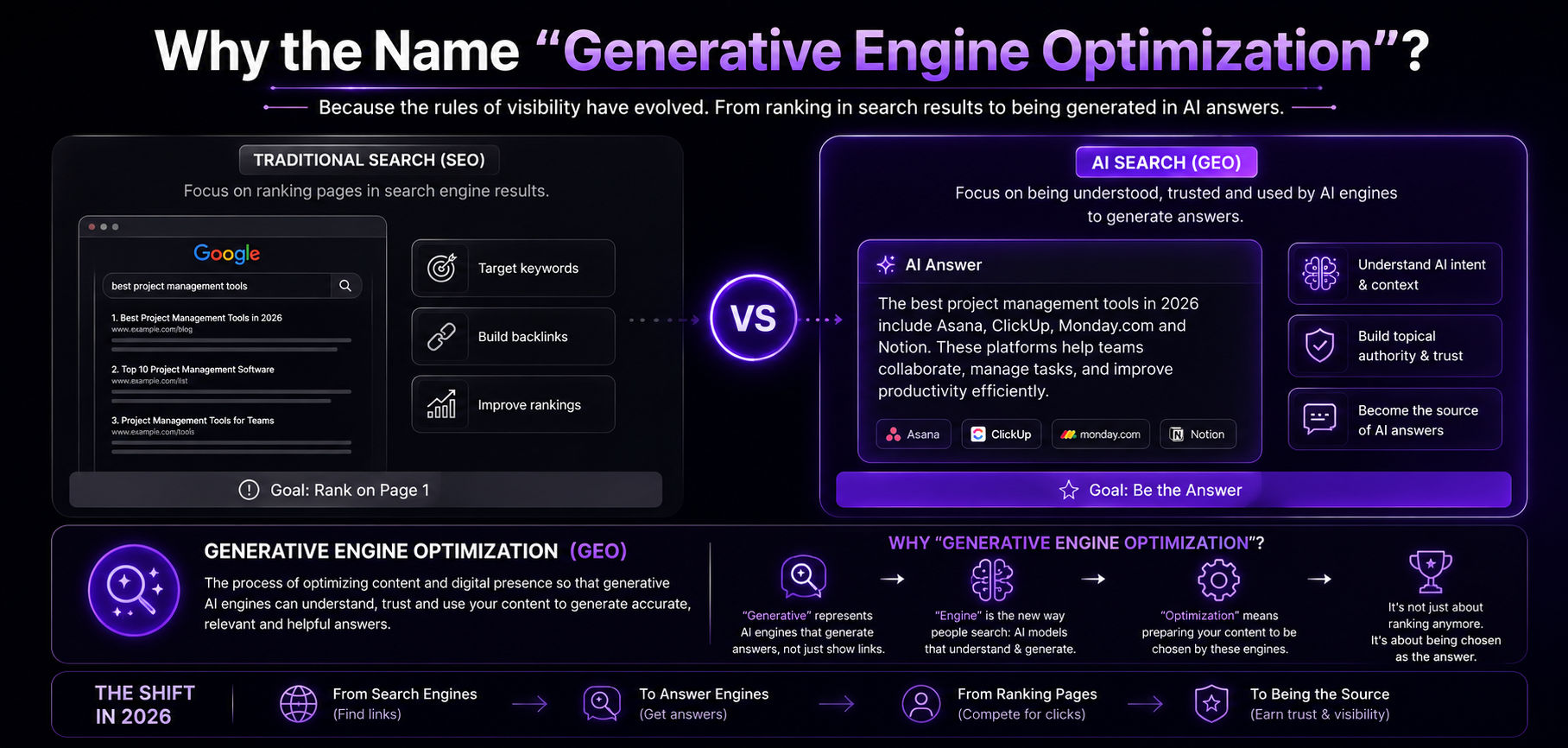
Why the Name "Generative Engine Optimization"?
The term comes from “generative engines” — AI systems that generate original answers instead of retrieving and ranking existing pages. This includes:
- ChatGPT (OpenAI)
- Google AI Overviews and Google Gemini
- Perplexity AI
- Microsoft Copilot
- Claude AI (Anthropic)
- Meta AI
Each of these tools pulls from massive training data and, increasingly, live web results, to construct answers. GEO is about earning your place inside that generation process.
How GEO Works
GEO isn’t magic — it follows a logical pipeline. Here’s a simplified breakdown of how most generative search engines process a query and decide what to include in an answer.
Step 1: Query Understanding The AI model interprets the user’s intent, not just their keywords. It considers context, prior conversation history, and semantic meaning.
Step 2: Retrieval Many AI engines (especially Perplexity, Gemini, and Google AI Overviews) perform real-time web retrieval, pulling in current, relevant pages using search indexes and Retrieval-Augmented Generation (RAG) techniques.
Step 3: Evaluation and Ranking of Sources The engine evaluates which sources are trustworthy, relevant, and well-structured enough to use. This is where entity clarity, topical authority, and EEAT (Experience, Expertise, Authoritativeness, Trustworthiness) come into play heavily.
Step 4: Synthesis The model synthesizes information from multiple sources into a single, coherent, conversational answer — often blending facts from several pages rather than quoting just one.
Step 5: Citation (Sometimes) Depending on the platform, the AI may cite sources directly (Perplexity and Google AI Overviews do this consistently; ChatGPT does this more selectively, especially when browsing is active).
Step 6: Delivery The final answer is presented to the user — often with no need to click through to a website at all.
Why GEO Matters in 2026
By 2026, AI-powered search isn’t a side experiment anymore — it’s mainstream behavior. Here’s why ignoring GEO is a genuinely risky business decision.
1. Zero-click search is accelerating. More users get their answer directly inside the AI response and never visit a website. If your content isn’t part of that answer, you’re invisible for that entire segment of searchers.
2. AI search usage is growing fast. Millions of people now start their research on ChatGPT or Perplexity instead of Google, especially for comparison shopping, technical questions, and B2B research.
3. Google itself is going generative. Google AI Overviews now appear across a large share of informational queries, meaning even “regular” Google search is becoming an AI search experience.
4. Trust and citations are the new currency. Being cited by an AI engine builds brand visibility and credibility in a way a buried page-two ranking never could.
5. Early movers will dominate. Just like early SEO adopters in the 2000s built massive authority advantages, businesses optimizing for GEO now will have a significant head start as AI search becomes the default.
Industry Insight: Analysts across the SEO and digital marketing industry widely agree that AI Overviews and chat-based search assistants are reshaping click-through behavior, with many informational queries now resolved without a single website visit. Brands that fail to adapt risk losing visibility precisely where their future customers are looking.
Difference Between SEO, AEO and GEO
These three terms get thrown around interchangeably, but they’re not the same thing. Here’s a clear breakdown.
| Factor | Traditional SEO | AEO (Answer Engine Optimization) | GEO (Generative Engine Optimization) |
|---|---|---|---|
| Primary Goal | Rank high on search engine results pages (SERPs) | Get featured in direct-answer boxes (snippets, voice assistants) | Get cited/referenced inside AI-generated answers |
| Target Platforms | Google, Bing organic results | Featured snippets, Google Assistant, Alexa, Siri | ChatGPT, Gemini, Perplexity, Google AI Overviews, Copilot |
| Content Format | Long-form articles, keyword-optimized pages | Concise, direct answers to specific questions | Well-structured, semantically rich, fact-dense content |
| Ranking Signal Focus | Backlinks, keywords, page speed, technical SEO | Clear Q&A formatting, schema markup | Entity clarity, EEAT, citations, structured data, topical depth |
| User Outcome | Click to website | Quick answer, sometimes clicks through | Full answer, often no click at all |
| Success Metric | Keyword rankings, organic traffic | Snippet ownership, voice search visibility | Citation frequency, brand mentions in AI answers |
| Content Structure | Headings, keyword density | FAQ blocks, concise answers | Structured data + narrative + statistics + citations |
| Time Horizon | Established discipline since early 2000s | Grew with voice search (2015 onward) | Emerging and rapidly evolving (2023 onward) |
How ChatGPT Finds Information
ChatGPT SEO is one of the most searched terms in this space, and for good reason — ChatGPT has become a default research tool for millions of professionals.
Here’s how it typically sources information:
- Training data knowledge — ChatGPT has broad knowledge baked into its model from its training data, which has a knowledge cutoff date.
- Live web browsing (when enabled) — For current events or up-to-date facts, ChatGPT can perform real-time web searches and cite sources directly in its response.
- Retrieval-Augmented Generation (RAG) — The model retrieves relevant, high-quality documents and blends them into a synthesized answer rather than quoting one source verbatim.
- Source credibility weighting — Well-structured, authoritative, and frequently referenced content tends to surface more often in browsing-enabled answers.
What this means for you: If you want to show up in ChatGPT’s browsing-based answers, your content needs to be crawlable, clearly structured, factually accurate, and hosted on a site with reasonable domain trust. Vague, thin, or purely promotional content rarely gets pulled into a synthesized answer.
How Google AI Overviews Work
Google AI Overviews (part of Google’s Search Generative Experience) sit at the top of many search results, generating a synthesized answer using multiple sources before the traditional blue links even appear.
Key mechanics:
- Built on Google’s index — AI Overviews pull from the same massive web index Google already uses for organic search, meaning traditional SEO fundamentals still directly influence eligibility.
- Multi-source synthesis — Google blends information from several top-ranking pages into one cohesive answer, often with inline citation links.
- Featured snippet overlap — Pages that already perform well for featured snippets and “People Also Ask” boxes have a strong head start for AI Overview inclusion.
- E-E-A-T weighting — Google has repeatedly emphasized Experience, Expertise, Authoritativeness, and Trustworthiness signals as central to which content gets surfaced in AI-generated summaries.
Practical takeaway: Ranking in the traditional top 10 is still one of the strongest predictors of appearing in a Google AI Overview. GEO and classic SEO are deeply intertwined here — you can’t skip the fundamentals.
How Gemini Generates Answers
Gemini SEO matters increasingly because Gemini is deeply integrated across Google’s ecosystem — Search, Android, Workspace, and Chrome.
How Gemini typically builds answers:
- Multimodal understanding — Gemini can process text, images, and other data types together, meaning visual content and structured media can influence how it interprets a page.
- Google Knowledge Graph integration — Gemini leans heavily on entity relationships mapped in Google’s Knowledge Graph, reinforcing the importance of clear entity definitions on your site (who you are, what you do, how you relate to other known entities).
- Real-time grounding — Gemini can ground responses in live Google Search results for accuracy, similar to RAG-based retrieval.
- Conversational context — Because Gemini often operates within multi-turn conversations, it prioritizes content that answers follow-up and clarifying questions clearly, not just the first query.
Practical takeaway: Structuring your content around clear entities (your brand, products, people, locations) and their relationships to broader industry concepts significantly boosts your odds of being pulled into Gemini’s answers.
How Perplexity AI Searches the Web
Gemini SEO matters increasingly because Gemini is deeply integrated across Google’s ecosystem — Search, Android, Workspace, and Chrome.
How Gemini typically builds answers:
- Multimodal understanding — Gemini can process text, images, and other data types together, meaning visual content and structured media can influence how it interprets a page.
- Google Knowledge Graph integration — Gemini leans heavily on entity relationships mapped in Google’s Knowledge Graph, reinforcing the importance of clear entity definitions on your site (who you are, what you do, how you relate to other known entities).
- Real-time grounding — Gemini can ground responses in live Google Search results for accuracy, similar to RAG-based retrieval.
- Conversational context — Because Gemini often operates within multi-turn conversations, it prioritizes content that answers follow-up and clarifying questions clearly, not just the first query.
Practical takeaway: Structuring your content around clear entities (your brand, products, people, locations) and their relationships to broader industry concepts significantly boosts your odds of being pulled into Gemini’s answers.
How Perplexity AI Searches the Web
Perplexity SEO is a growing focus because Perplexity has built its entire product around being a citation-first, source-transparent answer engine.
How it works:
- Real-time web crawling — Perplexity actively crawls and indexes the live web for nearly every query, rather than relying primarily on static training data.
- Direct source citations — Almost every Perplexity answer includes numbered citations linking back to original sources, making it one of the more “SEO-friendly” AI engines in terms of driving referral traffic.
- Freshness weighting — Recently published or updated content tends to perform well, since Perplexity emphasizes current, verifiable information.
- Multi-source cross-referencing — Perplexity often pulls from 5–10+ sources per answer, favoring diversity and factual consistency across sources.
Practical takeaway: Because Perplexity cites so transparently, it’s one of the best platforms to track for measuring your GEO success — you can literally see when and how often your content gets referenced.
Ranking Factors for GEO
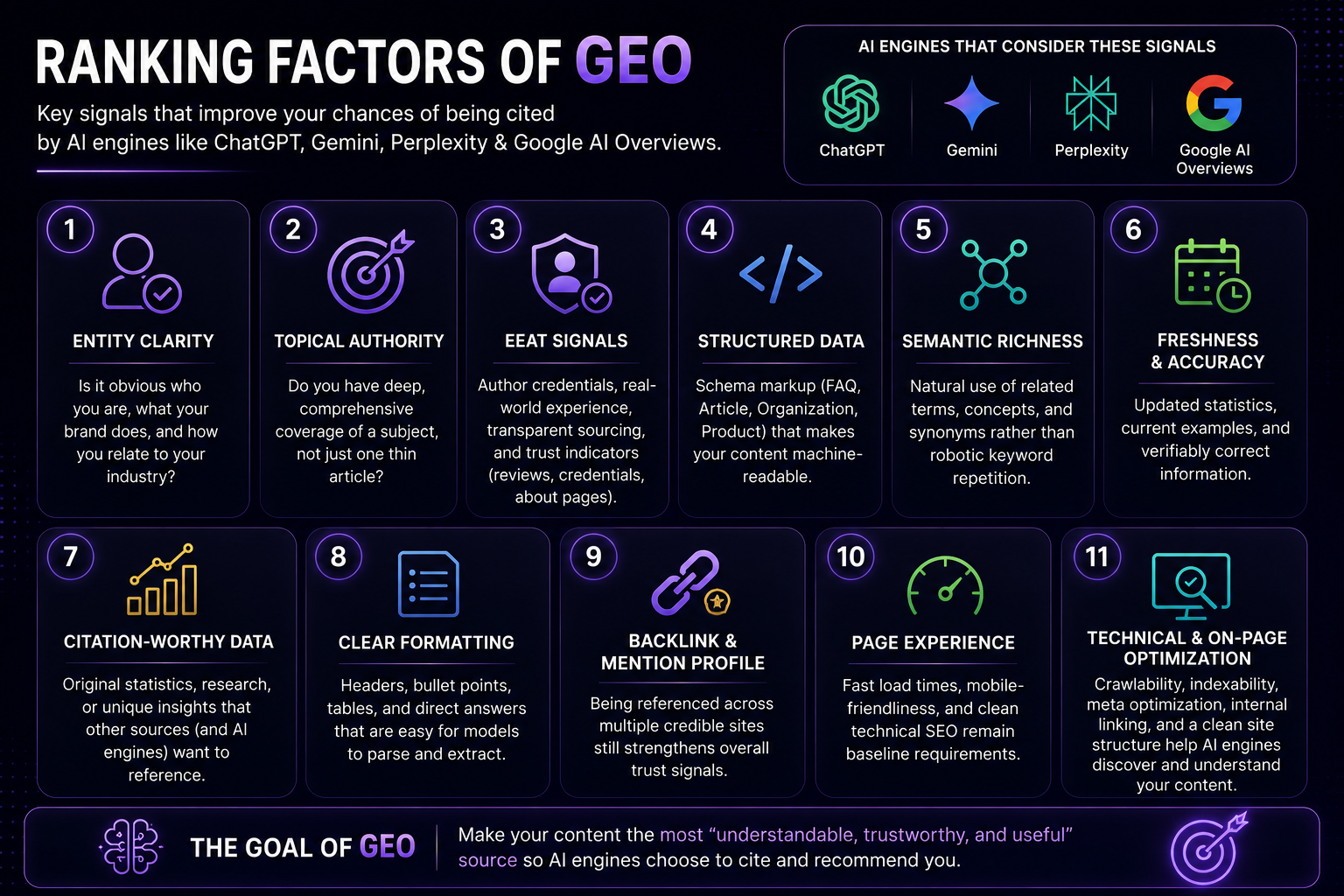
While no platform publishes an official “GEO algorithm,” patterns across ChatGPT, Gemini, Perplexity, and Google AI Overviews reveal consistent signals that influence citation likelihood.
Core GEO Ranking Factors:
- Entity clarity — Is it obvious who you are, what your brand does, and how you relate to your industry?
- Topical authority — Do you have deep, comprehensive coverage of a subject, not just one thin article?
- EEAT signals — Author credentials, real-world experience, transparent sourcing, and trust indicators (reviews, credentials, about pages).
- Structured data — Schema markup (FAQ, Article, Organization, Product) that makes your content machine-readable.
- Semantic richness — Natural use of related terms, concepts, and synonyms rather than robotic keyword repetition.
- Freshness and accuracy — Updated statistics, current examples, and verifiably correct information.
- Citation-worthy data — Original statistics, research, or unique insights that other sources (and AI engines) want to reference.
- Clear formatting — Headers, bullet points, tables, and direct answers that are easy for models to parse and extract.
- Backlink and mention profile — Being referenced across multiple credible sites still strengthens overall trust signals.
- Page experience — Fast load times, mobile-friendliness, and clean technical SEO remain baseline requirements.
How to Optimize Content for GEO
This is the section most readers came for — the actionable playbook. Here’s exactly how to optimize content for generative engines.
1. Entity Optimization
Make sure search engines and AI models know exactly who and what you are. Use consistent naming for your brand, clear “About” pages, and structured data that defines your organization, people, and offerings.
2. Semantic SEO
Write around topics and concepts, not just isolated keywords. Cover related subtopics, use natural variations of your target terms, and answer the questions a real expert would anticipate.
3. Structured Data (Schema Markup)
Implement Article, FAQ, Organization, Product, and Review schema wherever relevant. This gives AI crawlers a machine-readable map of your content.
4. FAQ Optimization
Add clear, direct FAQ sections addressing real user questions. AI engines love pulling concise, well-formatted Q&A content directly into their answers.
5. Natural Language Writing
Write the way people actually talk and ask questions. Avoid stuffing keywords unnaturally — generative models are exceptionally good at detecting (and penalizing relevance for) forced, unnatural phrasing.
6. Topical Authority
Don’t publish one article and hope. Build a full content cluster around your core topic with interlinked, comprehensive coverage — this signals depth of expertise.
7. Internal Linking
Connect related content across your site so both users and crawlers understand your topical ecosystem and can trace your authority across a subject.
8. External Authority Links
Cite credible, authoritative sources yourself. This context helps AI models validate the trustworthiness of your content.
9. EEAT (Experience, Expertise, Authoritativeness, Trustworthiness)
Show real author bylines, credentials, first-hand experience, and transparency. AI engines increasingly weigh trust signals as heavily as relevance.
10. Fresh Content
Update statistics, examples, and dates regularly. Stale content loses ground fast in freshness-sensitive engines like Perplexity.
11. Statistics and Data
Include specific, sourced numbers. AI engines love citing concrete data points over vague claims.
12. Citations
Reference reputable studies, reports, and primary sources — this builds credibility and encourages AI engines to treat your content as a reliable node in their retrieval process.
13. Original Research
Publish your own surveys, case studies, or proprietary data. Original research is one of the single strongest GEO assets because it can’t be found anywhere else — making it uniquely citation-worthy.
Best GEO Strategies for Businesses
Here’s how different types of businesses can practically apply GEO starting today.
For Local Businesses:
- Claim and optimize Google Business Profile listings (a major entity trust signal).
- Publish location-specific FAQ content addressing common customer questions.
- Encourage genuine customer reviews, which feed trust signals AI engines pick up on.
For SaaS and Startups:
- Build detailed comparison pages (“Us vs. Competitor”) — these are exactly the kind of content ChatGPT and Perplexity pull from for buyer-intent queries.
- Publish original product usage data or benchmarks.
- Maintain a well-structured knowledge base with clear, indexable documentation.
For E-commerce:
- Use Product schema markup on every listing.
- Publish detailed buying guides with real specifications and comparisons.
- Highlight verified reviews prominently.
For Agencies and Consultants:
- Publish case studies with measurable, specific results.
- Build topical hub pages that comprehensively cover your service areas.
- Showcase team credentials and real client outcomes.
For Bloggers and Content Creators:
- Add author bio boxes with genuine credentials and experience.
- Update older top-performing posts with current statistics.
- Structure posts with clear headers, TL;DR summaries, and FAQ sections.
Real-World Example: A mid-sized B2B software company restructured its blog around clear comparison content, added FAQ schema across its top 20 articles, and published a proprietary industry survey. Within a few months of consistent publishing, the team began noticing their brand name and product comparisons appearing directly inside Perplexity and ChatGPT browsing responses for category-related queries — driving both brand visibility and qualified referral traffic from AI-curious buyers who clicked through to verify details.
Common GEO Mistakes
Avoid these pitfalls — they’re the fastest way to stay invisible to AI search engines.
- Keyword stuffing — Generative models detect unnatural phrasing and deprioritize it for relevance and trust.
- Thin, generic content — A 300-word article with no depth won’t get cited over a comprehensive competitor.
- Ignoring structured data — Skipping schema markup makes it harder for AI crawlers to parse your content correctly.
- No clear author identity — Anonymous or vague authorship damages EEAT signals significantly.
- Outdated statistics — Old data quietly kills your credibility with freshness-sensitive engines.
- Overly promotional tone — Pure sales copy rarely gets synthesized into neutral AI answers.
- Neglecting FAQ sections — Missing an obvious opportunity to match natural language queries.
- No internal linking strategy — Isolated pages struggle to demonstrate topical authority.
- Copy-paste or duplicate content — Unoriginal content offers AI engines no unique reason to cite you.
- Treating GEO as a one-time project — GEO requires ongoing updates, not a single optimization pass.
Best AI Tools for GEO
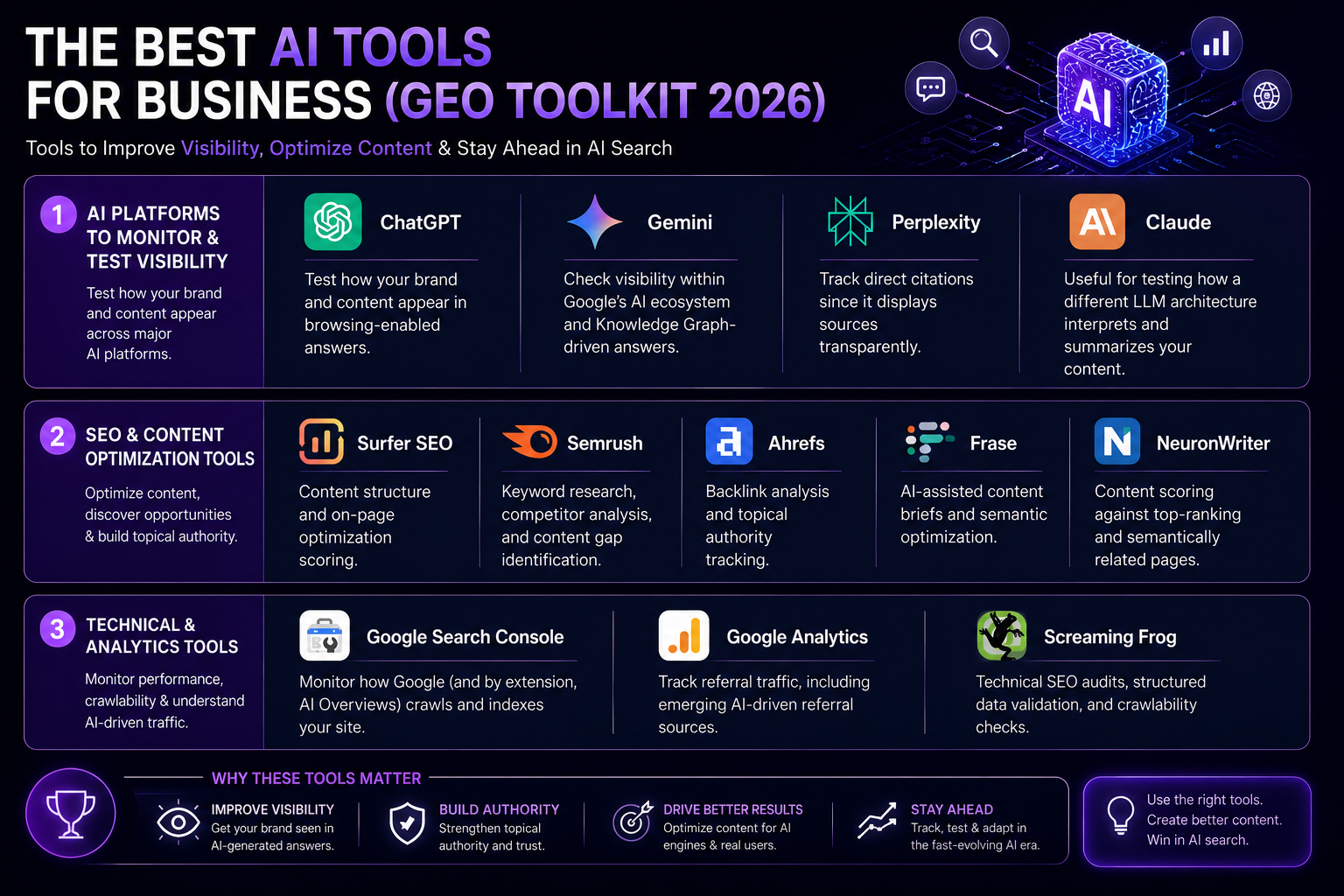
Here are the tools worth having in your GEO toolkit, organized by function.
AI Platforms to Monitor and Test Visibility:
- ChatGPT — Test how your brand and content appear in browsing-enabled answers.
- Gemini — Check visibility within Google’s AI ecosystem and Knowledge Graph-driven answers.
- Perplexity — Track direct citations since it displays sources transparently.
- Claude — Useful for testing how a different LLM architecture interprets and summarizes your content.
SEO and Content Optimization Tools:
- Surfer SEO — Content structure and on-page optimization scoring.
- Semrush — Keyword research, competitor analysis, and content gap identification.
- Ahrefs — Backlink analysis and topical authority tracking.
- Frase — AI-assisted content briefs and semantic optimization.
- NeuronWriter — Content scoring against top-ranking and semantically related pages.
Technical and Analytics Tools:
- Google Search Console — Monitor how Google (and by extension, AI Overviews) crawls and indexes your site.
- Google Analytics — Track referral traffic, including emerging AI-driven referral sources.
- Screaming Frog — Technical SEO audits, structured data validation, and crawlability checks.
Future of GEO
Where is this all heading? A few trends are already becoming clear as we move deeper into 2026:
- AI search will keep growing as a discovery channel, sitting alongside (not fully replacing) traditional search for the foreseeable future.
- Multimodal optimization will matter more — images, video, and structured data will increasingly influence how AI engines understand and cite content.
- Personalized, conversational search will deepen, meaning content that anticipates follow-up questions will have an edge.
- Brand mentions (even without links) will carry more weight, as AI models increasingly treat frequently-referenced brands as more trustworthy — a shift some marketers already call “mention equity.”
- Structured, original data will become even more valuable, since generative engines consistently favor unique, verifiable information over recycled content.
- GEO and traditional SEO will continue to converge into a single, unified discipline focused on genuine expertise, clarity, and trust — rather than technical tricks.
The businesses that treat GEO as a long-term investment in real expertise and clarity — not a shortcut — will be the ones AI engines keep coming back to.
GEO Optimization Checklist
Use this checklist to audit your content for generative search readiness.
Content Foundations
- Content answers a clear, specific search intent
- Written in natural, conversational language
- Includes original data, statistics, or research
- Updated within the last 6–12 months
Structure and Formatting
- Uses clear H2/H3 headers
- Includes an FAQ section
- Uses bullet points and numbered lists where relevant
- Includes at least one table or comparison where applicable
Technical and Schema
- FAQ schema implemented
- Article/Organization schema implemented
- Fast page load speed
- Mobile-friendly design
Authority and Trust
- Clear author byline with credentials
- Links to credible external sources
- Internal links to related topical content
- Genuine reviews or testimonials present (where applicable)
Entity and Brand Clarity
- Consistent brand/entity naming across the site
- Complete, detailed “About” page
- Google Business Profile optimized (for local businesses)
Monitoring
- Regularly test target queries in ChatGPT, Gemini, and Perplexity
- Track referral traffic from AI platforms in Google Analytics
- Review and refresh top-performing content quarterly
Frequently Asked Questions
1. What is Generative Engine Optimization (GEO)?
Generative Engine Optimization is the practice of structuring and optimizing content so AI-powered answer engines like ChatGPT, Gemini, and Perplexity can understand, trust, and cite it within their generated responses.
2. How is GEO different from traditional SEO?
Traditional SEO focuses on ranking pages within search engine results pages. GEO focuses on getting content referenced or cited directly inside AI-generated answers, which often means no click-through occurs at all.
3. Is GEO replacing SEO?
No. GEO builds on top of strong SEO fundamentals — technical health, quality content, and authority signals still matter enormously. GEO adds an additional layer focused on AI-specific trust and structure signals.
4. What is AI Search Optimization?
AI Search Optimization is a broader term often used interchangeably with GEO, referring to optimizing content and websites to perform well across AI-powered search tools and answer engines.
5. How does ChatGPT decide what content to reference?
When browsing is enabled, ChatGPT retrieves and evaluates web content in real time, favoring well-structured, authoritative, and factually accurate sources over thin or purely promotional pages.
6. What are Google AI Overviews?
Google AI Overviews are AI-generated summaries that appear at the top of Google Search results, synthesizing information from multiple top-ranking pages into a single, cited answer.
7. Does Gemini use the same ranking system as Google Search?
Gemini leans heavily on Google’s existing search index and Knowledge Graph, but it also incorporates multimodal understanding and conversational context, making entity clarity especially important.
8. Why does Perplexity cite sources so directly?
Perplexity is built as a citation-first answer engine, meaning transparency and source attribution are core to its product design — making it one of the easier platforms to track your GEO performance on.
9. What are the most important GEO ranking factors?
Entity clarity, topical authority, EEAT signals, structured data, semantic richness, freshness, and citation-worthy original content are among the most consistently important factors.
10. Do I need structured data (schema markup) for GEO?
Yes. Structured data helps AI crawlers accurately parse and understand your content, significantly improving your chances of being correctly represented in AI-generated answers.
11. How important is EEAT for GEO?
Extremely important. AI engines increasingly weigh Experience, Expertise, Authoritativeness, and Trustworthiness signals heavily when deciding which sources to trust and cite.
12. Can small businesses compete with big brands in GEO?
Yes. Because GEO rewards clarity, originality, and genuine expertise rather than sheer size or budget, small businesses with well-structured, authentic content can absolutely earn citations alongside — or instead of — larger competitors.
13. How do I measure GEO success?
Track brand and content mentions across ChatGPT, Gemini, and Perplexity manually, monitor referral traffic from AI platforms in Google Analytics, and keep an eye on featured snippet and AI Overview appearances in Google Search Console.
14. What is Search Generative Experience (SGE)?
Search Generative Experience is Google’s term for its AI-powered search features, now largely represented through Google AI Overviews, which generate synthesized answers directly within search results.
15. Will voice search and GEO overlap?
Yes. Voice assistants often rely on the same conversational, direct-answer content that performs well for GEO, meaning many optimization strategies benefit both channels simultaneously.
16. How often should I update content for GEO?
Aim to review and refresh top-performing content at least quarterly, updating statistics, examples, and any outdated information to maintain freshness signals.
17. What’s the biggest mistake businesses make with GEO?
Treating it as a one-time technical fix rather than an ongoing commitment to genuine expertise, fresh data, and clear, well-structured content.
Conclusion
Search has entered a new era — one where the winning move isn’t just being found, but being trusted enough to be quoted. Generative Engine Optimization isn’t a passing trend or a rebrand of SEO; it’s a genuine shift in how information gets discovered, evaluated, and delivered to real people, through ChatGPT, Google AI Overviews, Gemini, Perplexity, and whatever comes next.
The businesses, brands, and creators who adapt now — by building real topical authority, publishing original data, structuring content clearly, and doubling down on genuine expertise — will be the ones AI engines keep referencing for years to come. The ones who wait will simply become invisible in an increasingly AI-mediated search landscape.
The good news? None of this requires reinventing your business. It requires doing what good marketers and honest content creators have always tried to do — just with a sharper focus on structure, trust, and clarity that both humans and machines can recognize.
Ready to Future-Proof Your Search Visibility?
If you want your brand to show up inside AI-generated answers — not just buried on page two of Google — now is the time to act. Contact a trusted digital marketing agency to audit your content, implement a tailored GEO strategy, and make sure your business is positioned at the center of the AI search conversation in 2026 and beyond.