
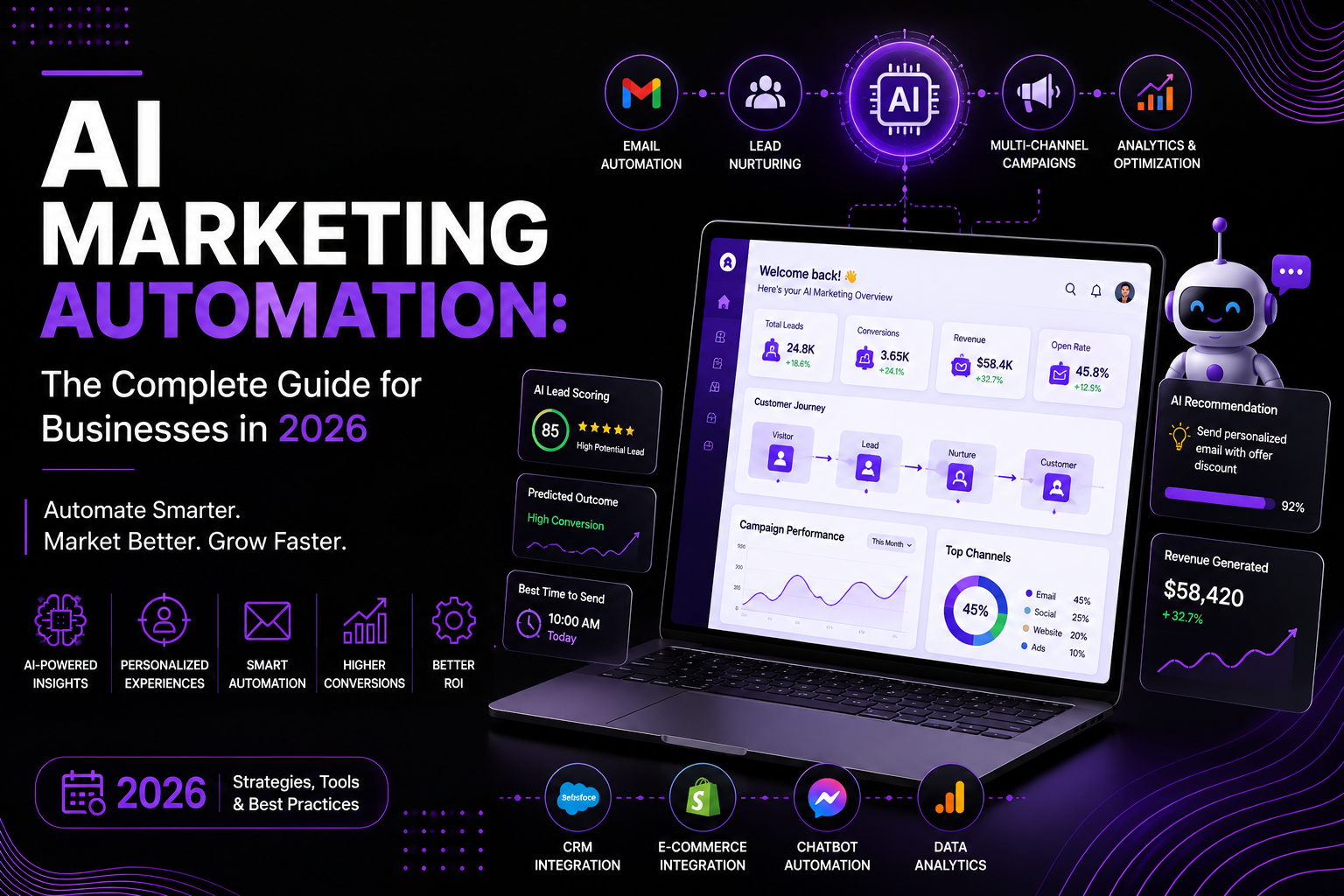
AI Marketing Automation: The Complete Guide for Businesses in 2026
Marketing has changed more in the last three years than it did in the previous decade. If you’ve noticed your inbox filling with emails that seem to know exactly what you want, or chatbots that answer questions faster than a human ever could, you’ve already experienced AI marketing automation in action.
By 2026, this technology isn’t just a “nice to have” anymore. It’s becoming the backbone of how businesses attract, convert, and retain customers. Rising customer expectations, the death of third-party cookies, and the explosion of generative AI tools have pushed companies of every size to rethink how they run campaigns.
In this guide, you’ll learn what AI marketing automation actually is, how it works behind the scenes, why it matters so much right now, and how to build a strategy that fits your business. We’ll also compare the top tools, walk through real workflows, and answer the questions marketers ask most often. Whether you’re a solo freelancer or running marketing for a growing SaaS company, this guide will give you a clear, practical roadmap.
What is AI Marketing Automation?
AI marketing automation is the use of artificial intelligence combined with automated workflows to plan, personalize, execute, and optimize marketing campaigns with minimal manual effort.
In simple terms, it’s the marriage of two things:
- Automation — software that performs repetitive tasks (like sending emails or posting content) on a set schedule or trigger.
- Artificial Intelligence — technology that can analyze data, learn patterns, and make decisions, like predicting which customer is most likely to buy.
When you combine them, you get a system that doesn’t just follow rules you set. It learns from customer behavior and adjusts on its own.
Automation vs. AI Automation: What's the Difference?
Traditional marketing automation is rule-based. You tell the system: “If someone signs up, send them Email A three days later.” It follows that instruction exactly, every time, for every person, regardless of whether it’s the right move for that individual.
AI automation goes a step further. Instead of following a fixed rule, it studies each customer’s behavior, purchase history, and engagement patterns, then decides the best action for that specific person. It might send Email A to one customer and a completely different offer to another, based on what the data suggests will actually work.
Why Businesses Are Adopting AI Marketing Automation
Here’s the honest reason: manual marketing simply can’t keep up anymore. Customers expect personalized experiences across email, social media, websites, and even text messages, all in real time. No marketing team, no matter how talented, can manually track and respond to thousands of customer signals every day.
Businesses are adopting AI Marketing Automation because it:
- Frees up marketing teams from repetitive, low-value tasks
- Makes personalization possible at a scale humans simply can’t match
- Uses data to make smarter, faster decisions
- Improves ROI by targeting the right person with the right message at the right time
If you’re a beginner, think of it like this: imagine hiring an assistant who never sleeps, remembers every customer’s preferences, and gets a little smarter every single day. That’s essentially what AI marketing automation software does for your business.
How AI Marketing Automation Works
Understanding the mechanics behind AI marketing automation helps you use it more effectively. Here’s a step-by-step breakdown of what typically happens behind the scenes.
1. Data Collection
Everything starts with data. This includes website visits, email opens, purchase history, social media interactions, app usage, and customer support conversations. The more accurate and complete the data, the better the system performs.
2. Customer Segmentation
Once data is collected, AI groups customers into segments based on shared traits, such as behavior, demographics, purchase stage, or interests. This is far more precise than old-school segmentation, which often relied on broad categories like age or location alone.
3. Behavior Analysis
The system studies patterns: What pages does a customer visit repeatedly? Do they abandon their cart at the same step every time? Do they open emails but never click through? These behavioral signals reveal intent.
4. AI Prediction
Using predictive analytics, the AI forecasts what a customer is likely to do next. Will they buy? Will they churn? Are they ready for an upsell? This prediction becomes the foundation for the next action.
5. Personalization
Based on the prediction, the system tailors the message, offer, or content to that specific individual. This could mean a personalized subject line, a product recommendation, or a special discount timed to when the customer is most likely to convert.
6. Workflow Automation
The personalized action is then triggered automatically through a pre-built workflow; no manual work required. If a customer abandons their cart, the workflow kicks in without anyone lifting a finger.
7. Campaign Execution
The message goes out across the right channel, whether that’s email, SMS, push notification, or social media ad, at the optimal time for that individual.
8. Performance Optimization
Finally, the system tracks results and uses that feedback to improve future decisions. Over time, it gets better at knowing what works for your audience.
A Simple Workflow Example
Let’s say a shopper visits an online clothing store, adds a jacket to their cart, and leaves without buying.
- Data collection logs the cart abandonment.
- Segmentation flags them as a “warm lead, cart abandoner.”
- Behavior analysis notes they browsed jackets three times this week.
- AI prediction estimates a 68% chance they’ll return if reminded within 24 hours.
- Personalization crafts an email with the exact jacket, plus a related item.
- Workflow automation triggers the email exactly one hour after abandonment.
- Campaign execution sends the email and a follow-up SMS if there’s no response.
- Performance optimization tracks whether the email led to a purchase and adjusts timing for next time.
That entire sequence happens without a single marketer manually clicking “send.”
Why AI Marketing Automation Matters in 2026
A few years ago, AI marketing automation was considered cutting-edge. In 2026, it’s closer to essential. Here’s why.
The Cookie-less Marketing Shift
Major browsers have phased out third-party cookies, making it much harder to track users across the web the old-fashioned way. This has pushed marketers toward smarter, privacy-friendly ways of understanding customer behavior, and AI is central to filling that gap.
Privacy-First Marketing
Regulations and customer expectations around data privacy have tightened significantly. Businesses now need consent-based, transparent data practices. AI marketing automation tools are increasingly built with privacy-first design, helping businesses stay compliant while still delivering personalized experiences.
The Rise of First-Party Data
Since third-party data is less reliable, first-party data (information customers give you directly, like email sign-ups, purchase history, and on-site behavior) has become the most valuable asset a marketing team has. AI helps businesses make the most of this data by finding patterns humans would miss.
Real-Time Personalization
Customers no longer tolerate generic marketing. They expect a website, email, or ad to reflect their specific interests the moment they interact with it. AI makes real-time personalization possible at scale, something manual processes simply cannot achieve.
Generative AI’s Growing Role
Generative AI tools, like those from OpenAI, have made it possible to create personalized email copy, ad variations, and even entire campaigns in seconds. This is transforming how quickly marketing teams can test and launch new ideas.
Predictive Marketing
Instead of reacting to customer behavior after it happens, predictive marketing anticipates it. AI models can forecast churn risk, lifetime value, and purchase likelihood, letting businesses act before an opportunity is lost.
Rising Customer Expectations
Customers compare every brand experience to the best one they’ve had recently. If Amazon’s recommendations feel spot-on, customers expect that same level of relevance everywhere else. Businesses that don’t keep up risk losing customers to competitors who do.
Key Benefits of AI Marketing Automation
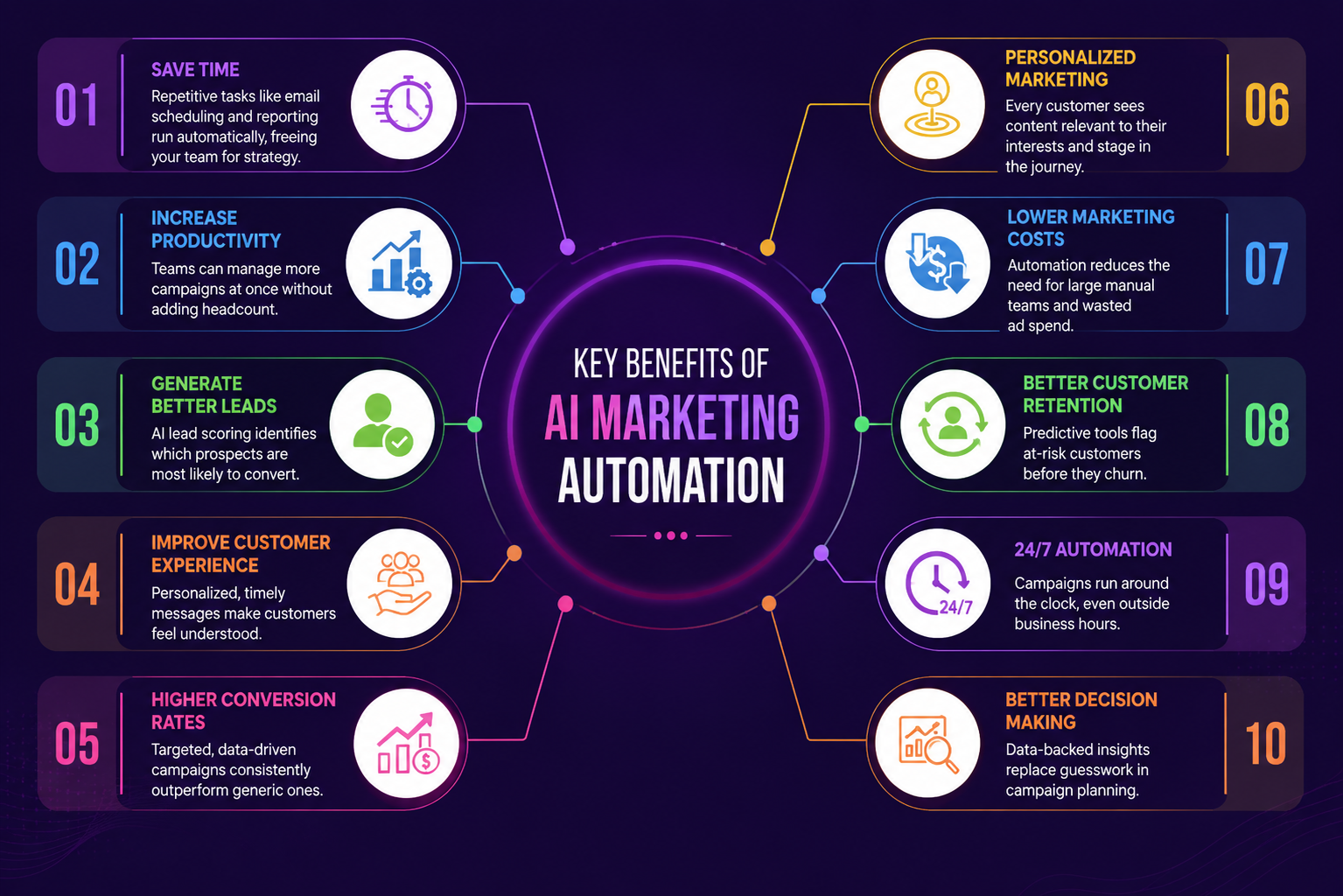
Let’s unpack a few of these in more detail.
Save Time: Marketers spend a surprising amount of time on manual, repetitive work: building email lists, scheduling posts, pulling reports. AI marketing automation handles these tasks in the background, so your team can focus on strategy, creativity, and big-picture planning.
Generate Better Leads: Not every lead is worth the same effort. AI-powered lead scoring ranks prospects based on how likely they are to convert, so sales teams spend their time on the leads that matter most instead of chasing cold contacts.
Higher Conversion Rates: Because messages are personalized and timed based on real behavior, customers are far more likely to respond. A generic “Buy Now” email converts at a fraction of the rate of a message tailored to what that specific customer was already browsing.
Lower Marketing Costs: While there’s an upfront investment in tools and setup, AI marketing automation typically pays for itself by reducing wasted ad spend, cutting down on manual labor hours, and improving campaign performance over time.
Better Decision Making: Instead of relying on gut feeling, marketing teams can look at real data and predictive insights to decide what to test next, where to invest budget, and which customer segments deserve more attention.
Traditional Marketing Automation vs AI Marketing Automation
| Feature | Traditional Marketing Automation | AI Marketing Automation |
|---|---|---|
| Decision Making | Rule-based, fixed logic | Adaptive, learns from data |
| Personalization | Basic (name, location) | Deep, behavior-driven personalization |
| Customer Segmentation | Manual, static groups | Dynamic, AI-generated segments |
| Campaign Optimization | Manual A/B testing | Continuous, automated optimization |
| Predictive Analytics | Not available | Built-in forecasting and predictions |
| Lead Scoring | Manual or basic point systems | AI-driven, behavior-based scoring |
| Customer Journey | Linear, pre-set paths | Dynamic, adjusts in real time |
| Reporting | Static reports | Real-time, predictive insights |
| Efficiency | Moderate | High, minimal manual intervention |
| Learning Capability | None; rules stay fixed | Continuously improves over time |
The biggest takeaway from this comparison: traditional automation follows instructions, while AI automation makes decisions. That difference becomes more valuable the larger and more complex your customer base grows.
Core Features of AI Marketing Automation
Here’s a closer look at the features that make up a strong AI marketing automation platform.
AI Email Automation: Automatically sends personalized emails based on triggers like sign-ups, purchases, or inactivity, often with AI-optimized subject lines and send times.
Lead Scoring: Assigns a value to each lead based on their likelihood to convert, using signals like website visits, email engagement, and past purchases.
CRM Automation: Keeps customer records updated automatically, logs interactions, and triggers sales workflows without manual data entry.
Predictive Analytics: Forecasts future outcomes, such as churn risk or purchase probability, based on historical data patterns.
Customer Segmentation: Groups customers dynamically based on real-time behavior rather than static categories.
Behavior Tracking: Monitors how customers interact with your website, emails, and app to understand intent.
AI Chatbots: Provide instant customer support, answer FAQs, and even qualify leads 24/7 without human involvement.
Campaign Automation: Runs multi-step marketing campaigns automatically across email, SMS, and social channels.
Content Personalization: Adjusts website copy, product recommendations, and offers based on the visitor’s profile and behavior.
Multi-channel Marketing: Coordinates messaging across email, social media, SMS, and web to create a consistent customer experience.
Sales Automation: Automates follow-ups, appointment scheduling, and deal tracking to speed up the sales cycle.
Marketing Analytics: Provides dashboards and reports that show what’s working, what isn’t, and where to focus next.
Best AI Marketing Automation Tools in 2026
| Tool | Features | Pros & Cons |
|---|
| HubSpot | Primary Use: All-in-one marketing, sales & CRM Best For: Small to mid-sized businesses Key Features: CRM automation, Email marketing, Lead scoring, Reporting Pricing: Free + Paid tiers | ✅ Pros: Easy to use, Strong ecosystem ❌ Cons: Costs increase as you scale |
| Salesforce Marketing Cloud | Primary Use: Enterprise marketing automation Best For: Large enterprises Key Features: Journey Builder, Predictive analytics, AI personalization Pricing: Custom enterprise pricing | ✅ Pros: Powerful & highly scalable ❌ Cons: Expensive, Steep learning curve |
| ActiveCampaign | Primary Use: Email & CRM automation Best For: Small businesses & startups Key Features: Email automation, Lead scoring, CRM Pricing: Affordable tiered plans | ✅ Pros: Excellent automation builder ❌ Cons: Interface can feel complex |
| Brevo | Primary Use: Email, SMS & CRM automation Best For: Budget-conscious businesses Key Features: Email automation, SMS marketing, CRM Pricing: Free + Affordable plans | ✅ Pros: Cost-effective, Beginner-friendly ❌ Cons: Limited advanced AI features |
| Mailchimp | Primary Use: Email marketing automation Best For: Freelancers & small businesses Key Features: Email automation, Segmentation, Reporting Pricing: Free + Paid plans | ✅ Pros: Simple and popular ❌ Cons: Limited AI capabilities |
| Klaviyo | Primary Use: E-commerce marketing automation Best For: Online stores Key Features: Predictive analytics, Product recommendations, SMS & Email Pricing: Usage-based | ✅ Pros: Excellent e-commerce integrations ❌ Cons: Can become expensive |
| Marketo | Primary Use: Enterprise marketing automation Best For: Mid-size & large B2B companies Key Features: Lead scoring, Campaign automation, Analytics Pricing: Custom pricing | ✅ Pros: Robust B2B features ❌ Cons: Complex setup and pricing |
| Zapier | Primary Use: Workflow automation Best For: Businesses connecting multiple apps Key Features: No-code automation, App integrations Pricing: Free + Paid plans | ✅ Pros: Connects thousands of apps ❌ Cons: Not marketing-specific |
| Make | Primary Use: Advanced workflow automation Best For: Technical teams Key Features: Visual workflows, Complex automation Pricing: Free + Paid plans | ✅ Pros: Flexible and powerful ❌ Cons: Steeper learning curve |
| Microsoft Copilot | Primary Use: AI productivity assistant Best For: Microsoft 365 users Key Features: AI content, Data analysis Pricing: Included with eligible Microsoft 365 plans | ✅ Pros: Seamless Microsoft integration ❌ Cons: Less marketing-focused |
| ChatGPT | Primary Use: AI content creation & strategy Best For: Marketers Key Features: Copywriting, Brainstorming, Campaign planning Pricing: Free + Paid plans | ✅ Pros: Fast and versatile ❌ Cons: Needs human review |
| Google Analytics 4 | Primary Use: Analytics & behavior tracking Best For: Any business Key Features: Predictive metrics, Cross-platform tracking Pricing: Free (Enterprise version available) | ✅ Pros: Deep Google integration ❌ Cons: Advanced reporting takes time to learn |
Tip: Most businesses don’t need every tool on this list. Start with one solid CRM/email automation platform (like HubSpot, ActiveCampaign, or Klaviyo), then layer in workflow connectors like Zapier or Make as your needs grow.
Real-World Examples of AI Marketing Automation
E-commerce: Online stores use AI to recommend products based on browsing history, automatically recover abandoned carts, and send personalized restock alerts. This alone can significantly boost repeat purchase rates.
Healthcare: Clinics and health platforms use automation for appointment reminders, personalized health content, and patient follow-ups, improving both engagement and show-up rates while respecting strict privacy requirements.
Education: Schools and online course platforms use AI to nurture prospective students with personalized email sequences, track engagement with course content, and automatically flag at-risk students for outreach.
Real Estate: Agents use AI marketing automation to score leads based on browsing behavior on property listings, send personalized property recommendations, and automate follow-ups after showings.
Travel: Travel companies use behavior-based automation to send personalized trip suggestions, price-drop alerts, and abandoned booking reminders timed to when a traveler is most likely to book.
Restaurants: Restaurants use automation for loyalty programs, birthday offers, and personalized promotions based on past orders, helping turn one-time diners into regulars.
Finance: Financial services firms use AI to segment customers by financial goals, automate compliant educational content, and flag customers who may benefit from additional products or services.
B2B SaaS: SaaS companies rely heavily on lead scoring, onboarding email sequences, and usage-based automation that nudges free-trial users toward conversion based on how they’re using the product.
In every industry, the pattern is the same: automation handles the repetitive work, while AI ensures each interaction feels relevant to the individual.
How to Build an AI Marketing Automation Strategy
Getting started can feel overwhelming, but breaking it down into clear steps makes the process manageable.
1. Define Your Business Goals Start with what you actually want to achieve, more leads, higher retention, lower churn, or increased revenue per customer. Your goals shape every decision that follows.
2. Build Customer Personas Understand who you’re marketing to. What are their pain points, preferences, and buying triggers? AI works best when it has clear customer profiles to learn from.
3. Choose the Right Tools Pick a platform that matches your business size and goals (refer to the tool comparison table above). Don’t over-invest in enterprise software if you’re a small team; start where you are and scale up.
4. Collect First-Party Data Focus on gathering data directly from your audience through sign-up forms, surveys, purchase history, and website behavior. This is the fuel that makes AI marketing automation effective.
5. Create Workflows Map out the customer journeys you want to automate: welcome sequences, cart recovery, re-engagement campaigns, and so on.
6. Set Up Email Automation Build your core email sequences first, since email remains one of the highest-ROI channels in marketing automation.
7. Implement Lead Nurturing Design workflows that guide leads from awareness to purchase with relevant, timed content rather than pushing a sale too early.
8. Integrate Your CRM Connect your marketing automation tool with your CRM so sales and marketing teams work from the same customer data.
9. Measure Performance Track KPIs regularly (see the table below) to understand what’s actually working.
10. Optimize Continuously AI marketing automation isn’t a “set it and forget it” system. Review performance monthly, test new approaches, and let the data guide your next move.
AI Marketing Automation Workflows
| Workflow | Trigger | Goal |
|---|---|---|
| Welcome Email Series | New sign-up or purchase | Introduce the brand and set expectations |
| Lead Nurturing | Lead enters the funnel | Move prospects toward a purchase decision |
| Abandoned Cart | Cart left without checkout | Recover lost sales |
| Re-engagement Campaign | Inactivity over a set period | Win back disengaged customers |
| Upsell Workflow | Existing purchase or subscription | Encourage upgrades to higher-value products |
| Cross-sell Workflow | Recent purchase | Recommend complementary products |
| Appointment Reminder | Scheduled booking | Reduce no-shows |
| Customer Feedback | Post-purchase or post-service | Collect reviews and testimonials |
| Birthday Campaign | Customer’s birthday | Strengthen loyalty with a personal touch |
| Product Recommendation Workflow | Browsing or purchase behavior | Increase average order value |
Each of these workflows can run entirely on autopilot once set up, adjusting its messaging and timing based on how each individual customer responds.
Common Mistakes to Avoid
Too Much Automation: Automating every single touchpoint can make your brand feel robotic. Keep space for genuine human interaction, especially for high-value customers or sensitive situations.
Ignoring the Human Touch: AI can personalize at scale, but it shouldn’t replace real conversations entirely. Customers still want to know a human is behind the brand when it matters.
Poor Data Quality: AI is only as good as the data it learns from. Outdated, duplicate, or inaccurate customer data leads to poor predictions and irrelevant messaging.
Wrong Tool Selection: Choosing a platform that’s too complex (or too basic) for your needs wastes time and budget. Match the tool to your actual business size and goals.
No Testing: Skipping A/B testing means you’re relying on assumptions instead of evidence. Even AI-driven campaigns benefit from ongoing testing.
No Analytics: Automation without measurement is just guesswork with extra steps. Always track performance and adjust based on real results.
Generic Emails: Sending the same message to everyone defeats the purpose of AI marketing automation. Personalization should go beyond just using someone’s first name.
Ignoring Customer Privacy: With privacy regulations tightening worldwide, always be transparent about data collection and give customers control over their information. This isn’t just a legal requirement, it builds trust.
Future Trends in AI Marketing Automation (2026–2030)
AI Agents: Autonomous AI agents are beginning to handle entire marketing tasks independently, from drafting campaigns to launching and optimizing them with minimal human oversight.
Voice AI: Voice search and voice assistants are increasingly influencing how customers discover and interact with brands, pushing marketers to optimize for conversational queries.
Predictive Marketing: Expect predictive models to become even more precise, anticipating customer needs before the customer is consciously aware of them.
Hyper-Personalization: Marketing will move beyond segment-based personalization toward individualized experiences unique to each customer, updated in real time.
Autonomous Campaigns: Campaigns that plan, launch, test, and optimize themselves with little manual input are becoming more common, especially among larger organizations.
Generative AI: Content creation, from ad copy to video scripts, will continue to be shaped by generative AI tools, speeding up production while raising the bar for creative differentiation.
Customer Data Platforms (CDPs): Businesses will increasingly rely on CDPs to unify customer data across every channel into a single, actionable profile.
Privacy-First Automation: As regulations evolve, automation platforms will build stronger privacy safeguards directly into their core architecture, rather than treating it as an add-on.
Zero-Party Data: Data that customers proactively share (preferences, survey answers) will become increasingly valuable as third-party tracking continues to decline.
AI Decision Engines: More platforms will incorporate decision engines that not only analyze data but recommend, or automatically execute, the next best marketing action.
Frequently Asked Questions
1. What is AI marketing automation in simple terms?
It’s the use of artificial intelligence combined with automated workflows to run personalized marketing campaigns with less manual effort.
2. How is AI marketing automation different from regular marketing automation?
Traditional automation follows fixed rules, while AI automation learns from data and adapts its decisions over time.
3. Do small businesses need AI marketing automation?
Yes. Many affordable tools like Brevo and Mailchimp offer AI-powered features specifically designed for small budgets and teams.
4. Is AI marketing automation expensive?
Costs vary widely. Some tools offer free plans for beginners, while enterprise platforms can cost thousands per month depending on scale.
5. Can AI marketing automation replace human marketers?
No. It handles repetitive tasks and data analysis, but strategy, creativity, and relationship-building still require human input.
6. What’s the best AI marketing automation tool for beginners?
Mailchimp and Brevo are generally considered beginner-friendly due to their simple interfaces and free plans.
7. How does AI improve email marketing automation?
AI optimizes send times, personalizes subject lines and content, and predicts which offers will resonate with each recipient.
8. What is lead scoring in AI marketing automation?
It’s a system that ranks leads based on their likelihood to convert, using behavioral and demographic data.
9. Is customer data safe with AI marketing automation tools?
Reputable platforms follow strict privacy regulations and offer transparent data controls, but businesses should always review a tool’s compliance standards before adopting it.
10. How long does it take to see results from AI marketing automation?
Many businesses see measurable improvements within 30 to 90 days, though full optimization often takes longer as the AI learns from more data.
11. Can AI marketing automation work for B2B businesses?
Yes. B2B companies often use it for lead nurturing, CRM automation, and sales follow-ups, shortening long sales cycles.
12. What industries benefit most from AI marketing automation?
E-commerce, SaaS, healthcare, real estate, and finance are among the industries seeing the strongest results, though nearly every industry can benefit.
13. What’s the difference between AI chatbots and AI marketing automation?
Chatbots are one feature within a broader AI marketing automation strategy, handling real-time conversations, while automation covers the full customer journey.
14. How do I choose the right AI marketing automation tool?
Consider your business size, budget, existing tech stack, and specific goals, then compare tools based on those factors rather than picking the most popular option.
15. Will AI marketing automation continue to grow after 2026?
Yes. Trends point toward even greater adoption of AI agents, predictive marketing, and hyper-personalization through 2030 and beyond
Conclusion
AI marketing automation isn’t a passing trend, it’s quickly becoming the standard way businesses connect with customers. From saving time and cutting costs to delivering the kind of personalized experience today’s customers expect, the benefits are hard to ignore.
The businesses that will thrive in 2026 and beyond are the ones willing to start now: choosing the right tools, building thoughtful workflows, and letting data guide their decisions, without losing the human touch that makes a brand memorable.
If you haven’t started exploring AI marketing automation for your business, there’s no better time than now. Start small, pick one workflow (like email automation or lead nurturing), test it, learn from it, and build from there.
Ready to bring AI marketing automation into your business? Begin by mapping out your customer journey, choosing a tool that fits your budget, and automating just one workflow this month. Small, consistent steps will compound into real, measurable growth.