
How to Measure Digital Marketing ROI in 2026: A Complete Guide for Businesses
AD costs keep climbing, competition keeps growing, and “we got a lot of engagement” no longer satisfies anyone signing the checks. In 2026, businesses that survive tight budgets are the ones that can prove — in numbers — that marketing spend turns into revenue. This guide walks through exactly how to measure digital marketing ROI, step by step, without the jargon.
What Is Digital Marketing ROI?
Digital marketing ROI (return on investment) tells you how much profit your marketing generates relative to what you spent.
Formula:
ROI = ((Revenue – Marketing Cost) ÷ Marketing Cost) × 100Example: You spend ₹2,00,000 on a campaign and generate ₹6,00,000 in revenue. ROI = ((6,00,000 – 2,00,000) ÷ 2,00,000) × 100 = 200%
That means for every rupee spent, you earned two back in profit — a strong result by most standards.
Why Measuring Marketing ROI Matters in 2026
- Better budget allocation — you can shift spend toward what actually works.
- Higher profitability — every campaign gets judged on real business impact.
- Smarter optimization — you fix underperforming channels before they drain budget.
- Data-driven decisions — less guesswork, more evidence.
- AI-powered reporting — automated tools now surface ROI trends in real time.
- Improved acquisition — you learn which channels bring profitable customers, not just traffic.
- Long-term growth — consistent ROI tracking compounds into sustainable scaling.
Step-by-Step Guide to Measuring Digital Marketing ROI
1. Set clear marketing goals. Define what success looks like — sales, leads, sign-ups — before spending a rupee.
2. Define KPIs. Choose metrics tied to that goal (e.g., conversion rate for sales campaigns, CPL for lead gen).
3. Track conversions. Set up conversion tracking in Google Analytics 4 and ad platforms so every action is captured.
4. Measure revenue. Connect sales data (e-commerce platform or CRM) to your marketing reports.
5. Calculate marketing costs. Include ad spend, tools, freelancers, and team time — not just media cost.
6. Calculate ROI. Apply the formula above per campaign, channel, and overall.
7. Compare channels. See which channels deliver the best ROI, not just the most volume.
8. Optimize campaigns. Reallocate budget toward high-ROI channels and fix or pause weak ones.
9. Monitor regularly. Review weekly or monthly — ROI isn’t a one-time calculation.
Example: An online store tracks ₹50,000 spent on Meta Ads generating ₹1,80,000 in sales that month — a 260% ROI — versus Google Ads at ₹50,000 spent for ₹90,000 in sales (80% ROI). Budget shifts toward Meta.
Essential Performance Marketing Metrics to Track
| Metric | Formula | Why It Matters |
|---|---|---|
| ROI | (Revenue – Cost) ÷ Cost × 100 | Overall profitability |
| ROAS | Revenue ÷ Ad Spend | Ad-spend efficiency |
| CAC | Total Acquisition Cost ÷ New Customers | Cost to win a customer |
| CLV | AOV × Purchase Frequency × Lifespan | Long-term customer value |
| Conversion Rate | Conversions ÷ Visitors × 100 | Funnel effectiveness |
| CPC | Ad Spend ÷ Clicks | Traffic cost |
| CPA | Ad Spend ÷ Conversions | Cost per result |
| CTR | Clicks ÷ Impressions × 100 | Ad relevance |
| CPL | Spend ÷ Leads | Lead-gen efficiency |
| Revenue Per Visitor | Revenue ÷ Visitors | Traffic monetization |
| Average Order Value | Revenue ÷ Orders | Spend per transaction |
| Bounce Rate | Single-Page Sessions ÷ Total Sessions × 100 | Landing page fit |
| Retention Rate | (End Customers – New) ÷ Start Customers × 100 | Repeat business health |
| MQLs / SQLs | SQLs ÷ MQLs × 100 | Sales-marketing alignment |
Track CAC and CLV together — a low CAC means little if customers never come back.
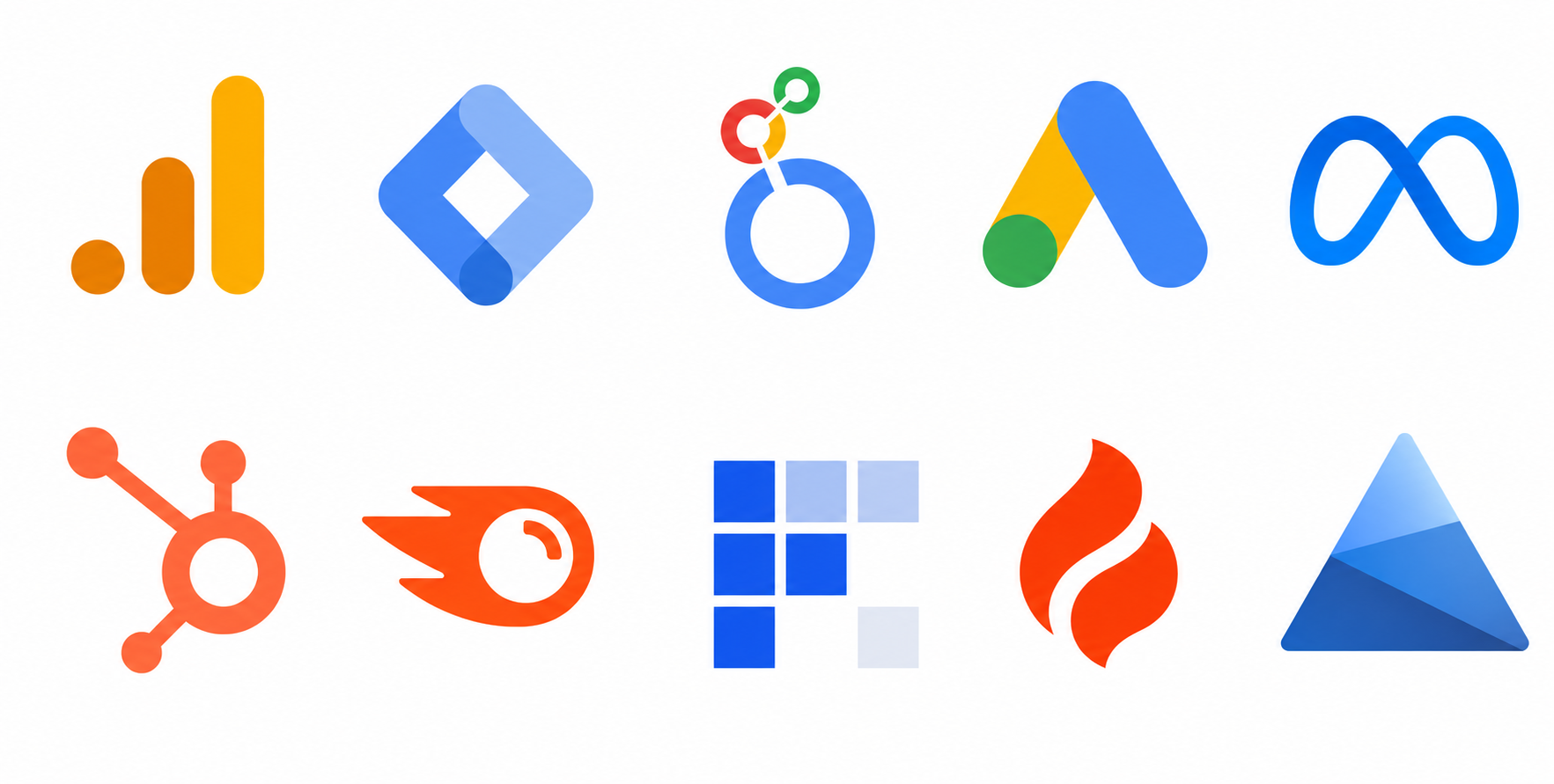
Best Tools to Measure Digital Marketing ROI in 2026
| Tool | Primary Purpose | Best For | Free/Paid | Key Features |
|---|---|---|---|---|
| Google Analytics 4 | Traffic & conversion tracking | All businesses | Free | Funnels, attribution, events |
| Google Tag Manager | Tag/pixel management | Technical tracking setup | Free | No-code tag deployment |
| Looker Studio | Dashboards | Cross-channel reporting | Free | Custom visual reports |
| Google Ads | Search/display campaigns | PPC advertisers | Paid | Conversion tracking, bidding |
| Meta Ads Manager | Social campaigns | Facebook/Instagram ads | Paid | Audience insights, ROAS reports |
| HubSpot | CRM & marketing automation | Lead-based businesses | Freemium | Pipeline & attribution tracking |
| Semrush | SEO & competitive analysis | Organic growth | Paid | Keyword & traffic tracking |
| Ahrefs | SEO & backlink analysis | Content/SEO teams | Paid | Rank tracking, site audits |
| Hotjar | Behavior analytics | UX optimization | Freemium | Heatmaps, recordings |
| Microsoft Clarity | Behavior analytics | Budget-conscious teams | Free | Heatmaps, session replays |
Common ROI Measurement Mistakes
- Tracking vanity metrics like likes and impressions instead of revenue.
- Ignoring attribution, over-crediting last-click channels.
- Not calculating total marketing costs — forgetting tools and team time.
- Focusing only on clicks, ignoring what happens after.
- Forgetting customer lifetime value when judging acquisition cost.
- Poor conversion tracking from broken or duplicate pixels.
- Not using dashboards, relying on scattered spreadsheets.
- Measuring results too early, before campaigns have enough data to judge fairly.
How AI Is Improving ROI Measurement in 2026
AI now powers predictive analytics that flag underperforming campaigns before they waste budget, along with AI attribution models that fairly credit every touchpoint in the customer journey. Automated reporting pulls data across platforms into one view, while smart bidding adjusts spend in real time based on conversion likelihood. Tools increasingly offer customer journey analysis, AI dashboards, and predictive ROI forecasting, letting marketers see likely outcomes before committing full budgets — all tied together through broader marketing automation workflows.
Practical Example
A skincare brand spends ₹4,00,000/month across Google and Meta Ads, generating ₹11,00,000 in revenue.
- ROI: ((11,00,000 – 4,00,000) ÷ 4,00,000) × 100 = 175%
- ROAS: 11,00,000 ÷ 4,00,000 = 2.75x
- CAC: ₹4,00,000 ÷ 800 customers = ₹500
- CLV: ₹1,200 AOV × 2.5 orders/year × 2 years = ₹6,000
Key insight: With CLV at 12x CAC, the brand has room to increase acquisition spend profitably — a decision ROI alone wouldn’t reveal without CLV context.
Best Practices to Improve Marketing ROI
Improve landing pages, increase conversion rate through UX fixes, sharpen audience targeting, run continuous A/B tests, adopt marketing automation, use AI for bid and budget optimization, apply multi-touch attribution, launch retargeting campaigns, invest in content marketing and SEO for compounding organic ROI, strengthen email marketing for low-cost repeat revenue, and prioritize customer retention alongside acquisition.
Frequently Asked Questions
1. What is Digital Marketing ROI?
It’s the return generated from marketing spend, measured as profit relative to cost.
2. How do you calculate marketing ROI?
Use: ((Revenue – Cost) ÷ Cost) × 100.
3. What is a good ROI percentage?
It varies by industry and margins, but many businesses consider 100%+ a strong result — context matters more than a fixed benchmark.
4. What is the difference between ROI and ROAS?
ROAS measures ad revenue against ad spend only; ROI includes all marketing costs and reflects true profitability.
5. Which tools measure marketing ROI?
Google Analytics 4, Looker Studio, HubSpot, and platform-native tools like Google Ads and Meta Ads Manager.
6. How does Google Analytics measure ROI?
By tracking conversions, revenue, and traffic sources, which can be combined with cost data to calculate ROI per channel.
7. What KPIs should businesses track?
At minimum: ROI, ROAS, CAC, CLV, and conversion rate.
8. How can small businesses improve ROI?
Focus on a few high-performing channels, fix conversion tracking, and prioritize retention over constant new acquisition.
9. Why is attribution important?
It shows which touchpoints actually contribute to conversions, preventing misallocated budgets.
10. What are the biggest ROI mistakes?
Tracking vanity metrics, ignoring total costs, and judging campaigns before enough data has accumulated.
Conclusion
Measuring digital marketing ROI isn’t a one-time report — it’s an ongoing discipline. Set clear goals, track the right metrics, use reliable tools, and let AI-powered analytics support (not replace) your judgment. Businesses that consistently measure, analyze, and optimize will keep turning marketing spend into real, provable growth in 2026 and beyond.
Internal linking suggestions: link to related posts on “Performance Marketing Metrics That Actually Matter,” “Google Analytics 4 Setup Guide,” and “Customer Lifetime Value Explained.”
External source suggestions: Google Analytics Help Center, Google Ads Help, Meta Business Help Center — for authoritative platform-specific documentation.
Schema markup recommendations: Article schema (headline, author, datePublished), FAQPage schema (for the FAQ section), and BreadcrumbList schema (Home > Blog > How to Measure Digital Marketing ROI).