
Ranking #1 on Google used to be the finish line.
In 2026, it's barely the starting line.
ChatGPT now processes more than 1 billion queries every day, and a huge share of its users — 77% of Americans who use it, according to recent research — treat it less like a chatbot and more like a search engine.
Here's the number that should really change how you think about content strategy: roughly 80% of the URLs ChatGPT cites don't even rank in Google's top 100.
Read that again. Your traditional SEO footprint predicts almost nothing about whether ChatGPT will ever mention you.
So if you've been wondering why your well-ranked blog never seems to get quoted when someone asks ChatGPT the exact same question, this guide is for you.
We're going to break down exactly how ChatGPT decides what to cite, what actually moves the needle, and a step-by-step framework you can start using today.
Let's clear up a common misunderstanding first.
ChatGPT doesn't "rank" content the way Google does. Google returns a list of links in order of relevance. ChatGPT generates one synthesized answer and decides, source by source, whether something is worth citing inside that answer.
That distinction matters enormously. As one technical breakdown of the process put it, the distinction between retrieval and citation is the most important thing to understand about ChatGPT optimization in 2026.
In simple terms, there are two separate steps:
Retrieval — ChatGPT pulls a set of candidate pages that might be relevant to the question
Citation — ChatGPT decides which of those retrieved pages are actually trustworthy and clear enough to quote or reference in its answer
An AirOps study that analyzed over half a million pages across 15,000 prompts found that ChatGPT only ends up citing about 15% of the pages it initially retrieves. The other 85% get pulled in, evaluated, and quietly discarded.
That's the real competition you're up against — not other pages on a results page, but a silent filtering process happening inside the model itself.
The stakes here are bigger than they might first appear.
ChatGPT now commands over 80% of the AI chatbot market and reached 900 million weekly active users by February 2026.
AI referral traffic converts roughly twice as well as traditional organic search traffic, in about one-third the number of sessions.
The AI's top recommendation becomes the user's final choice 74% of the time, according to Growth Memo's April 2026 research.In 88% of AI Mode sessions, users never leave the AI interface to check any external source at all.
That last stat is the one to sit with for a second. If ChatGPT doesn't mention you, in most cases the user simply never finds out you exist — not because they rejected you, but because you were never part of the conversation.
This is exactly why GEO (Generative Engine Optimization) has shifted, in the words of one 2026 industry survival guide, from an experimental marketing tactic to a core brand survival strategy.
Higher-converting traffic. Visitors who arrive via an AI citation already trust the recommendation, so they convert at a noticeably higher rate.
Brand visibility without the click. Even in the 88% of sessions where users never leave the chat, being named builds awareness and trust.
Lower competition from new domains. Backlinks explain only about 2.8% of AI citations, according to current research, meaning brand-new websites with strong content structure can compete with established domains far faster than in traditional SEO.
Compounding authority. Once you're established as a trusted source on a topic, you tend to keep getting cited for related questions too.
This is where most guides get too vague. Let's get specific.
When ChatGPT Search is active and a user's question requires current information, the model issues queries to its retrieval layer — built on Microsoft Bing, not Google — pulls back a set of candidate pages, and then a reranking step selects which passages actually get quoted or paraphrased in the final answer.
There's also a second, separate layer to understand: ChatGPT's training data. Sources that appear repeatedly across high-trust domains — Wikipedia, Reddit, mainstream news outlets, .edu and .gov sites, and major industry publishers — become facts the model can state confidently without needing to search the live web at all.
In practice, this means ChatGPT visibility happens on two levels:
Does the model already "know" about you from training data?
Does the live retrieval and citation process surface you when it searches in real time?
Winning both matters. Winning just one isn't enough.
Based on converging research from multiple 2025-2026 studies, three factors dominate:
Content structure — clear headings, direct answers placed early, scannable formatting
Source authority — domain trust signals, especially backlink and referring-domain profiles
Content freshness — how recently the page was meaningfully updated
On authority specifically, the data shows a sharp cutoff effect. Sites with more than 32,000 referring domains are roughly 3.5 times more likely to be cited by ChatGPT than sites with fewer than 200 referring domains.
Researchers have started calling this the authority "trust cliff" — unlike classic Google SEO, where a moderately authoritative site could still rank for a specific long-tail keyword, ChatGPT tends to be more risk-averse. It prefers sources it can confidently attribute, which means your backlink profile functions more like a credibility signal than a simple ranking input.
On freshness, the numbers are equally striking: content updated within the last 30 days receives roughly 3.2 times more citations than older material.
Not all content types earn citations equally. A recent citation-rate study found meaningful differences by query type:
Product discovery queries: 18.3% citation rateHow-to queries: 16.9% citation rate
Validation/comparison queries: 11.3% citation rateThe pattern is clear — content that helps someone decide or do something earns more citations than content that simply validates an opinion they already hold.
Strong SEO does still help, but it's not sufficient on its own. One 2026 study found 55.8% of cited pages also ranked in Google's top 20, and pages in Google's position one were 3.5 times more likely to get an AI citation than lower-ranked pages. SEO and GEO clearly overlap — they just aren't the same lever.
ChatGPT doesn't just evaluate pages — it evaluates entities: people, brands, and organizations it can confidently identify and trust.
This means your presence (or absence) on Wikipedia, Wikidata, and high-trust review or community platforms matters more than most marketers assume. A 2026 analysis of over one million AI citations found that community-driven platforms like Reddit and Quora captured 52.5% of citations across ChatGPT, Perplexity, and Google AI Overviews combined.
Practical entity-building steps:
Claim and complete a Wikidata entry if you're notable enough to qualifyBuild a genuine, non-spammy presence in relevant Reddit and forum communities
Pursue editorial mentions in tier-1 publishers your industry respects
Keep your brand name, founder names, and key facts consistent everywhere online
Structured data continues to matter for AI visibility — even where it's faded in classic Google search.
Pages cited by ChatGPT include structured data roughly 71% of the time, according to recent analysis. FAQ Page schema in particular remains valuable: even after Google retired its FAQ rich result display in May 2026, FAQ schema still helps language models read and index your content's question-and-answer structure independently of how Google chooses to display it.
A useful formatting note: answers in the 80-150 word range tend to perform better for AI extraction than the ultra-short, 30-word answers that were originally built for Google's old accordion-style snippets.
Example 1 — A B2B software comparison page.
A mid-sized SaaS company rewrote its "best CRM software" page using a clear comparison table, direct 100-word answers under each heading, and FAQPage schema. Within roughly eight to twelve weeks — the typical window cited by recent AI visibility research — it started appearing as a cited source in ChatGPT answers for related buyer questions, despite ranking only on page two of Google.
Example 2 — A niche health information site.
A site with strong author credentials (licensed practitioners with visible bios) but a small backlink profile still earned citations because of strong E-E-A-T signals and freshness, even though it sat well below the "trust cliff" threshold for total referring domains.
Example 3 — A Reddit-driven recommendation.
A B2C product brand saw a noticeable lift in ChatGPT citations after community members began organically discussing it on Reddit, illustrating how community-driven platforms now feed directly into AI citation behavior.
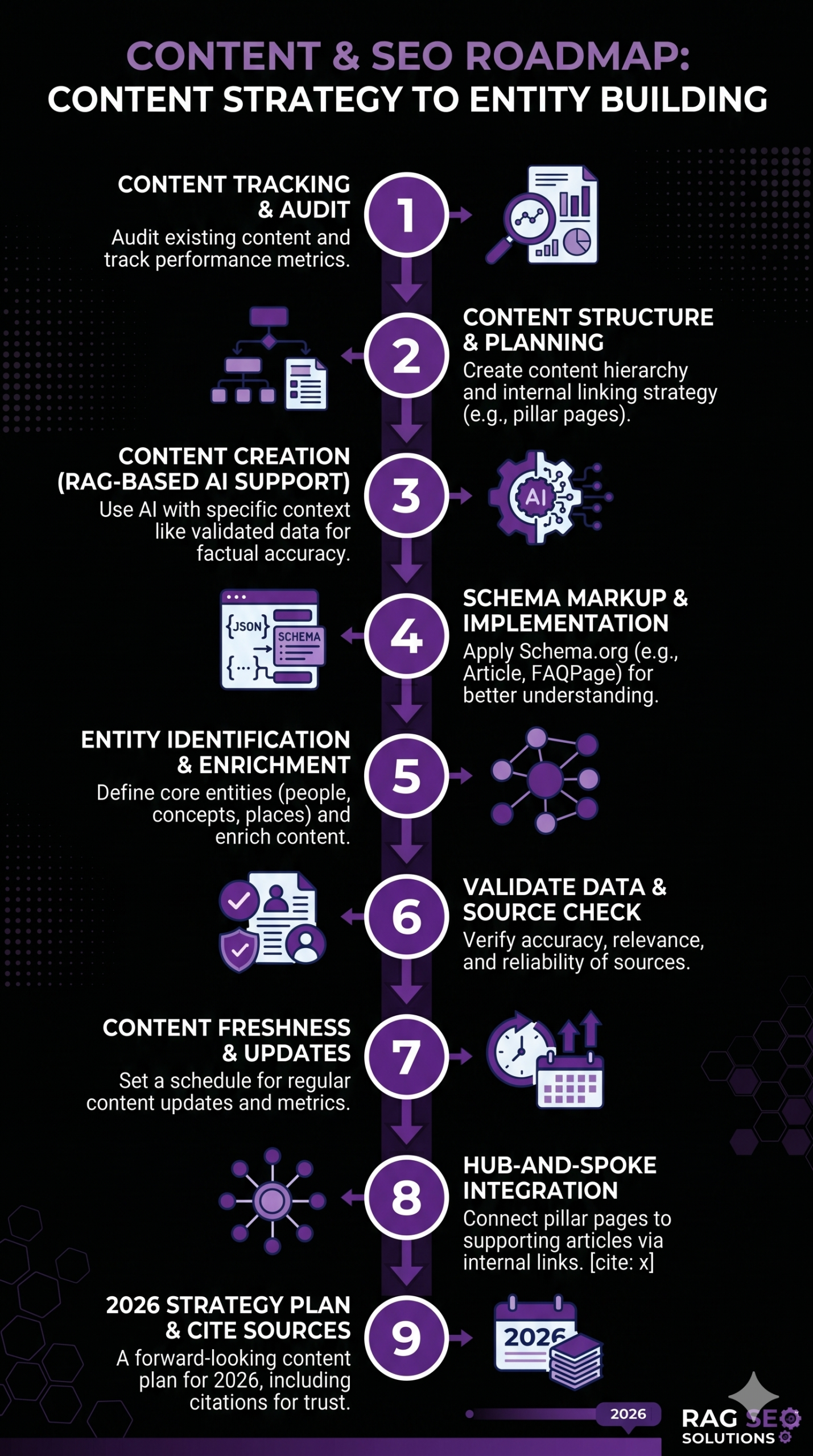
Set up tracking before doing anything else. Run the queries your audience actually asks directly inside ChatGPT, weekly, and document whether and how you're mentioned. You cannot improve what you don't measure.
Identify your highest-intent question set. Focus first on product discovery and how-to questions, since these show meaningfully higher citation rates than general validation content.
Restructure your top pages for extractability. Add a clear, direct 80-150 word answer immediately under each major heading.
Page and Article schema. Even with reduced visibility in Google's own display, this structured data still helps language models parse your content.
Strengthen your entity presence. Pursue legitimate mentions on Wikipedia/Wikidata, build a genuine Reddit and community footprint, and seek editorial coverage from respected publishers.
Refresh your most important pages on a fixed schedule. Update meaningfully at least every 30 days; many practitioners run tighter 7-14 day cycles during active optimization pushes.
Add original data or expert commentary. Original research and credentialed author input are some of the strongest differentiators in a content landscape full of AI-generated summaries.
Confirm AI crawlers can reach your site. Check robots.txt and any bot-protection or firewall settings to ensure GPTBot and related crawlers aren't accidentally blocked.
Re-test and iterate monthly. Citation patterns shift regularly, so treat this as an ongoing process, not a one-time project.
GEO and ChatGPT optimization overlap heavily, but a few things are specific to this platform:
ChatGPT's retrieval layer runs through Bing, so maintaining a clean, indexable presence in Bing specifically (not just Google) is worth checking
Roughly 60% of ChatGPT's answers draw on parametric (training) knowledge rather than live retrieval, so building long-term brand presence across the open web matters as much as optimizing any single page
SearchGPT, ChatGPT's dedicated search-style interface, applies its own evaluation layer that weighs relevance, authority, intent, and conversational clarity somewhat differently than standard conversational ChatGPT
Assuming a high Google ranking guarantees a ChatGPT citation — research shows the large majority of cited URLs don't even appear in Google's top 100
Blocking AI crawlers, which removes any chance of citation while offering little real protection, since most models were already trained on broad internet data
Publishing once and never updating, despite clear evidence that freshness strongly influences citation rates
Writing extremely short, snippet-style answers built for Google's old accordion UI instead of the slightly longer, fuller answers AI models extract more easily
Ignoring community platforms like Reddit and Quora, which now influence a substantial share of AI citationsTreating GEO as a one-off project instead of an ongoing measurement and refresh cycle
Build dedicated tracking for AI citations separate from your normal SEO dashboard
Prioritize product discovery and how-to content formats, which show the strongest citation performance
Keep a consistent 30-day (or tighter) refresh cycle on your highest-priority pages
Use FAQPage and Article schema even if Google's own display of FAQ snippets has changed
Invest in genuine entity-building: Wikidata, credible community presence, editorial coverage
Write clear, standalone sentences that don't require the previous sentence for context, since AI models often extract individual passages
Pair structured data with real, visible E-E-A-T signals like author bios and original research
Citation tracking tools will keep maturing. Dedicated AI visibility platforms are increasingly offering citation frequency, sentiment analysis, and competitor benchmarking that go well beyond what traditional SEO tools ever measured.
The authority trust cliff may sharpen further. As more brands compete for AI citations, models may lean even harder on high-confidence, well-corroborated sources.
Community platforms will likely grow in influence. With Reddit and Quora already capturing over half of citations across major AI platforms combined, expect continued emphasis on authentic community presence.
Multi-platform AI search will matter more. ChatGPT, Perplexity, Gemini, and Google AI Overviews each weigh signals slightly differently, pushing brands toward broader, platform-agnostic authority building rather than single-platform tactics.
1. How long does it take to start ranking in ChatGPT?
Many brands see measurable citation improvements within roughly 8-12 weeks of focused optimization, with sustained visibility typically building over 3-6 months.
2. Do backlinks matter for ChatGPT citations?
Somewhat, but less than in traditional SEO — current research suggests backlinks explain only about 2.8% of AI citations directly, though overall domain authority still plays a role through the "trust cliff" effect.
3. Can a brand-new website rank in ChatGPT?
Yes, often faster than in traditional Google SEO, since AI platforms weigh content quality, structure, and freshness more heavily than long-established domain authority metrics.
4. Does blocking AI crawlers protect my content?
Not meaningfully. It removes any chance of future citation while offering limited protection, since large language models were generally trained on broad internet datasets already.
5. Is FAQ schema still worth using?
Yes. Even though Google changed how it displays FAQ rich results, FAQPage schema still helps AI models parse and understand your content's structure independently of Google's display choices.
6. How is ChatGPT's ranking different from Google's?
Google returns a ranked list of links for users to choose from. ChatGPT generates one synthesized answer and selects a small number of sources to cite within it — a fundamentally different selection process.
7. Does content freshness really matter that much?
Yes — current research shows content updated within the last 30 days receives roughly 3.2 times more citations than older, unrefreshed material.
8. What's the single most important first step?
Set up tracking. Run your key audience questions directly in ChatGPT and document results before making any content changes, so you can actually measure progress.
ChatGPT separates "retrieval" from "citation" — getting pulled in as a candidate doesn't guarantee being quoted
Content structure, source authority, and freshness are the three dominant citation factors
Roughly 80% of cited URLs don't rank in Google's top 100, so traditional SEO rank alone is not a reliable predictor
Entity signals, community presence (especially Reddit and Quora), and E-E-A-T strongly influence whether ChatGPT trusts a source
Freshness has an outsized impact — pages updated within 30 days earn significantly more citations
GEO for ChatGPT is an ongoing, measurable discipline, not a one-time content refresh
Ranking in ChatGPT isn't about gaming an algorithm. It's about becoming the source the model feels confident enough to quote on its behalf.
That means clear structure, real expertise, fresh content, and genuine authority signals — not keyword tricks or backlink shortcuts.
The brands winning AI search visibility in 2026 are treating this as seriously as they once treated Google rankings: measuring it, iterating on it, and refreshing it constantly.
Start by tracking where you currently stand. Then tighten your structure, strengthen your entity signals, and keep your best content genuinely fresh.
Do that consistently, and ChatGPT won't just retrieve your content — it will recommend it.