
Introduction
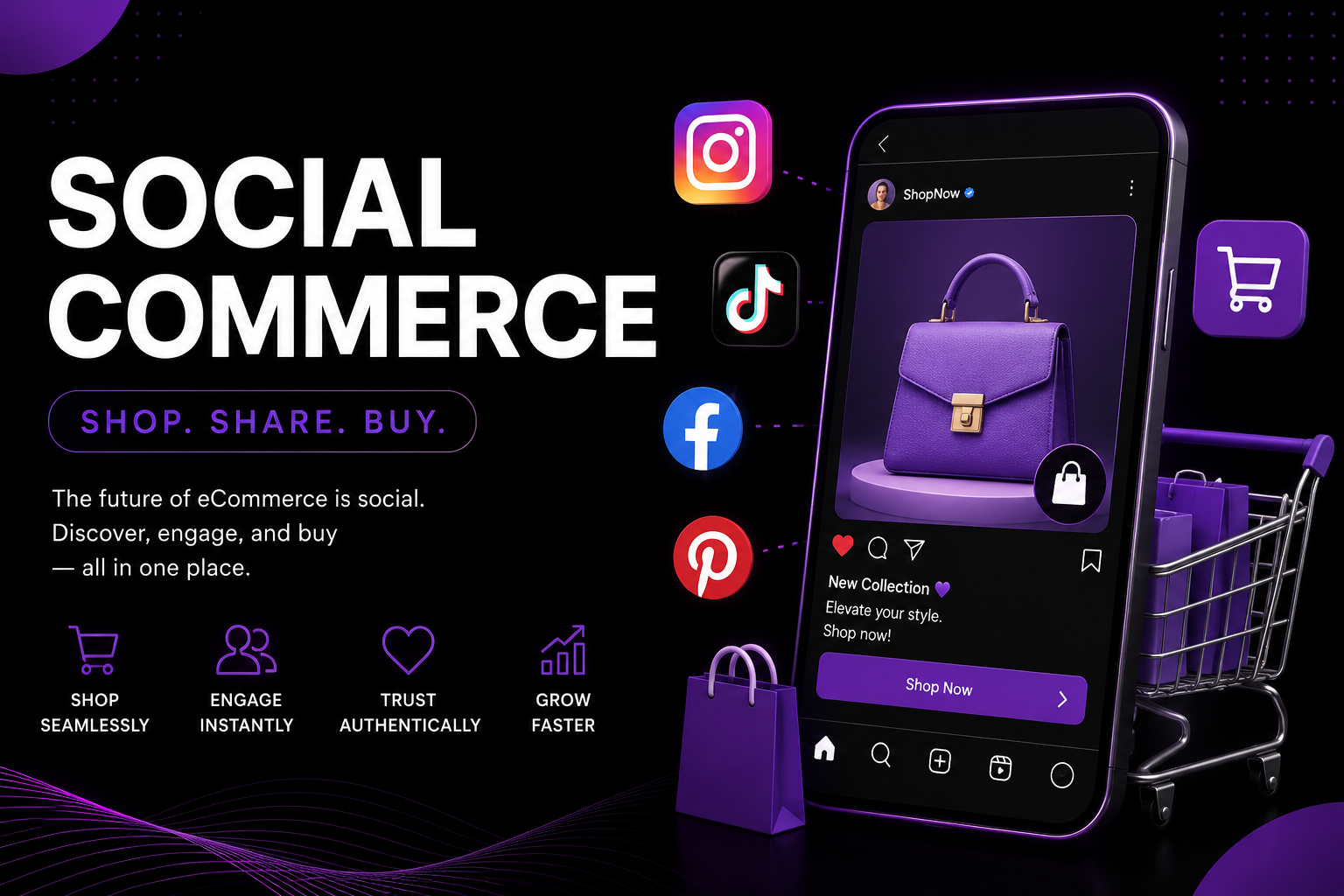
A decade ago, social media was a place to build awareness. Today, it’s a fully functioning storefront. Social commerce — the practice of discovering, evaluating, and buying products without ever leaving a social app — has become one of the fastest-growing corners of digital retail, with global spending now measured in the trillions of dollars.
For brands and creators, this shift changes the math. A follower isn’t just a vanity metric anymore; they’re a potential customer sitting a few taps away from checkout. But turning attention into revenue takes more than posting product photos and hoping for the best. It requires a deliberate strategy across Instagram Shopping, TikTok Shop, live selling, and creator partnerships — backed by content marketing that earns trust before it asks for a sale.
This guide breaks down exactly how social commerce works in 2026, why it’s growing so fast, and the specific tactics you can use to convert followers into loyal, paying customers.
What is Social Commerce?
Social commerce is the fusion of e-commerce and social media: product discovery, engagement, and checkout all happen inside the same app, with no redirect to an external website required. It’s different from traditional social media marketing, which typically drives traffic toward a separate online store, and it’s different from ordinary e-commerce, which relies on people arriving at your site with intent already formed.
In practice, social commerce includes:
- Shoppable posts and stories (Instagram, Facebook)
- In-app storefronts (TikTok Shop, Instagram Shop)
- Live shopping events with real-time purchasing
- Creator and affiliate selling, where influencers earn commission on sales they generate
- Social selling, where individual sellers or small businesses build relationships and close sales through DMs and comments
The common thread is friction removal. The shorter the distance between “I want that” and “I bought that,” the higher the conversion rate.
Why Social Commerce Is Booming
Several forces are converging to make 2026 a landmark year for the channel:
- Platform investment. Instagram, TikTok, and Facebook have all built native checkout, fulfillment, and payment infrastructure directly into their apps, reducing dependence on external websites.
- Video-first discovery. Short-form video now drives a larger share of product discovery than static posts, and it converts at meaningfully higher rates.
- Trust through creators. Consumers increasingly trust peer and creator recommendations over traditional advertising, even when they’re aware the content is sponsored.
- Mobile-native generations. Gen Z and Millennials treat their social feeds as a primary shopping destination, not just an entertainment source.
- AI-powered personalization. Recommendation engines and AI shopping assistants are getting better at surfacing the right product to the right person at the right moment.
The result: live shopping, creator storefronts, and in-app checkout are no longer experimental features — they’re core revenue channels for brands of every size.
Instagram Shopping Strategy
Instagram remains one of the most versatile platforms for social commerce because it blends visual storytelling with a mature shopping infrastructure. To build an effective Instagram Shopping strategy:
- Set up your Shop properly. Tag products in every post, Reel, and Story where relevant.
- Lead with Reels. Short-form video consistently outperforms static images for reach and product discovery.
- Use Collections to organize products by use case, season, or bundle — this mimics the browsing experience of a website.
- Leverage user-generated content (UGC). Reposting customer photos and reviews builds social proof and reduces purchase hesitation.
- Run shoppable ads that link directly to product pages inside the app.
Checklist: Instagram Shopping Setup
- Business or Creator account connected to a product catalog
- Product tags enabled on Reels, Stories, and posts
- Collections organized by category
- At least 3 UGC posts reshared per week
- Instagram Checkout enabled where available
Example: A skincare brand that shifts from static product photos to before-and-after Reels, tagged with products and paired with customer testimonials, typically sees a sharp lift in saves, shares, and add-to-cart actions — because the format matches how people actually browse for skincare advice.
TikTok Shop Strategy
TikTok Shop has grown into one of the largest social commerce channels in the U.S., with tens of millions of active buyers and conversion rates that outperform most other platforms. A strong TikTok Shop strategy includes:
- Native, unpolished content. TikTok users respond to authenticity, not studio-quality ads.
- Affiliate program participation. Recruiting creators to promote your products for commission is often more effective than paid ads alone.
- TikTok Shop tabs and product links embedded directly in videos.
- Trend-responsive content. Tying products to trending sounds, formats, or challenges increases discoverability.
- Bundling for impulse buys. Lower-priced, easy-to-understand products tend to convert fastest on TikTok.
Case Study: A mid-size beauty brand launching on TikTok Shop partnered with a network of micro-creators (10,000–50,000 followers) instead of a single celebrity influencer. The distributed approach generated a steady stream of authentic “unboxing” and “get ready with me” content, driving a multi-week sales spike during a single promotional event — a pattern now common among TikTok Shop’s top-performing sellers.
Live Shopping
Live shopping — real-time video where hosts demonstrate products and viewers buy instantly — has become one of the highest-converting formats in social commerce, with conversion rates far above standard e-commerce averages.
Why it works:
- Real-time Q&A removes purchase hesitation
- Limited-time offers create urgency
- The format feels more like shopping with a friend than watching an ad
Tips for running effective live shopping events:
- Promote the event in advance across all channels
- Offer an exclusive discount only available during the live stream
- Feature 3–5 products, not your entire catalog
- Have a co-host or creator to keep energy and pacing natural
Creator Selling
Creator-led selling — sometimes called influencer commerce — has evolved past one-off sponsored posts into long-term partnerships and affiliate storefronts.
| Model | Best For | Payment Structure |
|---|---|---|
| Flat-fee sponsorship | Brand awareness | Fixed payment per post |
| Affiliate commission | Direct sales | Percentage of revenue generated |
| Creator storefront | Ongoing sales | Revenue share on all storefront purchases |
| Hybrid deal | Established creators | Base fee plus commission |
Brands that build ongoing relationships with a smaller group of creators — rather than one-off campaigns with many — tend to see stronger long-term ROI, because repeated exposure builds familiarity and trust with the creator’s audience.
AI in Social Commerce
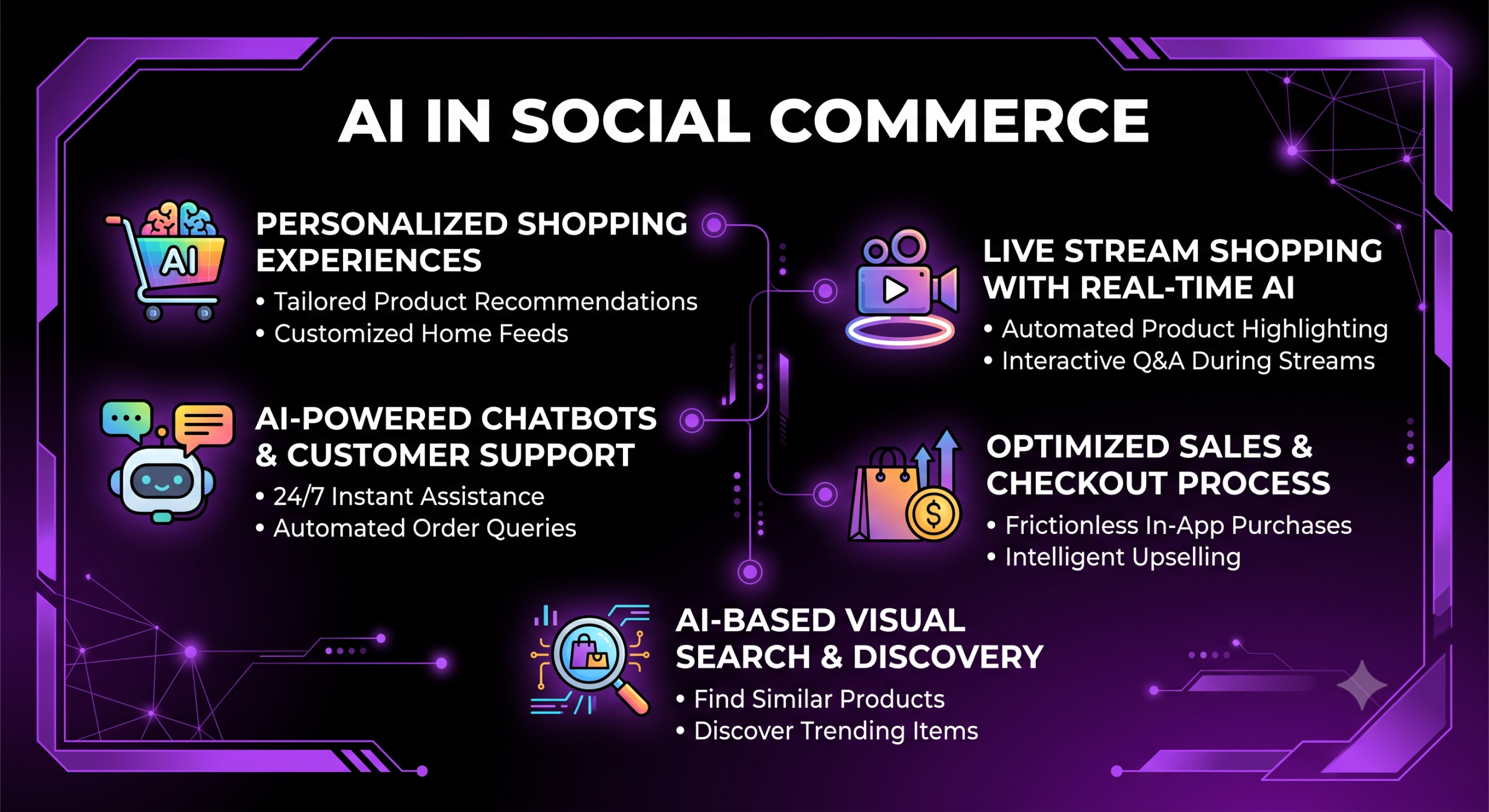
Artificial intelligence is now woven into nearly every stage of the social commerce funnel:
- Personalized product recommendations based on browsing and purchase history
- AI shopping assistants that answer product questions inside chat
- Automated content generation for product descriptions and ad variations
- Predictive analytics to identify which products are likely to trend
- AI-powered checkout assistants, which several major platforms have rolled out to reduce cart abandonment
Brands that integrate AI tools into their content marketing and customer service workflows are able to respond to prospective buyers faster — often a deciding factor in impulse-driven social purchases.
Conversion Tips
- Reduce checkout steps. A large share of shoppers abandon purchases when the process feels too long.
- Show social proof immediately. Reviews, UGC, and creator endorsements should appear near the product, not buried in a bio link.
- Use clear, native captions. Avoid overly polished ad copy; match the platform’s tone.
- Offer platform-exclusive deals to reward in-app purchases.
- Respond to comments and DMs quickly — social selling often happens in the comment section before it happens at checkout.
Common Mistakes
- Treating social commerce as a broadcast channel. Selling requires two-way engagement, not just posting.
- Ignoring platform-specific formats. Reposting the same content across Instagram and TikTok without adaptation underperforms.
- Overloading live streams with too many products. Focus drives conversion.
- Neglecting fulfillment and customer service. A great sale followed by a poor delivery experience damages long-term trust.
- Chasing follower count over engagement. A smaller, highly engaged audience often outsells a larger passive one.
Future Trends
- AI-driven shopping assistants becoming standard across major platforms
- Expansion of live commerce beyond beauty and fashion into electronics, home goods, and food
- Deeper creator-brand integration, including creator-owned product lines
- Cross-platform storefronts that sync inventory across Instagram, TikTok, and other channels
- Growing emphasis on trust and transparency, as consumers become more selective about influencer credibility
Key Takeaways
- Social commerce merges discovery and checkout into a single in-app experience.
- Instagram Shopping rewards visual storytelling and organized catalogs.
- TikTok Shop rewards authenticity, creator affiliates, and trend participation.
- Live shopping and creator selling consistently outperform static content on conversion.
- AI tools are becoming essential for personalization and faster customer response.
- Reducing friction at every step — from discovery to checkout — is the single biggest driver of sales.
FAQs
Is social commerce different from e-commerce? Yes. E-commerce typically happens on a brand’s own website, while social commerce allows the entire journey — discovery through checkout — to happen inside a social app.
Which platform converts better, Instagram or TikTok? TikTok Shop generally shows higher conversion rates, driven by video-first discovery and affiliate creator selling, while Instagram tends to excel at building longer-term brand trust and repeat purchases.
Do I need a large following to sell on social media? No. Many successful sellers use small, highly engaged audiences and creator partnerships rather than relying solely on follower count.
How important is live shopping for a new brand? It’s increasingly important. Live shopping converts at a much higher rate than standard posts and is one of the fastest ways to build trust with new audiences.
Conclusion
Social commerce in 2026 isn’t a side experiment — it’s a primary sales channel with its own strategy, tools, and best practices. Brands that treat Instagram Shopping, TikTok Shop, live selling, and creator partnerships as an integrated system — rather than isolated tactics — are the ones consistently turning followers into paying customers. The opportunity is significant, but it rewards brands that show up authentically, reduce friction at checkout, and build real relationships with their audience rather than simply broadcasting to it.