
Zero-Click Searches in 2026: How to Get Website Traffic Despite Google AI
Open Google right now and search for almost anything. Chances are, you'll get your answer before you even scroll past the first screen. No click. No visit to a website. No traffic for the business that spent hours creating that content.
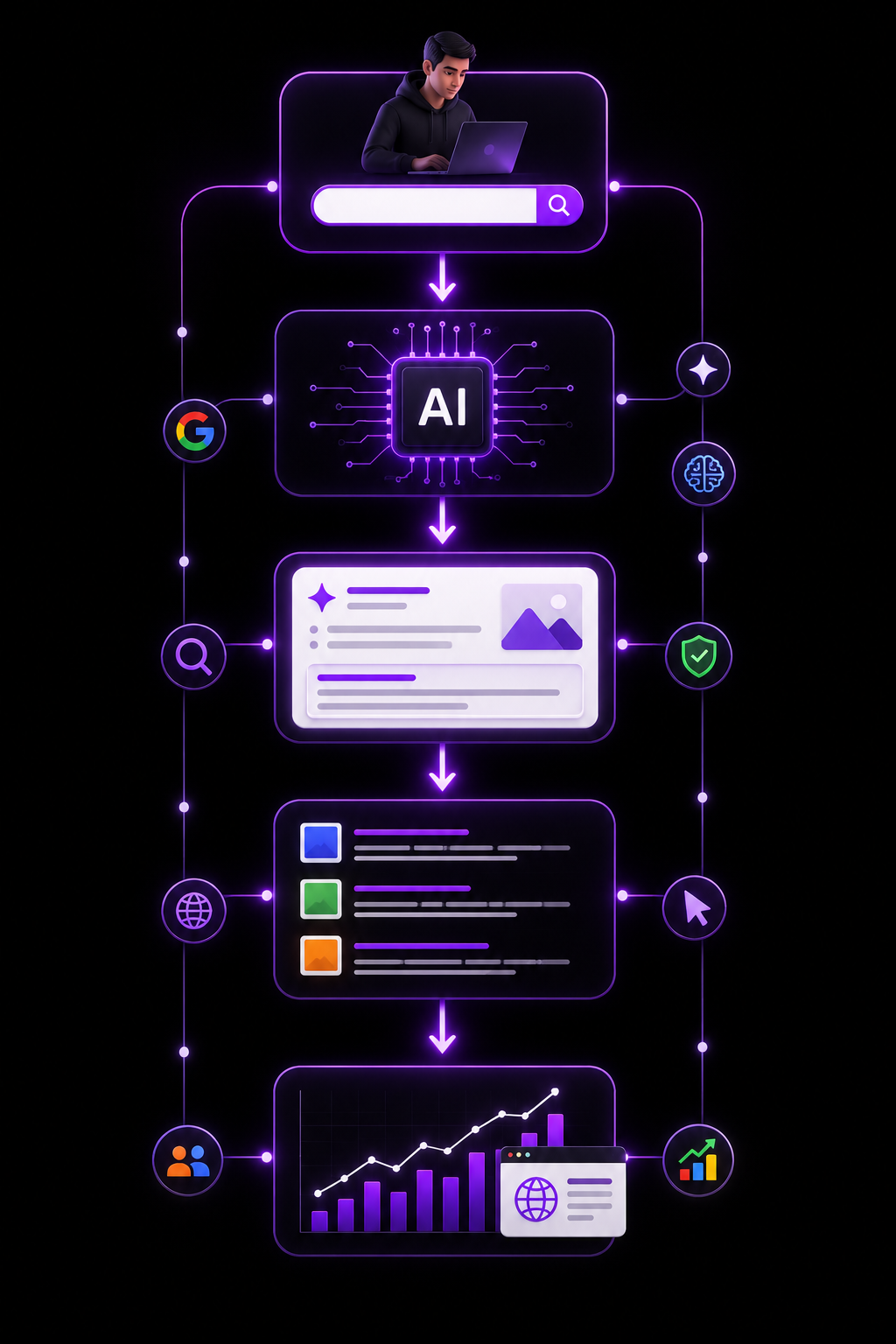
This is the reality of search in 2026. Google's AI Overviews, instant answers, and AI-powered summaries are answering questions directly on the results page, and millions of website owners are watching their organic traffic shrink even though their rankings haven't dropped.
If you've noticed your impressions staying steady while your clicks fall, you're not imagining it. You're experiencing the rise of zero-click searches, and it's reshaping how SEO works.
The good news? Zero-click searches aren't the end of organic traffic. They're a shift in the rules. Businesses and marketers who understand this shift, and adapt their strategy, are still growing their traffic, leads, and revenue. This guide will show you exactly how
What Are Zero-Click Searches?
A zero-click search happens when a user types a query into Google and gets their answer directly on the search results page, without clicking through to any website.
This happens through features like:
- Featured snippets that pull a direct answer from a webpage
- Google AI Overviews that generate a summary using multiple sources
- Knowledge panels showing facts about people, places, or things
- Direct answer boxes for quick facts (weather, time, definitions, conversions)
- People Also Ask boxes that expand inline
In each case, the user’s need is satisfied right there. There’s no reason to click further, and that means no website visit, no ad impression, and no chance to convert that visitor into a lead or customer.
Why Zero-Click Searches Are Increasing in 2026
A few years ago, zero-click results were limited mostly to simple facts like “what time is it in Tokyo” or “how many ounces in a cup.” That’s no longer the case.
Google’s AI Overview now answers complex, multi-part questions that used to require clicking through several websites to research. A query like “best project management software for small teams” or “how to improve credit score fast” now often returns a full AI-generated summary pulling information from multiple sources, organized and ready to read.
Several factors are driving this increase:
- Google wants to keep users on its platform longer. Every click away from Google is a click Google doesn’t monetize directly.
- AI models have gotten dramatically better at summarizing information accurately. What used to require human research can now be synthesized in seconds.
- User behavior has shifted. People have gotten used to fast answers and increasingly expect them, training Google’s algorithms to deliver more of the same.
- Voice search and mobile search favor quick, spoken-friendly answers over lists of blue links.
The result is a search landscape where, according to multiple industry studies, a majority of searches now end without a click to any website at all.
Why Traditional SEO Is No Longer Enough
For nearly two decades, the SEO playbook was simple: target a keyword, write quality content, build backlinks, rank on page one, and traffic followed automatically. That formula is breaking down.
Ranking #1 used to almost guarantee clicks. In 2026, ranking #1 might mean your content gets summarized in an AI Overview, and the user never scrolls down to your actual listing.
Traditional SEO focused on keyword matching and technical optimization. AI-era SEO requires something deeper: becoming a source AI systems trust enough to cite, and building a brand strong enough that people seek you out directly, bypassing search altogether.
This doesn’t mean SEO is dead. It means SEO has evolved, and the businesses that evolve with it will out-perform competitors stuck in the old playbook.
Types of Zero-Click Searches You Should Know
Understanding the different formats helps you optimize for each one strategically.
1. Featured Snippets A direct answer box pulled from a webpage, usually a paragraph, list, or table, shown above the organic results.
2. AI Overviews A generative summary combining information from multiple sources into one cohesive answer, often with linked citations.
3. Knowledge Panels Information boxes about entities (people, businesses, places) sourced from structured data and trusted databases.
4. People Also Ask (PAA) Expandable question boxes related to the search query, often pulling short answers from ranking pages.
5. Local Pack Results Map-based results for local searches that answer location-based queries without needing a website click.
6. Direct Answer Boxes Instant facts like definitions, conversions, sports scores, and calculations.
Each of these formats rewards content structured for clarity, directness, and authority, which is very different from content written purely to “rank for a keyword.”
Biggest SEO Challenges in 2026
Before getting into solutions, it’s worth being honest about what marketers are up against:
- Shrinking click-through rates even with top rankings
- AI Overviews summarizing content without sending traffic back
- Rising competition for “citation-worthy” content, not just ranking content
- Increased importance of E-E-A-T, making it harder for new or thin sites to compete
- Greater reliance on brand recognition, since people increasingly search for brands by name instead of generic queries
- More fragmented traffic sources, requiring diversification beyond Google search alone
These challenges are real, but every one of them has a workaround. Let’s get into the strategy.
How to Get Website Traffic Despite Google AI
The businesses still growing their organic traffic in 2026 share a common trait: they stopped chasing rankings alone and started building authority, experience, and brand demand. Here’s how to do the same.
1. Create Experience-Based Content
Google’s algorithms, and AI Overviews specifically, increasingly favor content that demonstrates first-hand experience, not just researched information. Show real photos, real data, real results, and real stories. Content written from genuine experience is harder for AI to fully replicate or summarize away, which keeps the click value with you.
2. Optimize for AI Overviews (Not Against Them)
Instead of resisting AI Overviews, optimize to get cited inside them. Use clear, direct answers near the top of your content, structured data, and well-organized headings. Being the cited source still builds trust and brand recall, even without an immediate click.
3. Build Topical Authority
Rather than writing one-off articles, build complete topic clusters around your core subject. A website that thoroughly covers a topic from every angle signals authority to both Google’s algorithm and its AI systems, making it more likely to be trusted as a citation source.
4. Target Long-Tail Keywords
Broad, generic keywords are the most likely to trigger AI Overviews. Long-tail, specific, and niche queries are less likely to be fully answered by AI alone, leaving more room for organic clicks.
5. Use FAQ Schema
Adding FAQ schema markup helps your content qualify for rich results and increases visibility in People Also Ask boxes, giving you more real estate on the results page even in a zero-click environment.
6. Add Original Research
Original data, surveys, and studies are extremely valuable to AI systems looking for unique, citable information. This is one of the strongest ways to differentiate from content that simply repeats what’s already published elsewhere.
7. Create Interactive Tools
Calculators, quizzes, and interactive tools can’t be replicated by an AI summary. Users have to visit your site to use them, making these excellent traffic-protected assets.
8. Improve E-E-A-T (Experience, Expertise, Authority, Trust)
Show clear author bios, credentials, citations, and transparent sourcing. E-E-A-T has become one of the strongest ranking and trust factors in the AI search era, directly influencing whether your content gets cited or buried.
9. Strengthen Internal Linking
A strong internal linking structure helps both users and search engines understand your site’s depth and authority, increasing the chances that visitors who do click stay longer and explore more pages.
10. Invest in Brand Building
When people search for your brand name directly, that’s a click Google AI can’t take away. Brand searches bypass the zero-click problem entirely.
11. Use Email Marketing
Build an email list so traffic isn’t 100% dependent on search. An engaged email audience gives you a direct, AI-proof channel to your readers.
12. Optimize Video SEO
Video content on platforms like YouTube continues to drive significant traffic and isn’t as vulnerable to AI Overview summarization, since users still need to watch the video itself.
13. Distribute Through Social Media
Diversify traffic sources by actively promoting content on social platforms, reducing dependency on Google search alone.
14. Build Community Marketing
Communities on platforms like Discord, Reddit, or even your own forum create direct, repeat engagement that doesn’t rely on search visibility at all.
15. Lean Into First-Hand Experience
Case studies, behind-the-scenes content, and personal stories are difficult for AI to convincingly replicate, making them a strong differentiator.
16. Optimize Visual Content
Properly optimized images and infographics can appear in Google Images and Discover, both of which can drive significant traffic outside of traditional zero-click search results.
17. Prepare for Voice Search
As voice assistants grow, optimizing for conversational, question-based queries positions your content to be the trusted source even when the answer is spoken aloud.
Common Mistakes to Avoid
- Writing for keywords instead of people. AI systems can detect generic, low-value content easily.
- Ignoring schema markup. Missing structured data reduces your chances of appearing in rich results.
- Relying solely on Google traffic. Diversification is no longer optional.
- Skipping author bios and credentials. This weakens your E-E-A-T signals significantly.
- Publishing thin, surface-level content. AI Overviews favor depth and original insight over generic summaries.
- Neglecting brand building. Businesses with strong brand recognition consistently outperform competitors who rely purely on generic search traffic.
Real Examples
A niche software review site noticed a 40% drop in click-through rate for comparison-style articles once AI Overviews began summarizing “best tool for X” queries. Their fix: adding original testing data, screenshots, and scoring criteria that AI Overviews couldn’t fully replicate, which helped recover a meaningful portion of lost clicks within a few months.
A local bakery business shifted focus from generic recipe blog content (heavily affected by AI Overviews) toward video content showing their baking process and customer reviews. This shift reduced dependency on blog traffic while increasing direct, brand-driven search volume.
A B2B consulting firm began publishing original industry surveys each quarter. These reports became frequently cited sources within AI Overviews and by other websites, increasing both backlinks and brand authority.
Future of SEO Beyond Google AI
SEO in the next few years will likely continue moving toward a model where brand trust, original data, and direct audience relationships matter more than keyword rankings alone. Search engines will keep evolving toward AI-driven, conversational interfaces, and new platforms (AI chat assistants, voice search, and discovery feeds) will increasingly compete with traditional search for user attention.
The businesses that thrive won’t be the ones chasing algorithm updates. They’ll be the ones building genuine authority, real audiences, and content so valuable that people seek it out directly, regardless of which platform they’re using.
Frequently Asked Questions
1. What is a zero-click search?
A zero-click search is when a user gets their answer directly on the search results page without clicking through to any website.
2. Why are zero-click searches increasing?
Google’s AI Overviews and improved summarization capabilities allow more complex questions to be answered directly on the results page, reducing the need for users to click further.
3. Does this mean SEO is no longer useful?
No. SEO is still essential, but the strategy has shifted from chasing rankings alone toward building authority, trust, and brand recognition that drives traffic through multiple channels.
4. How can I get my content featured in AI Overviews?
Focus on clear, direct answers, strong E-E-A-T signals, structured data, and original, well-researched content that demonstrates genuine expertise.
5. Are featured snippets still important in 2026?
Yes. Featured snippets remain a valuable way to gain visibility, especially when combined with FAQ schema and clearly structured answers.
6. How does brand building help with zero-click searches?
When users search for your brand name directly, that traffic isn’t affected by AI Overviews summarizing generic queries, making brand searches a reliable traffic source.
7. Is video content a good alternative to blog traffic?
Yes. Video content on platforms like YouTube continues to drive strong engagement and isn’t easily summarized away by AI Overviews.
8. What is E-E-A-T and why does it matter more now?
E-E-A-T stands for Experience, Expertise, Authority, and Trust. It matters more now because AI systems prioritize citing sources that demonstrate genuine credibility and first-hand knowledge.
9. Should I stop targeting broad keywords entirely?
Not entirely, but shifting more focus toward long-tail, specific keywords can help you capture traffic less likely to be fully answered by AI Overviews.
10. How long does it take to see results from these strategies?
Most businesses see measurable improvements within three to six months, depending on competition, content quality, and consistency of execution.
Conclusion
Zero-click searches and Google AI Overviews represent one of the biggest shifts in search behavior in years, but they don’t have to mean the end of your organic traffic. The marketers and businesses who adapt, by building genuine authority, creating original and experience-driven content, diversifying their traffic sources, and investing in brand recognition, will continue to grow even as search itself keeps changing.
The opportunity here isn’t to fight the algorithm. It’s to become the kind of source that algorithms, and people, trust enough to choose every time.
Key Takeaways
Zero-click searches and Google AI Overviews represent one of the biggest shifts in search behavior in years, but they don’t have to mean the end of your organic traffic. The marketers and businesses who adapt, by building genuine authority, creating original and experience-driven content, diversifying their traffic sources, and investing in brand recognition, will continue to grow even as search itself keeps changing.
The opportunity here isn’t to fight the algorithm. It’s to become the kind of source that algorithms, and people, trust enough to choose every time.