
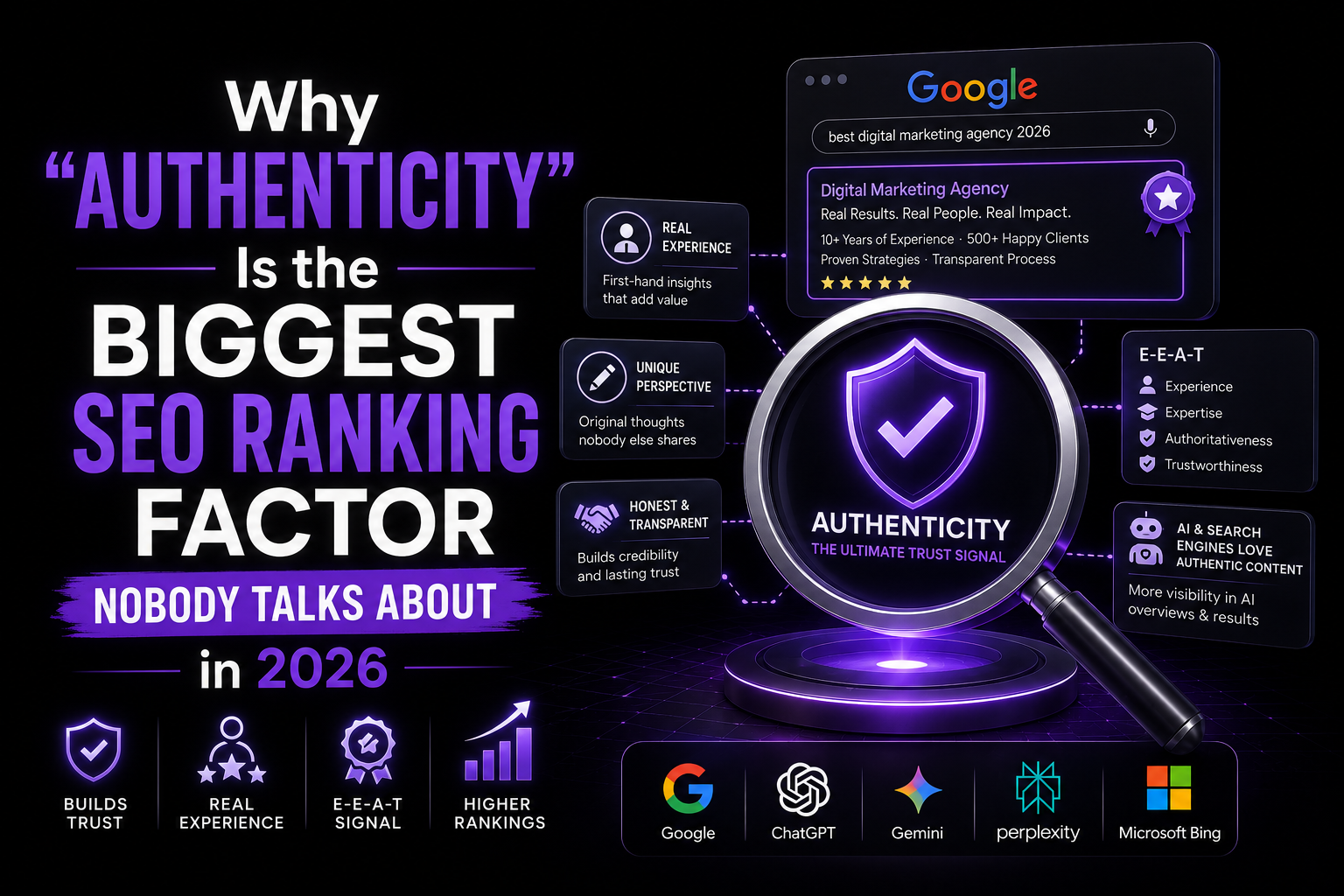
Why "Authenticity" Is the Biggest SEO Ranking Factor Nobody Talks About in 2026
Here’s something most SEO checklists won’t tell you: you can hit every technical box — fast site, clean structure, solid keywords — and still lose to a competitor whose content simply feels more real.
That’s not a fluke. It’s authenticity in SEO, and it’s quietly become one of the most powerful ranking signals of 2026. Nobody puts it on a slide at a marketing conference, because it’s hard to measure. But search engines and AI models are both chasing the same thing: content they can actually trust.
Let’s unpack why that matters, and what to do about it.
What Does Authenticity Mean in Modern SEO?
Authenticity isn’t a buzzword here — it’s specific. It means content written by someone (or a team) who has real experience with the topic, says something that isn’t a rehash of the top ten Google results, and doesn’t try to sound impressive instead of being useful.
In practice, authentic content:
- Reflects a genuine point of view, not a neutral summary
- Includes details only someone with hands-on experience would know
- Admits nuance or trade-offs instead of overselling
- Sounds like it came from a person, not a template
It’s the difference between “Email marketing increases customer retention” and “We tested three subject line formats across 40,000 sends last quarter, and the plain-text one outperformed the designed template by a wide margin.” One is generic. The other is authentic.
Why Search Engines Are Prioritizing Authentic Content
Google’s core mission has always been to serve the most helpful result. But the web changed faster than most marketers noticed. AI writing tools made it trivially easy to produce thousands of “good enough” articles a day. So did everyone’s competitors.
The result? A flood of content that’s technically correct but interchangeable. Search engines responded by leaning harder on signals that are much harder to fake: real experience, consistent expertise, and trust built over time.
This isn’t Google being sentimental about human writers. It’s a practical response to a content supply problem. When everyone’s content looks the same, the ranking factor that matters most is the one that can’t be copy-pasted.
How AI Has Changed the Definition of Quality Content
AI content isn’t the enemy here — plenty of great content is AI-assisted. The problem is unedited, ungrounded AI content: articles that sound polished but say nothing that couldn’t be said about any brand, in any industry, at any time.
Search engines have gotten noticeably better at detecting that flatness. Not through some secret “AI detector,” but through the same signals humans use: shallow depth, generic examples, and an absence of any real point of view. When quality becomes easy to fake at scale, genuine depth becomes the differentiator.
The Connection Between Authenticity and Google's EEAT
This is where Google EEAT comes in — Experience, Expertise, Authoritativeness, and Trust. Authenticity is essentially EEAT in action.
- Experience shows up when content includes first-hand detail — screenshots, results, specific numbers.
- Expertise shows up when the writer clearly understands the subject beyond surface level.
- Authoritativeness builds when other credible sources reference or cite your content.
- Trust is the sum of all three, reinforced by transparency — clear authorship, honest claims, and no exaggerated promises.
Think of EEAT as the framework, and authenticity as the fuel that makes it real instead of performative.
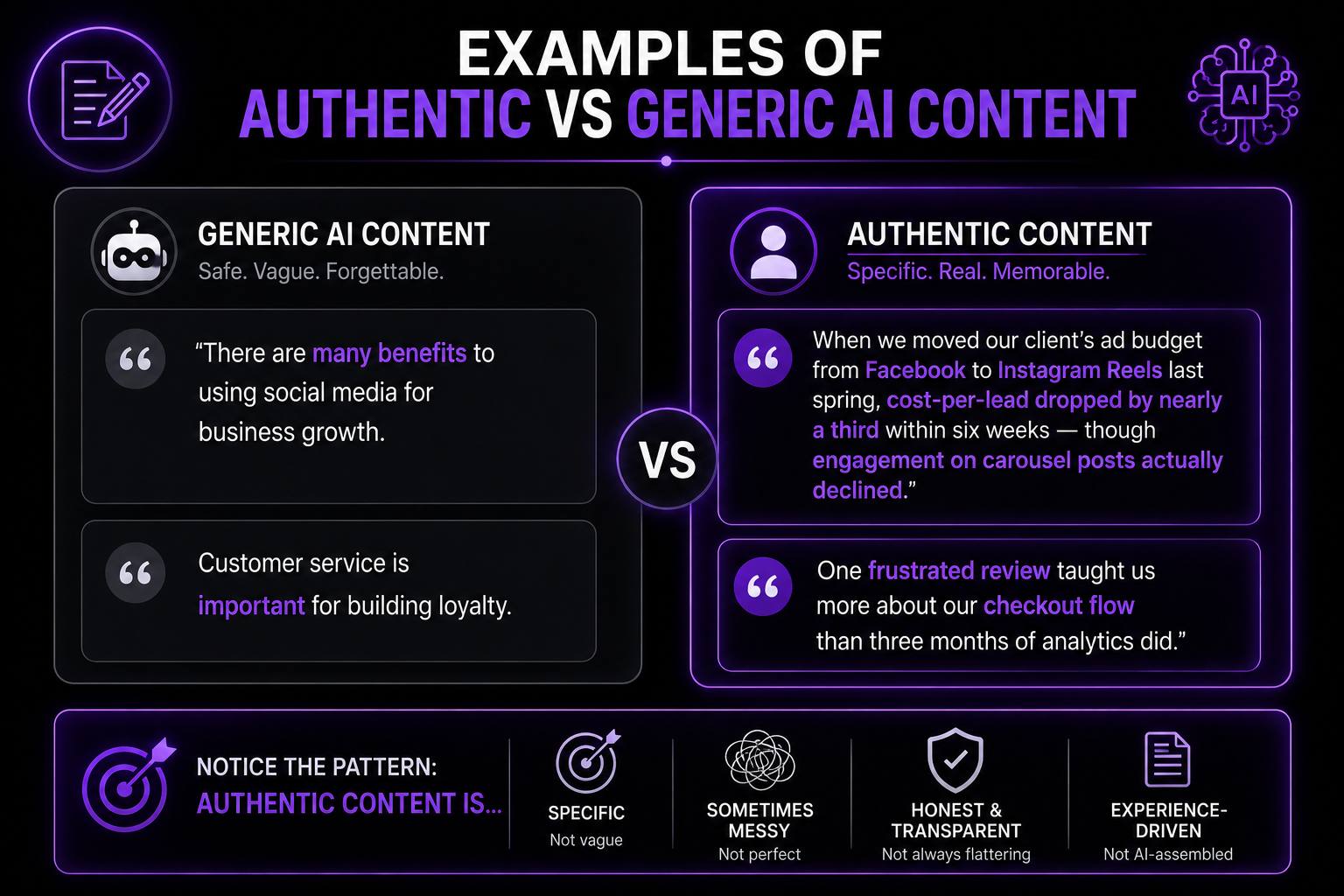
Examples of Authentic vs Generic AI Content
Generic: “There are many benefits to using social media for business growth.”
Authentic: “When we moved our client’s ad budget from Facebook to Instagram Reels last spring, cost-per-lead dropped by nearly a third within six weeks — though engagement on carousel posts actually declined.”
Generic: “Customer service is important for building loyalty.”
Authentic: “One frustrated review taught us more about our checkout flow than three months of analytics did.”
Notice the pattern: authentic content is specific, sometimes messy, and never afraid to include a detail that isn’t flattering. That’s exactly what generic AI content avoids.
Practical Ways to Create Authentic Content
- Publishing AI content with zero human review, hoping volume compensates for depth
- Copying competitor structure and swapping in different keywords
- Hiding authorship, which weakens trust signals
- Chasing keyword density instead of answering the actual question well
- Treating authenticity as a “nice to have” instead of a ranking strategy
Future of Authenticity in AI Search
As AI Overviews and chat-based search grow, the web will likely split into two tiers: content that’s genuinely useful and gets cited, and content that’s invisible noise. Authenticity is the clearest lever businesses have to land in the first group. It can’t be automated away, which is exactly why it’s becoming more valuable, not less.
Key Takeaways
- Authenticity is now a core, if under-discussed, SEO ranking factor.
- It directly supports Google’s E-E-A-T framework.
- Generic AI content underperforms because it lacks real experience and point of view.
- Authentic content improves rankings, engagement, and GEO citations simultaneously.
- Real data, honest nuance, and named authorship are the fastest ways to build it.
FAQs
1. What is authenticity in SEO? It’s content that reflects genuine expertise, first-hand experience, and honest perspective, rather than generic or templated writing.
2. Does using AI content hurt my SEO rankings? Not inherently — but unedited, generic AI content tends to underperform because it lacks the depth and trust signals search engines reward.
3. How does authenticity relate to Google EEAT? Authenticity is essentially how E-E-A-T shows up in practice — experience, expertise, authority, and trust all stem from genuinely authentic content.
4. Can authenticity help with Generative Engine Optimization (GEO)? Yes. AI search tools favor original, well-supported content when choosing what to cite, which makes authenticity valuable for both SEO and GEO.
5. What’s the easiest way to make content more authentic? Add real data, specific examples, and a named author with genuine expertise — then edit out anything that sounds like it could apply to any brand.