
Is SEO Dead in 2026? What the Data Actually Shows
I’ve lost count of how many times a client has opened a call this year with some version of the same question: “Should we even bother with SEO anymore?” Usually it’s followed by a screenshot of a LinkedIn post declaring SEO officially dead, or a stat about ChatGPT eating Google’s lunch.
Here’s my honest answer, the one I give every time: SEO isn’t dead. It’s going through the most significant identity crisis of its 25-year existence, and if you’re still measuring it the way you did in 2019, it’s going to feel like it’s dying. But the businesses quietly growing their organic visibility right now aren’t the ones who gave up. They’re the ones who figured out what changed and adjusted.
This article is my attempt to cut through the noise with actual numbers — not vibes, not fear, not vendor hype. Let’s get into it.
Why Everyone Thinks SEO Is Dying
The “SEO is dead” narrative resurfaces every few years. It happened when mobile search took off. It happened when voice assistants arrived. It happened again when Google introduced featured snippets. Each time, traffic patterns shifted, some publishers panicked, and the obituaries got written a little early.
This time feels different for a few real reasons, though:
- AI Overviews now appear across a meaningful share of Google searches, inserting a synthesized answer above the traditional blue links.
- Zero-click search has become the norm, not the exception. Multiple independent studies — SparkToro’s clickstream research chief among them — now put the share of Google searches ending without any click to an external site somewhere between 60% and 68% in the U.S., depending on methodology and time period.
- A growing share of people are starting their search journey in ChatGPT, Perplexity, or Google’s AI Mode instead of a traditional search bar.
- Content marketers are watching organic sessions decline even when their rankings haven’t moved, which feels counterintuitive and scary if you don’t understand why it’s happening.
Put those together and it’s easy to see why “SEO is dead” trends every few months. But dying and changing are two very different things, and the data backs up the second one, not the first.
What the Real Data Shows
Let’s separate signal from noise. A few data points worth sitting with:
According to SparkToro’s ongoing zero-click research, the share of Google searches in the U.S. that end without a click to any website has climbed steadily for years and now sits somewhere in the mid-to-high 60% range as of early 2026, up sharply from roughly 50% back in 2019. Ahrefs’ analysis of AI Overview citations found that when an AI Overview appears above a page’s normal ranking position, click-through to that top organic result drops substantially — estimates across different studies range from roughly 35% to almost 60%, depending on query type and industry. Pew Research’s analysis found that users click through to a traditional result only about 8% of the time when an AI Overview is present, compared to roughly 15% when it isn’t.
None of that means organic search traffic has vanished. It means the relationship between ranking and clicking has become less direct. Google itself still handles the overwhelming majority of global search volume — by most estimates, north of 90% market share — and organic listings remain the backbone of how Google’s AI Overviews and AI Mode decide what to summarize in the first place. Multiple analyses, including Ahrefs’ review of AI Overview citations, have found that a large majority of cited sources in AI Overviews also rank in the top results for that query organically. In other words, ranking well is still the price of admission — it’s just no longer the finish line.
What AI Search Actually Changed
The shift isn’t that Google stopped valuing good content. It’s that a second discovery layer got built on top of traditional search: one where answers get synthesized and presented directly, and where new platforms are competing for the “front door” of the internet that Google used to own outright.
McKinsey’s research on AI-powered search frames it well: the front door to information is diversifying. Where a search once meant typing into one box and scanning ten blue links, it now might mean asking ChatGPT a question conversationally, checking Perplexity for a sourced summary, or letting Google’s AI Overview answer the question before you ever see a traditional result.
This is where terms like GEO (Generative Engine Optimization), AEO (Answer Engine Optimization), and LLM SEO come from. They’re not replacements for SEO — they’re extensions of it, aimed at a new set of surfaces.
| Term | What It Optimizes For | Example Platforms |
|---|---|---|
| SEO | Ranking position on traditional search results | Google, Bing |
| AEO | Being selected as a direct answer or featured snippet | Google featured snippets, voice assistants, People Also Ask |
| GEO | Being cited or referenced inside an AI-generated response | ChatGPT, Perplexity, Google AI Overviews, Gemini |
The important thing to understand is that these three disciplines share the same foundation: authoritative, well-structured, genuinely useful content. You’re not building three separate strategies. You’re building one strategy that’s designed to perform across more surfaces than before.
How Google AI Overviews Are Reshaping the SERP
AI Overviews are the single biggest structural change to the Google results page since featured snippets arrived. They sit at the top of many search results, synthesizing an answer pulled from multiple sources before a user sees a single traditional listing.
A few things matter here for anyone doing SEO in 2026:
- AI Overviews mostly cite pages that already rank well organically. Ahrefs’ large-scale analysis of AI Overview citations found the majority of cited URLs also appear somewhere in the top organic results for that query, which means traditional ranking signals still heavily influence who gets cited.
- Informational queries are hit hardest. Simple definitional or “what is” style searches now resolve almost entirely inside the AI Overview, while transactional and high-intent commercial searches retain much higher click-through rates.
- Brand visibility inside the summary still has value, even without a click. Being named as a source builds trust and recognition at the exact moment someone is deciding what to do next, even if they don’t click through immediately.
The practical takeaway: if your content strategy has been built entirely around top-of-funnel, generic informational content, you’re the most exposed. If you’ve built content around specific, high-intent, comparison-driven, or transactional queries, the impact is far smaller.
I’ve lost count of how many times a client has opened a call this year with some version of the same question: “Should we even bother with SEO anymore?” Usually it’s followed by a screenshot of a LinkedIn post declaring SEO officially dead, or a stat about ChatGPT eating Google’s lunch.
Here’s my honest answer, the one I give every time: SEO isn’t dead. It’s going through the most significant identity crisis of its 25-year existence, and if you’re still measuring it the way you did in 2019, it’s going to feel like it’s dying. But the businesses quietly growing their organic visibility right now aren’t the ones who gave up. They’re the ones who figured out what changed and adjusted.
This article is my attempt to cut through the noise with actual numbers — not vibes, not fear, not vendor hype. Let’s get into it.
ChatGPT Search and the Rise of Conversational Discovery
ChatGPT’s search functionality has moved from novelty to genuine habit for a meaningful and growing slice of internet users, particularly for research-heavy or comparison-driven queries. It works differently from Google in an important way: instead of ranking a list of pages, it synthesizes an answer from multiple sources in a conversational format, often citing two or three sources rather than ten.
That has two implications for SEO strategy. First, being one of the few sources cited matters enormously more than being one of ten blue links, because there’s far less competition for attention inside the answer itself. Second, ChatGPT tends to lean on sources it considers authoritative and well-structured — clear headings, direct answers near the top of the page, and content that reads like a knowledgeable person explaining something, rather than content stuffed with keywords for algorithmic reasons.
Perplexity: The Citation-First Search Engine
Perplexity built its entire product around citing sources transparently, which makes it a useful lens for understanding what GEO actually rewards. Every answer comes with visible footnotes pointing back to the pages it pulled from.
Analyses of Perplexity’s sourcing behavior consistently show a preference for content that is recent, specific, and easy to extract a clear answer from — think structured comparisons, data-backed claims, and content that directly answers a narrow question rather than burying the answer three paragraphs deep. If you want a practical litmus test for whether your content is “GEO-ready,” ask whether a tool like Perplexity could pull a clean, accurate one- or two-sentence answer out of your page without misrepresenting it.
The Broader AI Search Landscape
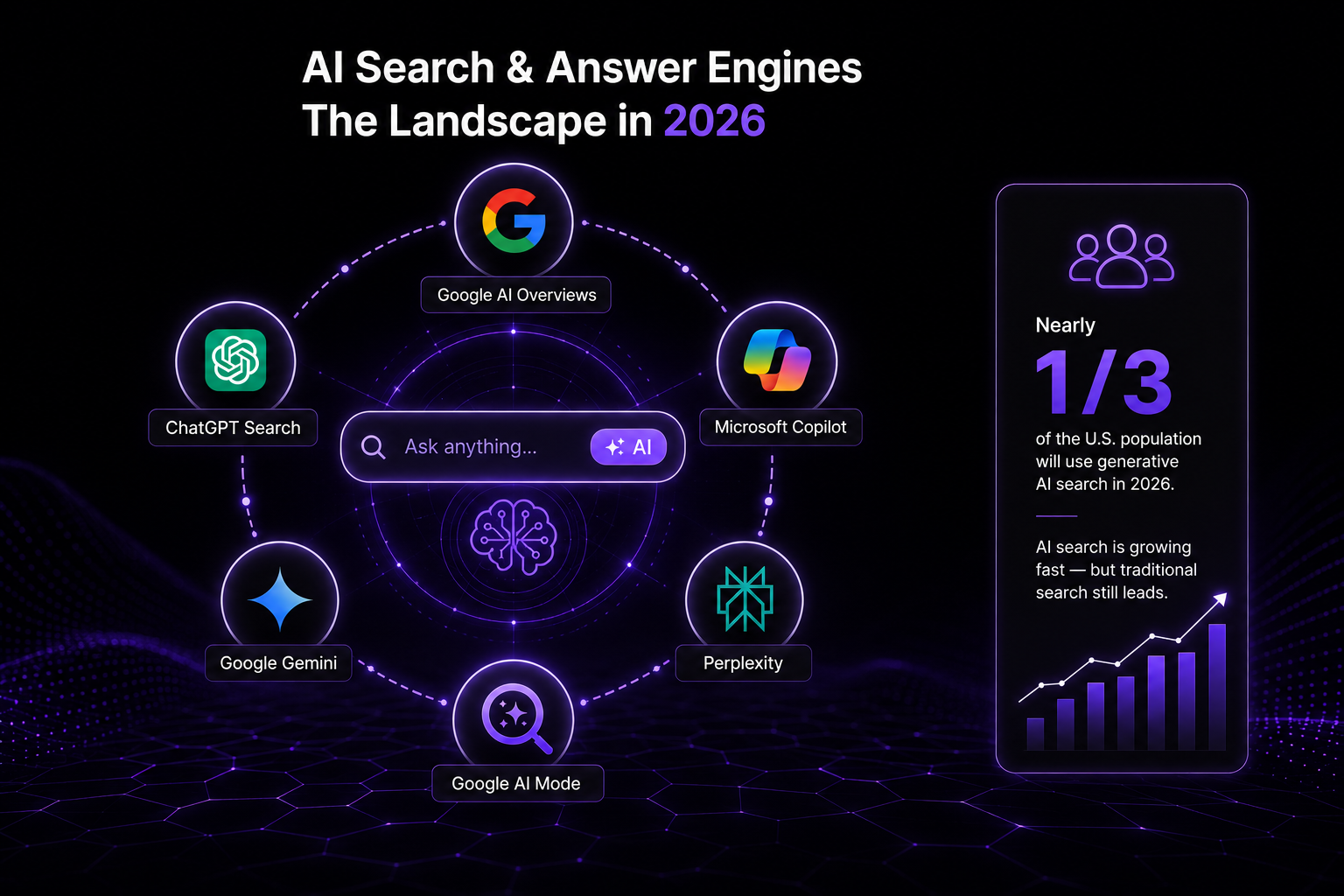
Beyond Google, ChatGPT, and Perplexity, the field of AI-powered search and answer engines keeps expanding — Microsoft Copilot, Google’s Gemini app, and Google’s AI Mode among them. Each behaves slightly differently, but they share common traits worth optimizing for:
| Platform | Typical Behavior | What It Tends to Reward |
|---|---|---|
| Google AI Overviews | Summarizes multiple sources above organic results | Strong existing organic rankings, structured content, E-E-A-T signals |
| ChatGPT Search | Conversational synthesis, fewer cited sources | Clear, authoritative, well-organized answers |
| Perplexity | Transparent, citation-heavy answers | Specific, extractable, recent, data-backed content |
| Google AI Mode | Fully generative, multi-step search experience | Depth, topical authority, entity clarity |
EMARKETER’s forecasting suggests that roughly a third of the U.S. population will use some form of generative AI search in 2026 — a meaningful number, but still a minority relative to the billions of daily queries Google alone processes. That gap matters. AI search is growing fast, but traditional search hasn’t been replaced; it’s being supplemented.
Why Organic Traffic Still Matters
Here’s where I’ll push back a little on the doom narrative. Organic search remains one of the highest-intent, lowest-cost-per-acquisition channels available to most businesses, and that hasn’t changed just because the results page looks different.
A few reasons organic traffic still deserves serious investment:
- Transactional and commercial-intent queries have much lower zero-click rates than informational ones. Someone searching “best project management software for small teams” is still clicking through to compare options.
- Branded search and local search remain resilient. People searching for your company by name, or searching “near me” for a local service, are still landing on your website or Google Business Profile at high rates.
- AI citation and organic ranking are correlated, not separate battles. Since AI Overviews and tools like Perplexity draw heavily from organically ranking, authoritative content, investing in strong SEO fundamentals improves your odds in both worlds simultaneously.
The mistake isn’t investing in SEO. The mistake is measuring it exclusively by raw click volume, the same way you might have in 2018.
Zero-Click Search: The Uncomfortable New Normal
Let’s sit with this a bit longer because it’s the statistic causing the most anxiety in marketing meetings right now.
Zero-click search isn’t new — it’s been climbing steadily since well before generative AI existed, driven first by featured snippets and knowledge panels, then accelerated further by AI Overviews. The honest framing is this: zero-click doesn’t mean zero value. If your brand is named inside an AI-generated answer or a featured snippet, that’s still a brand impression delivered by one of the most trusted interfaces on the internet, even without a click.
What it does mean is that “organic sessions” alone is an incomplete success metric in 2026. Smart teams are supplementing it with:
- Impression share and SERP feature appearances, tracked through Google Search Console
- Branded search volume growth, which often rises when AI Overviews expose your brand to new audiences
- AI citation tracking, using tools built specifically to monitor how often your brand appears inside ChatGPT, Perplexity, or Gemini answers
- Assisted conversions, recognizing that someone who first encountered your brand in an AI summary may convert later through a branded search or direct visit
Changing User Behavior: What People Actually Want
Underneath all of this is a simpler truth: people haven’t stopped wanting information. They’ve just gotten pickier about how they want it delivered. Instant answers for simple questions. Deeper, more trustworthy sources for complex or high-stakes decisions.
That split matters for content strategy. Simple, commoditized “what is X” content is exactly the kind of thing AI Overviews now handle instantly, and competing head-on for that traffic is often a losing battle. Complex, nuanced, opinion-backed, or experience-driven content — the kind that requires judgment, comparison, or real expertise — is much harder for AI to fully replace, and it’s exactly the content that both human readers and AI systems tend to cite as a trustworthy source.
Why Content Quality Matters More Than Ever
If there’s one silver lining in all of this, it’s that thin, formulaic content is getting punished harder than at any point in SEO’s history. Google’s Helpful Content system, combined with the reality that AI systems actively evaluate source credibility before citing anything, means low-effort content has nowhere left to hide.
E-E-A-T Isn't Going Anywhere
Experience, Expertise, Authoritativeness, and Trustworthiness has quietly become the closest thing search has to a unifying principle across traditional SEO, AI Overviews, and GEO. AI systems generally favor sources that demonstrate real, first-hand experience over generic, recycled advice — which is exactly why original data, case studies, and genuinely lived expertise are becoming more valuable, not less.
Practically, that means:
- Showing your work — original research, real numbers, and specific examples rather than generic statements
- Author bios that establish genuine credentials and experience
- Transparent sourcing and honest acknowledgment of trade-offs or limitations
- Content that reflects an actual point of view, not a neutral summary of what everyone else already said
Topical Authority Beats One-Off Content
Publishing a single great article on a topic rarely moves the needle the way it used to. Both traditional Google rankings and AI citation systems increasingly favor sites that demonstrate depth across an entire subject area — a cluster of interconnected, well-linked content that collectively signals genuine authority rather than a single lucky hit.
Entity SEO and Semantic SEO
Search engines and AI models don’t just match keywords anymore; they understand entities — people, brands, products, and concepts — and the relationships between them. This is entity SEO: making sure search engines and AI systems clearly understand who you are, what you do, and how you relate to other known entities in your space, often reinforced through structured data, consistent naming, and clear “about” and author information.
Semantic SEO is the closely related practice of writing content that thoroughly covers the meaning and context around a topic, not just the exact keyword phrase. In practice, that looks like naturally answering related questions, covering adjacent subtopics, and using the vocabulary a genuine expert would use, rather than repeating a target keyword mechanically.
Do Backlinks Still Matter?
Yes — and this is one of the more persistent myths worth killing directly. Backlinks remain one of the strongest trust signals available to both traditional search algorithms and AI systems evaluating source credibility. A page that’s referenced and linked to by other reputable sites is, almost by definition, more likely to be accurate and worth citing.
What’s changed is emphasis, not relevance. Quality has mattered more than quantity for years now, and that gap has only widened. A handful of links from genuinely relevant, respected sources in your industry will outperform hundreds of low-quality directory links every time, and that’s true whether you’re optimizing for a Google ranking or an AI citation.
Technical SEO Still Carries Real Weight
It’s tempting to assume technical SEO matters less in an AI-driven search world. The opposite is closer to the truth — if anything, technical cleanliness matters more, because both search crawlers and AI retrieval systems need to be able to access, parse, and understand your content efficiently.
Key technical areas still worth prioritizing in 2026:
- Core Web Vitals and page speed — still a confirmed ranking factor, and a slow site creates friction for both human visitors and AI crawlers
- Mobile SEO — with the majority of searches happening on mobile devices, a poor mobile experience directly damages both rankings and user trust
- Structured data and schema markup — increasingly important for helping both traditional search features and AI systems accurately understand and extract information from your pages
- Clean site architecture — logical internal linking and clear content hierarchies help both search engines and AI models understand how your content relates to itself
- Crawlability — making sure AI crawlers (as well as traditional search bots) can actually access and read your content, which has become a genuine strategic decision as some publishers choose to block certain AI crawlers entirely
Local SEO in the AI Search Era
Local search has proven remarkably resilient throughout this shift. “Near me” and location-based searches carry strong transactional intent, and both traditional Google results and AI-powered assistants still lean heavily on structured, verified local data — Google Business Profiles, consistent name-address-phone information, and genuine local reviews — to answer those queries accurately. If anything, keeping local listings accurate and complete has become more important, since AI assistants increasingly personalize answers by region and need clean, unambiguous data to do it well.
SEO Myths vs. Reality in 2026
| Myth | Reality |
|---|---|
| “SEO is dead because of AI Overviews” | Organic rankings still heavily influence which sources AI Overviews cite |
| “Keywords don’t matter anymore” | Keywords still matter for intent-matching, but semantic depth and context matter more than exact-match repetition |
| “Backlinks are obsolete” | Backlinks remain one of the strongest trust and authority signals for both SEO and GEO |
| “You should abandon traditional SEO for GEO” | GEO builds on SEO fundamentals rather than replacing them |
| “Zero-click means zero value” | Brand visibility inside AI answers still builds trust and recognition, even without a click |
| “Technical SEO matters less now” | Technical SEO matters more, since AI systems also need to crawl and parse your content cleanly |
Old Ranking Factors vs. 2026 Ranking Factors
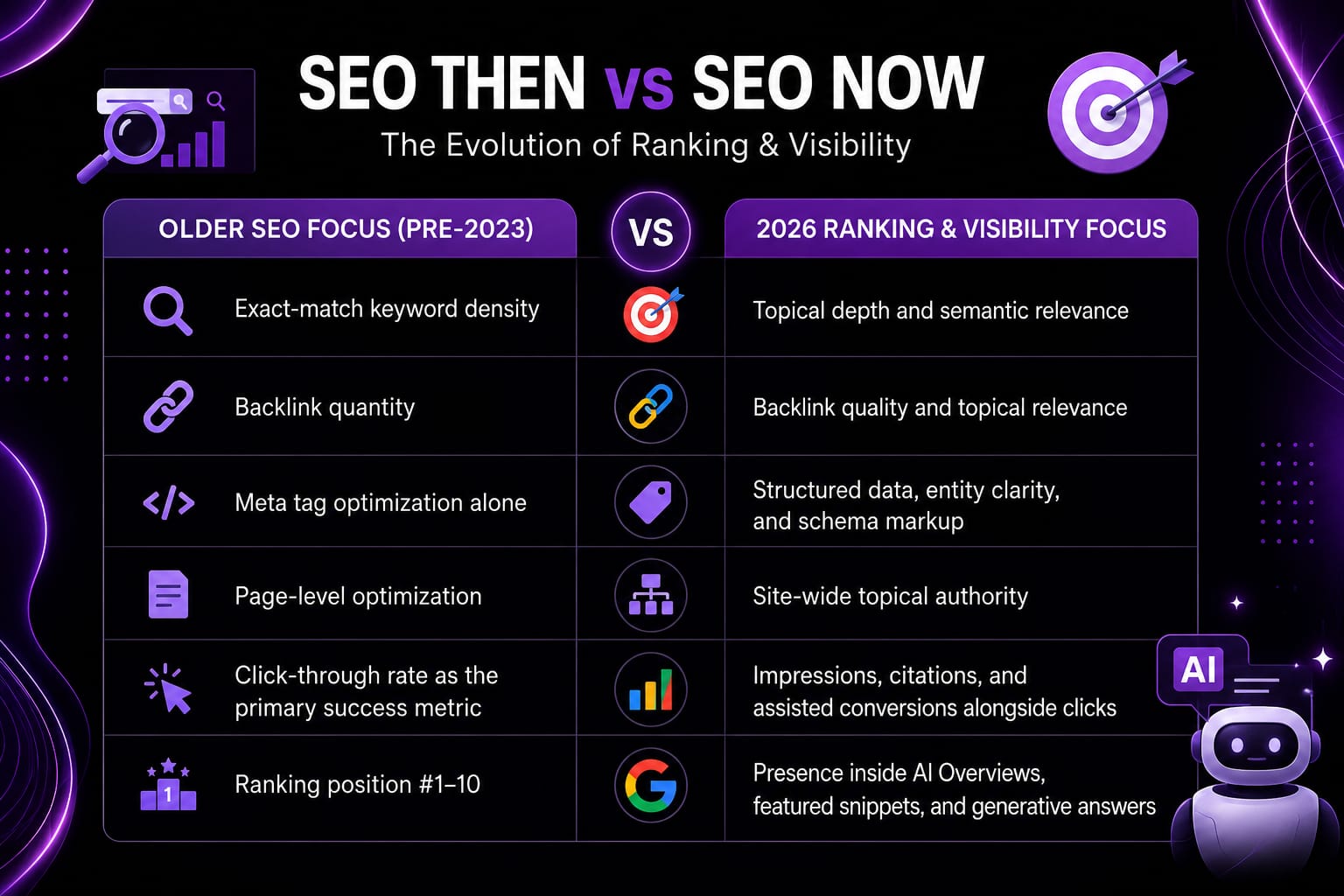
Older SEO Focus (Pre-2023)2026 Ranking & Visibility FocusExact-match keyword densityTopical depth and semantic relevanceBacklink quantityBacklink quality and topical relevanceMeta tag optimization aloneStructured data, entity clarity, and schema markupPage-level optimizationSite-wide topical authorityClick-through rate as the primary success metricImpressions, citations, and assisted conversions alongside clicksRanking position #1–10Presence inside AI Overviews, featured snippets, and generative answers
How to Actually Adapt Your SEO Strategy in 2026
If you take nothing else from this article, take this section. Here’s the practical roadmap I walk clients through:
- Audit your current AI visibility. Manually query ChatGPT, Perplexity, and Google AI Overviews with the questions your customers actually ask. See who gets cited — and whether it’s you.
- Double down on high-intent, transactional content. These queries retain the highest click-through rates and the clearest path to revenue.
- Build genuine topical authority, not scattered one-off posts. Map out a full content cluster around your core topics and fill the gaps deliberately.
- Strengthen your E-E-A-T signals. Add real author bios, cite original data where you can, and make your expertise visible, not just implied.
- Fix technical foundations. Core Web Vitals, mobile experience, structured data, and crawlability aren’t optional line items anymore.
- Diversify your visibility metrics. Track impressions, SERP features, branded search growth, and AI citations alongside — not instead of — organic clicks.
- Invest in brand presence beyond your own website. Reddit threads, YouTube videos, LinkedIn posts, and community discussions increasingly feed what AI systems cite, so a narrow “just optimize the website” strategy leaves visibility on the table.
- Keep publishing consistently, but raise the bar. Fewer, deeper, more original pieces tend to outperform a high volume of generic content in this environment.
Common Mistakes Businesses Are Making Right Now
- Panicking and cutting SEO budgets entirely the moment organic sessions dip, without checking whether impressions or branded search actually declined too
- Chasing GEO tactics while neglecting SEO fundamentals that GEO is actually built on top of
- Measuring success by clicks alone, missing the brand-visibility value of AI citations and featured placements
- Publishing more content instead of better content, flooding the site with thin pages that neither Google nor AI systems trust
- Ignoring technical health, assuming AI search means crawlability and site speed no longer matter
- Treating AI-generated content as a shortcut, publishing unedited AI output that lacks the original insight or experience that both Google’s Helpful Content system and AI citation models are actively trained to deprioritize
Frequently Asked Questions
Is SEO really dead in 2026?
No. Organic search still drives the majority of website traffic for most businesses, and the sources AI Overviews and tools like ChatGPT cite are overwhelmingly pages that already rank well organically. SEO has changed significantly, but it remains foundational.
What is GEO (Generative Engine Optimization)?
GEO is the practice of structuring content so that AI systems like ChatGPT, Perplexity, and Google’s AI Overviews are more likely to cite or reference it in generated answers. It builds on traditional SEO principles rather than replacing them.
How is AEO different from SEO?
AEO (Answer Engine Optimization) focuses specifically on getting content selected as a direct answer — in featured snippets, voice search results, or “People Also Ask” boxes — while SEO more broadly targets overall ranking position.
Do Google AI Overviews reduce website traffic?
Yes, for many informational queries, click-through rates drop measurably when an AI Overview appears. However, the impact varies significantly by query type, with transactional and commercial searches far less affected than simple informational ones.
Should I stop trying to rank on Google and focus only on AI search?
No. Traditional Google search still processes far more daily queries than any AI search platform, and strong organic rankings directly improve your odds of being cited inside AI-generated answers as well.
What is a zero-click search?
A zero-click search is a query where the user gets their answer directly on the search results page — through a featured snippet, knowledge panel, or AI Overview — without clicking through to any external website.
Are backlinks still important for SEO in 2026?
Yes. Backlinks remain one of the strongest trust and credibility signals used by both traditional search algorithms and AI systems evaluating which sources to cite.
Does content written by AI hurt SEO?
Not inherently, but low-effort, unedited AI content that lacks original insight or first-hand experience tends to underperform, since both Google’s Helpful Content system and AI citation models are designed to favor genuinely useful, expert-driven content.
How do I track whether my brand is being cited in AI search results?
Manually query platforms like ChatGPT, Perplexity, and Google AI Overviews with relevant customer questions, or use dedicated AI visibility tracking tools that monitor citation frequency across these platforms.
What matters most for SEO success in 2026?
A combination of strong technical foundations, genuine topical authority, clear E-E-A-T signals, high-quality backlinks, and content built around real expertise rather than keyword volume alone.
Key Takeaways
SEO isn’t dying in 2026 — it’s expanding into new territory. The core principles that have always mattered — genuine expertise, technical health, quality backlinks, and content built for real human intent — are still the foundation everything else is built on. What’s changed is the number of surfaces where that foundation gets tested: traditional search results, featured snippets, AI Overviews, and conversational AI platforms all draw from the same well of authoritative, well-structured content.
Businesses that treat this as a reason to abandon SEO will lose visibility across every one of those surfaces at once. Businesses that treat it as a reason to get more rigorous about quality, authority, and technical fundamentals will find that the “zero-click era” isn’t the threat it’s made out to be — it’s just a more complicated scoreboard.
SEO isn’t dead. It just stopped being simple.