
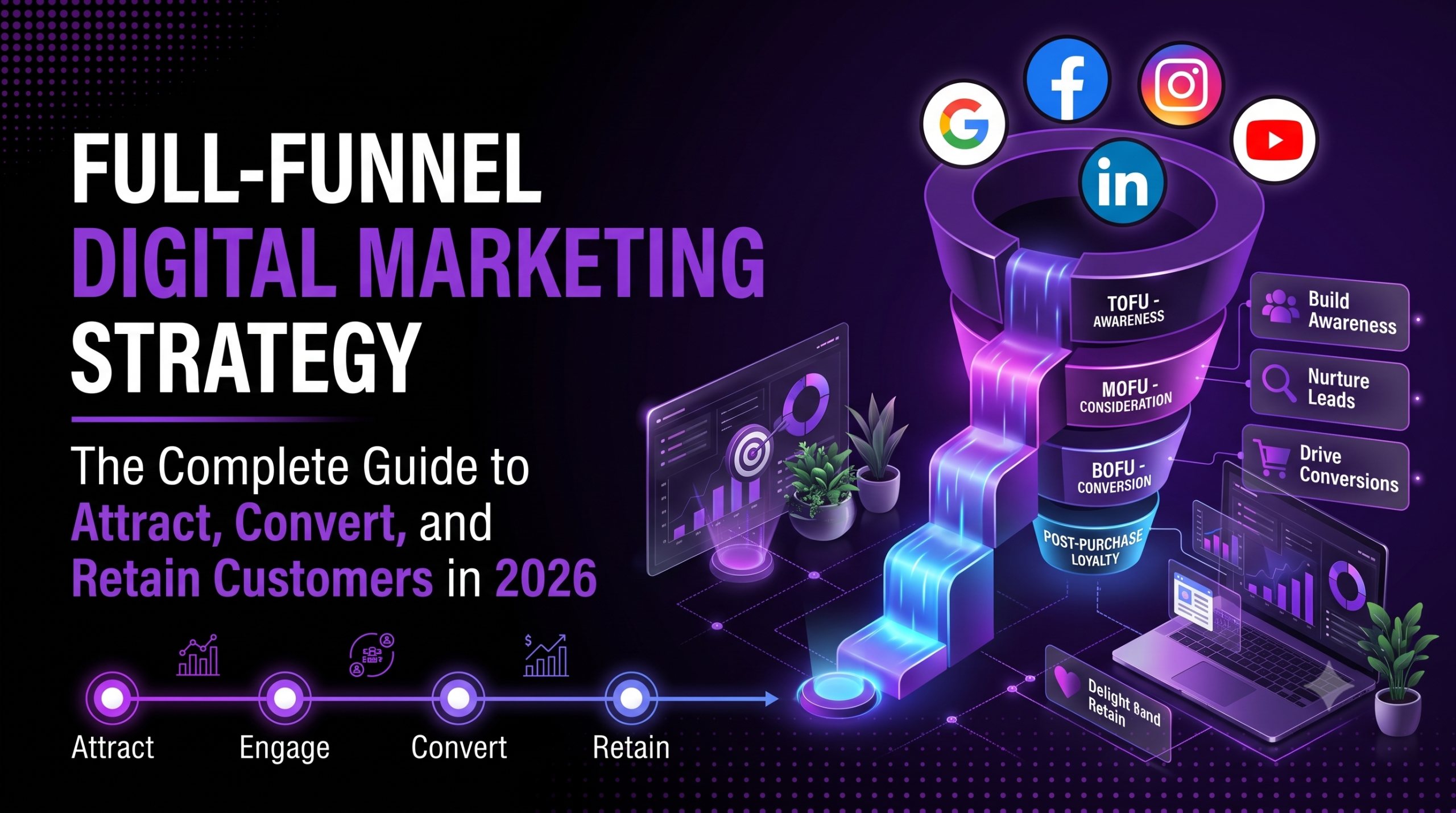
Full-Funnel Digital Marketing Strategy: The Complete Guide to Attract, Convert, and Retain Customers in 2026
If you’re still running marketing campaigns that focus only on clicks or only on sales, you’re leaving money on the table. A full-funnel digital marketing strategy is no longer a “nice to have” for ambitious brands — it’s the difference between businesses that grow predictably and ones that chase random spikes in traffic with nothing to show for it.
Here’s the problem with traditional marketing: it treats every visitor the same way. Someone who just discovered your brand gets the exact same message as someone who’s ready to buy. That mismatch is why so many campaigns burn budget without producing real revenue.
A true full-funnel digital marketing strategy fixes this by meeting people exactly where they are in their customer journey — from the first time they hear about you, all the way through purchase, and long after, when they become repeat buyers and advocates for your brand.
In this guide, you’ll learn what full-funnel marketing actually means, how the TOFU, MOFU, and BOFU stages work together, which channels perform best at each stage, how to measure results with real KPIs, and which AI tools are shaping digital marketing strategy 2026. Whether you’re a student, a freelancer, a startup founder, or an agency owner, you’ll walk away with a practical framework you can apply immediately.
Let’s build a marketing funnel that actually works from top to bottom.
What Is a Full-Funnel Digital Marketing Strategy?
A full-funnel digital marketing strategy is an approach that addresses every stage of the buyer’s journey, rather than focusing only on one goal like traffic or sales. It combines brand awareness, lead generation, lead nurturing, conversion optimization, and customer retention into one connected system.
Instead of treating SEO, paid ads, email, and social media as separate tactics, full-funnel marketing links them together so each channel supports the next. A blog post might attract a stranger through search. A retargeting ad might bring them back a week later. An email sequence might nurture them into a buyer. And a loyalty program might turn that buyer into a repeat customer.
Why Full-Funnel Marketing Matters in 2026
Consumer behavior has changed dramatically. Buyers now research across multiple devices, compare options using AI search tools, and expect personalized experiences at every touchpoint. A single-channel or single-stage approach simply can’t keep up.
- Rising ad costs mean businesses can’t rely on customer acquisition alone — retention has become just as important.
- AI-powered search (including AEO and GEO) is changing how people discover brands.
- Buyers expect omnichannel marketing experiences that feel consistent across every platform.
- Privacy changes mean marketers need first-party data strategies, not just cookies and pixels.
- Customers reward brands that nurture them, not just brands that sell to them.
Businesses that master the entire digital marketing funnel — not just the bottom — build compounding growth. Every piece of content, every ad, and every email works together instead of competing for attention.
Understanding the Customer Journey
The customer journey is the path someone takes from first hearing about your brand to becoming a loyal customer. It typically includes awareness, consideration, decision, purchase, and loyalty stages. Full-funnel marketing maps specific content and channels to each of these stages.
Difference Between Sales Funnel and Marketing Funnel
These terms are often used interchangeably, but they’re not quite the same thing.
| Aspect | Marketing Funnel | Sales Funnel |
|---|---|---|
| Focus | Awareness, education, and lead nurturing | Closing deals and driving revenue |
| Owned by | Marketing team | Sales team |
| Typical stages | TOFU, MOFU, BOFU | Qualified lead, proposal, negotiation, close |
| Goal | Generate and warm up leads | Convert leads into paying customers |
A strong full-funnel digital marketing strategy aligns both funnels so marketing and sales aren’t working against each other.
The Four Funnel Stages Explained
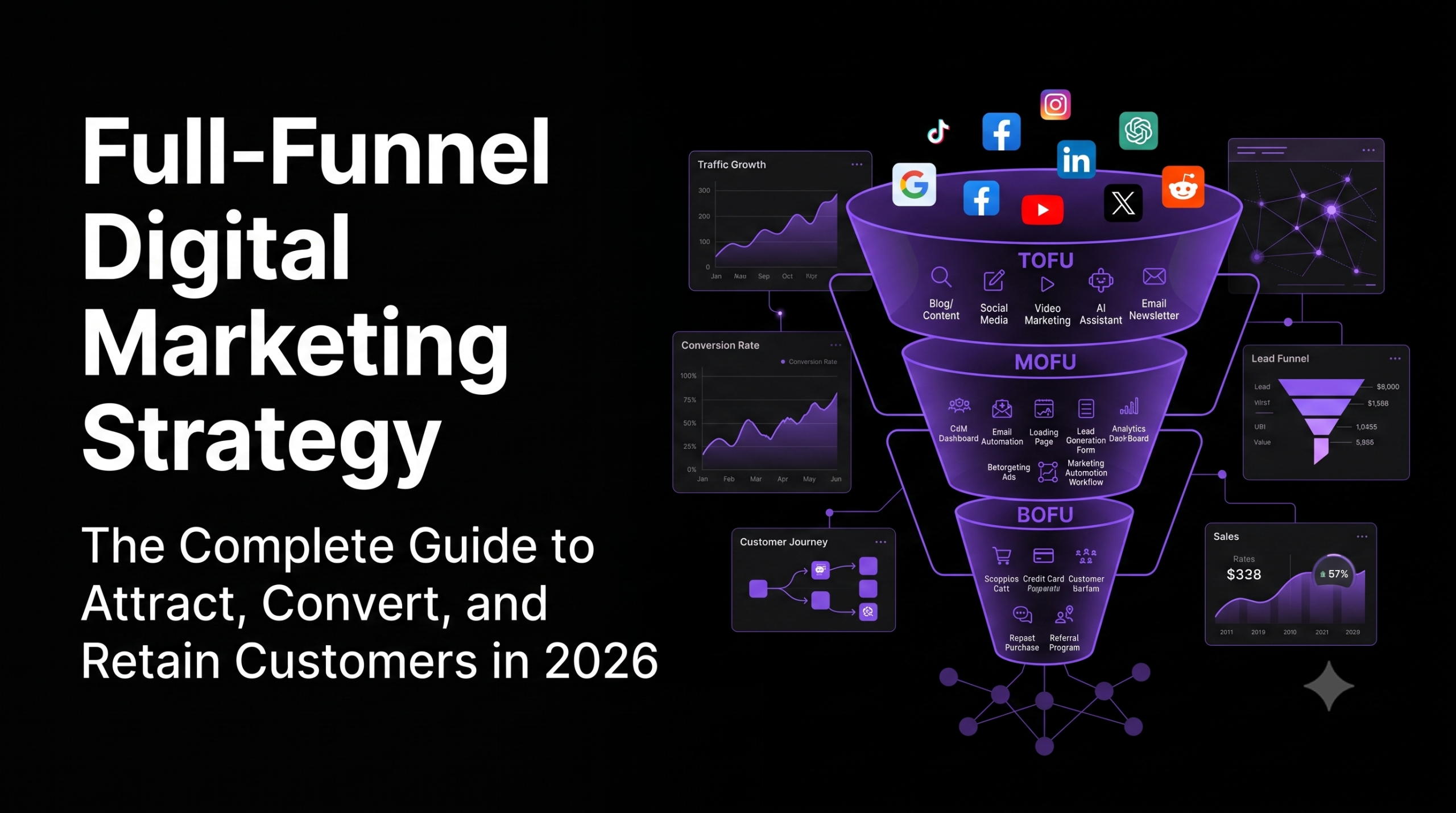
Every effective conversion funnel is built around four connected stages. Let’s break each one down.
Top of Funnel (TOFU) — Awareness
This is where strangers discover your brand for the first time. The goal isn’t to sell — it’s to educate, entertain, or solve a small problem so people remember you.
- SEO-optimized blog content
- Social media posts and short-form video
- YouTube tutorials
- Influencer collaborations
- Top-of-funnel Google Ads and Meta Ads for brand awareness
Middle of Funnel (MOFU) — Consideration
Here, leads know who you are and are comparing options. Your job is to build trust and demonstrate expertise.
- Email marketing sequences (lead nurturing)
- Case studies and comparison guides
- Webinars and free tools
- Retargeting ads based on website behavior
- Lead magnets like checklists or templates
Bottom of Funnel (BOFU) — Decision
This is where conversion optimization matters most. Leads are ready to buy — your job is to remove friction.
- Product demos and free trials
- Customer testimonials and reviews
- Clear pricing pages
- Retargeting and remarketing campaigns with strong offers
- Live chat or chatbot support to answer last-minute questions
Post-Purchase, Retention, and Advocacy
Many businesses stop marketing once someone buys. That’s a mistake. Customer retention is often cheaper and more profitable than customer acquisition.
- Onboarding emails and tutorials
- Loyalty and rewards programs
- Personalized upsell and cross-sell offers
- Requesting reviews and referrals to build advocacy
- Ongoing value through newsletters or community access
TOFU vs MOFU vs BOFU: Quick Comparison
| Stage | Buyer Mindset | Content Type | Primary Goal |
|---|---|---|---|
| TOFU | “I have a problem” | Blog posts, videos, social content | Brand awareness |
| MOFU | “I’m comparing solutions” | Emails, case studies, webinars | Lead nurturing |
| BOFU | “I’m ready to decide” | Demos, testimonials, offers | Conversion |
Channels Used at Every Funnel Stage
A well-built digital marketing funnel doesn’t rely on one channel. Here’s how the most important channels map to each stage.
| Channel | Best Funnel Stage | Purpose |
|---|---|---|
| SEO | TOFU / MOFU | Organic visibility for search intent |
| AEO (Answer Engine Optimization) | TOFU | Getting cited in AI-generated answers |
| GEO (Generative Engine Optimization) | TOFU / MOFU | Visibility inside AI search tools like ChatGPT and Gemini |
| Content Marketing / Blogging | TOFU / MOFU | Education and trust-building |
| Email Marketing | MOFU / BOFU / Retention | Nurturing and repeat engagement |
| Google Ads | TOFU / BOFU | Search intent capture and retargeting |
| Meta Ads | TOFU / MOFU / BOFU | Awareness, nurturing, and remarketing |
| LinkedIn Marketing | TOFU / MOFU (B2B) | Professional trust-building |
| YouTube Marketing | TOFU / MOFU | Long-form education and demos |
| Instagram Marketing | TOFU / MOFU | Brand storytelling and community |
| Influencer Marketing | TOFU | Trust transfer and reach |
| Marketing Automation / CRM | MOFU / BOFU / Retention | Lead scoring and personalization |
| Retargeting / Remarketing | MOFU / BOFU | Re-engaging warm audiences |
| Chatbots / AI Personalization | BOFU / Retention | Instant answers and tailored offers |
SEO, AEO, and GEO: The New Discovery Layer
Traditional SEO strategy still matters, but it’s no longer the only way people find brands. AEO focuses on structuring content so it can be pulled directly into featured snippets and voice answers. GEO goes a step further, optimizing content so AI tools like ChatGPT, Gemini, and Perplexity are more likely to reference your brand when generating answers.
Marketing Automation, Lead Scoring, and CRM
As your funnel grows, manually tracking every lead becomes impossible. This is where marketing automation and a CRM become essential.
- Lead scoring ranks leads based on behavior, like email opens or page visits, so sales teams focus on the hottest prospects first.
- CRM systems store every interaction, giving your team full context before a call or email.
- Automation triggers can send the right email, ad, or offer based on what a lead does — without manual work.
Real-World Examples of Full-Funnel Campaigns
B2B Example
A software consulting firm publishes SEO blog posts about industry challenges (TOFU), offers a free downloadable audit template to capture emails (MOFU), nurtures leads with case studies through email, and closes deals with a personalized demo and LinkedIn outreach (BOFU).
B2C Example
A skincare brand runs short-form video ads showcasing before-and-after results (TOFU), retargets viewers with customer testimonials (MOFU), and offers a limited-time discount to first-time visitors who abandoned their cart (BOFU).
E-commerce Example
An online store uses Google Shopping ads and influencer content to drive traffic (TOFU), sends abandoned cart emails and retargeting ads (MOFU/BOFU), then uses post-purchase email flows and loyalty points to boost customer lifetime value.
Local Business Example
A local dental clinic ranks for “dentist near me” searches through local SEO and Google Business Profile optimization (TOFU), nurtures leads with a free consultation offer (MOFU), and converts with online booking and patient reviews (BOFU).
SaaS Example
A project management tool creates educational YouTube content (TOFU), offers a free trial with onboarding emails (MOFU/BOFU), then uses in-app messages and upsell campaigns to move users to paid plans and reduce churn (Retention).
Common Full-Funnel Marketing Mistakes
- Focusing only on BOFU tactics and ignoring brand awareness
- Not aligning sales funnel and marketing funnel data
- Sending the same message to every stage of the funnel
- Ignoring customer retention after the first sale
- Not tracking data across channels, making it impossible to see the full picture
- Over-relying on paid ads without an organic content strategy
How to Measure Funnel Performance: Key KPIs
Marketing analytics is what separates guesswork from a real strategy. Track these metrics at each stage of your funnel.
| KPI | What It Measures | Funnel Stage |
|---|---|---|
| Traffic | Number of visitors reaching your site | TOFU |
| CTR (Click-Through Rate) | How many people click your ad or link | TOFU / MOFU |
| Bounce Rate | Visitors who leave without engaging | TOFU |
| Engagement Rate | Interactions like comments, shares, time on page | TOFU / MOFU |
| Open Rate | Email opens from your subscriber list | MOFU |
| Conversion Rate | Percentage of visitors who take a desired action | BOFU |
| CPA (Cost Per Acquisition) | Cost to acquire one customer | BOFU |
| CAC (Customer Acquisition Cost) | Total cost to gain a new customer | BOFU |
| ROAS (Return on Ad Spend) | Revenue generated per dollar spent on ads | BOFU |
| Retention Rate | Percentage of customers who stay or repurchase | Retention |
| Customer Lifetime Value (CLV) | Total revenue expected from one customer | Retention |
| Revenue | Overall income generated by the funnel | All stages |

Best AI Tools for Full-Funnel Marketing in 2026
| Tool | Best Use | Funnel Stage |
|---|---|---|
| ChatGPT | Content ideation, copywriting, research | TOFU / MOFU |
| Gemini | Search-integrated content research | TOFU |
| Claude | Long-form content, strategy documents, analysis | TOFU / MOFU |
| Perplexity | Real-time research and fact-checking | TOFU |
| Canva AI | Design for ads, social posts, graphics | TOFU / MOFU |
| HubSpot AI | CRM, automation, and lead scoring | MOFU / BOFU |
| Notion AI | Content planning and internal documentation | All stages |
| Semrush | Keyword research and SEO strategy | TOFU |
| Ahrefs | Backlink analysis and competitive research | TOFU |
| Google Analytics 4 | Traffic and behavior tracking | All stages |
| Google Search Console | Search performance monitoring | TOFU |
| Meta Business Suite | Ad management and audience insights | TOFU / MOFU / BOFU |
Full-Funnel Marketing Checklists
Full-Funnel Strategy Checklist
- Define your ideal customer profile and customer journey stages
- Create content and campaigns for TOFU, MOFU, and BOFU
- Set up retargeting and remarketing audiences
- Connect your CRM and marketing automation tools
- Build a post-purchase retention sequence
- Track KPIs across every funnel stage
SEO Checklist
- Target keywords that match real search intent
- Optimize title tags, meta descriptions, and headers
- Structure content for featured snippets and AEO
- Build internal links between related articles
- Earn authoritative backlinks
Content Checklist
- Map each piece of content to a specific funnel stage
- Include a clear call-to-action in every piece
- Repurpose long-form content into social and email formats
- Update older content regularly to keep it evergreen
Email Marketing Checklist
- Segment your list based on funnel stage and behavior
- Personalize subject lines and content
- A/B test send times and offers
- Automate welcome, nurture, and win-back sequences
Analytics Checklist
- Set up conversion tracking on all key actions
- Review funnel drop-off points monthly
- Compare CAC to customer lifetime value regularly
- Report on retention rate, not just new conversions
The Future of Full-Funnel Marketing
The next few years will reshape how brands approach digital marketing strategy 2026 and beyond. Here’s what to prepare for.
- AI Marketing: AI will handle more personalization, content generation, and predictive targeting.
- Automation: Funnels will become more self-optimizing, adjusting offers based on real-time behavior.
- Personalization: Generic campaigns will underperform compared to hyper-personalized journeys.
- Voice Search: More discovery will happen through voice assistants, making conversational content important.
- AEO and GEO: Brands will need to optimize for AI-generated answers, not just search rankings.
- Predictive Marketing: Data models will forecast which leads are likely to convert or churn.
- Privacy-First Marketing: First-party data and consent-based strategies will replace third-party tracking.
Frequently Asked Questions
What is a full-funnel digital marketing strategy?
It’s a marketing approach that covers every stage of the customer journey, including awareness, consideration, decision, and retention, instead of focusing on just one goal like traffic or sales.
What are TOFU, MOFU, and BOFU?
TOFU (top of funnel) is the awareness stage, MOFU (middle of funnel) is the consideration stage, and BOFU (bottom of funnel) is the decision stage where leads convert into customers.
What’s the difference between a marketing funnel and a sales funnel?
A marketing funnel focuses on generating and nurturing leads, while a sales funnel focuses on converting qualified leads into paying customers.
Why is full-funnel marketing important in 2026?
Rising ad costs, AI-driven search, and higher customer expectations mean businesses need connected strategies across every funnel stage to stay competitive.
Which channels work best for TOFU?
SEO, blogging, social media, YouTube, and influencer marketing are most effective for building brand awareness at the top of the funnel.
How does email marketing fit into the funnel?
Email marketing is primarily used for lead nurturing in the middle of the funnel and for retention and upsell campaigns after purchase.
What is retargeting and how is it different from remarketing?
Retargeting typically refers to showing ads to website visitors, while remarketing often refers to re-engaging past customers through email or ads. Both aim to bring warm audiences back into the funnel.
What KPIs should I track for each funnel stage?
Track traffic and CTR for TOFU, open rate and engagement for MOFU, and conversion rate, CPA, and ROAS for BOFU, along with retention rate and CLV for post-purchase stages.
What is customer lifetime value and why does it matter?
Customer lifetime value estimates the total revenue a customer will generate over their relationship with your brand. It helps businesses decide how much they can afford to spend on acquisition.
How does AI improve full-funnel marketing?
AI improves personalization, predicts which leads are likely to convert, automates repetitive tasks, and helps generate content faster across every funnel stage.
What is AEO and GEO in marketing?
AEO (Answer Engine Optimization) focuses on getting content featured in direct search answers, while GEO (Generative Engine Optimization) focuses on getting brands referenced inside AI-generated responses.
How do I reduce customer acquisition cost?
Improve targeting, optimize landing pages for conversion, focus on organic channels like SEO, and increase retention so fewer new customers are needed to sustain revenue.
What tools help manage a full-funnel strategy?
CRM platforms, marketing automation tools, analytics platforms like Google Analytics 4, and AI tools for content and personalization all support full-funnel execution.
How often should I review my funnel performance?
Most businesses benefit from a monthly review of funnel KPIs, with deeper quarterly reviews to spot longer-term trends in retention and lifetime value.
Can small businesses use a full-funnel strategy?
Yes. Even with a limited budget, small businesses can apply full-funnel thinking using organic SEO, email marketing, and simple retargeting campaigns to cover every stage.
Conclusion
Building a full-funnel digital marketing strategy isn’t about running more campaigns — it’s about connecting the campaigns you already run so they support each other. When TOFU content builds awareness, MOFU nurtures trust, BOFU removes friction, and retention keeps customers coming back, your marketing stops being a series of disconnected efforts and becomes a real growth engine.
The businesses that will thrive in 2026 are the ones treating the entire customer journey as one connected experience — not separate campaigns fighting for the same budget. That means investing in SEO strategy, content, email, paid channels, and retention all at once, backed by real marketing analytics instead of guesswork.
You don’t need a massive budget to start. You need a clear map of your funnel, the right channels for each stage, and a commitment to measuring what actually works. Start small, test consistently, and let the data guide where you invest next.
Ready to Build Your Full-Funnel Strategy?
Start by mapping your current content and campaigns against the TOFU, MOFU, and BOFU stages. Identify the gaps — are you strong at awareness but weak at retention? Strong at conversion but ignoring advocacy? Focus on connecting the full customer journey, prioritize the experience your customers have at every touchpoint, track your performance consistently, and keep refining based on what the data tells you. That’s how sustainable, compounding growth happens.