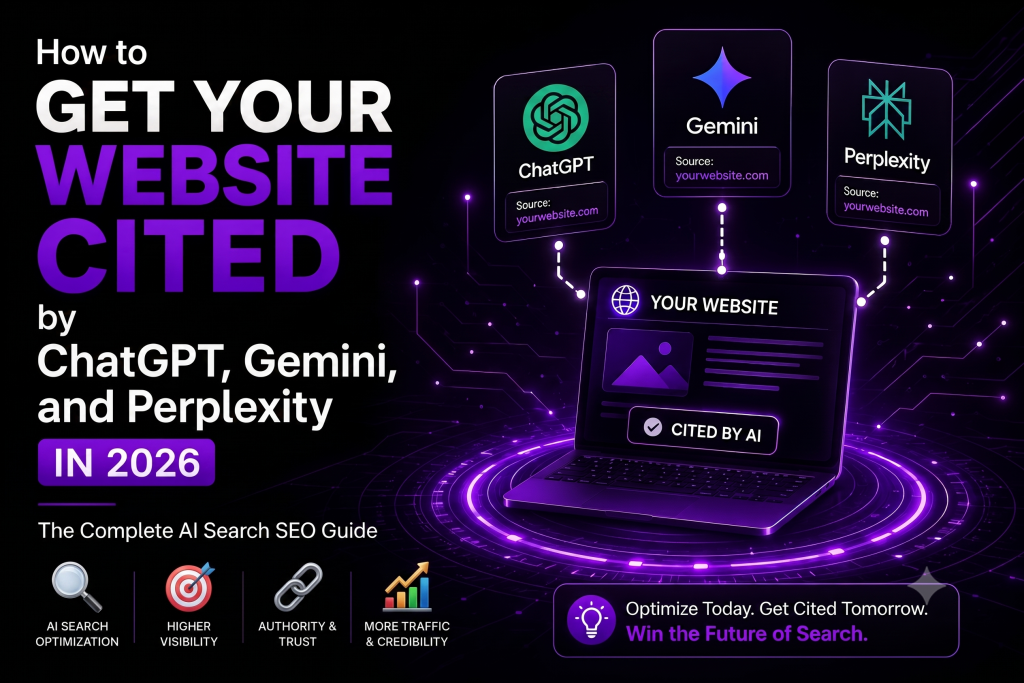
How to Get Your Website Cited by ChatGPT, Gemini, and Perplexity in 2026: The Complete AI Search SEO Guide
Search behavior has changed more in the last two years than in the previous decade. Millions of people now ask questions directly inside ChatGPT, Gemini, and Perplexity instead of typing them into a search bar and scrolling through ten blue links. If you’re wondering how to get your website cited by ChatGPT, Gemini, and Perplexity, you’re asking the right question at exactly the right time. Traditional rankings still matter, but they’re no longer the whole story. AI search engines generate answers directly, pulling from a smaller pool of trusted sources and citing them inline. If your website isn’t part of that pool, you’re invisible in a growing share of searches — even if you rank well on Google. In this guide, you’ll learn exactly how ChatGPT, Gemini, and Perplexity choose which websites to cite, the AI search ranking factors that matter most in 2026, a step-by-step process to improve your AI visibility, and the tools that can help you track your progress. Let’s get into it. What Does It Mean to Be Cited by AI Search? When someone asks an AI assistant a question, the response often includes an AI-generated answer with source attribution — a link or reference pointing back to the website the information came from. That’s a citation. It’s different from a traditional search ranking, where your goal is simply to appear on a results page. Being cited means the AI model has judged your content trustworthy and clear enough to pull directly into its answer. This is the core difference marketers need to understand: ranking gets you visible on a search results page, while being cited gets your website directly referenced inside the answer itself, often with far more visibility than a standard listing. For example, if someone asks Perplexity, “What are the best project management tools for small teams?” and your blog post is cited, your brand name and link appear directly in the response — often above where a traditional Google result would even load. Pro Tip: Think of AI citations as digital word-of-mouth. The AI model is essentially recommending your content the way a knowledgeable friend would. How ChatGPT Chooses Websites ChatGPT pulls information from a combination of trained knowledge and real-time browsing, depending on the query. When it browses and cites sources, it tends to favor content that demonstrates: Trusted sources: Established sites with a track record of accuracy Fresh content: Recently updated pages that reflect current information Authority: Deep coverage of a topic rather than a single shallow article Structured content: Clear headings, lists, and logical formatting the model can parse easily Well-defined entities: Clear identification of people, brands, products, and concepts Expertise: Content written by someone with demonstrable knowledge of the subject Content that directly answers user intent instead of circling around the topic In short, ChatGPT SEO rewards content that reads like it was written by a genuine expert solving a real problem — not content stuffed with keywords hoping to rank. How Google Gemini Selects Sources Gemini is deeply connected to Google’s broader search ecosystem, which means Gemini SEO overlaps heavily with traditional Google signals, but with an added layer of AI-driven synthesis. Existing search signals like backlinks, engagement, and rankings still influence which content Gemini considers Structured data helps Gemini understand exactly what your page is about Google’s Knowledge Graph connects your content to recognized entities and topics Sites with established authority in a niche are favored over new, unproven domains Freshness matters, especially for fast-changing topics like pricing or product features Content that satisfies Google’s helpful content standards has a natural advantage Topical relevance across your entire site, not just a single page, strengthens your chances If your site already performs well in traditional Google search, you have a head start with Gemini — but you’ll still need stronger structure and clearer entity signals to consistently earn citations. How Perplexity Finds Reliable Sources Perplexity operates differently — it’s built around a citation-first approach, showing sources directly alongside every answer. This makes Perplexity SEO particularly transparent compared to other AI search tools. Heavy emphasis on source quality over sheer domain size Accuracy is weighted strongly, since Perplexity positions itself as a research tool Established trust signals, including author credentials and site reputation A preference for real-time information on current events and evolving topics Transparency in how content is sourced, cited, and dated Because Perplexity displays citations so prominently, it’s often the easiest AI search engine to track your visibility on — you can literally see when and where your site gets referenced. AI Search Ranking Factors in 2026 While each AI platform has its own nuances, a consistent set of AI search ranking factors has emerged across all three. Understanding these factors is the foundation of any solid AI Search Optimization strategy. Entity SEO: Clearly defining who, what, and why your content matters Semantic SEO: Covering related concepts, not just isolated keywords Topical Authority: Comprehensive coverage of a subject across multiple pages EEAT: Experience, expertise, authoritativeness, and trustworthiness Original research and unique data points, not recycled information Real statistics that back up claims instead of vague generalizations First-hand experience woven into the content, not just theory Structured data and schema markup that make your content machine-readable Regular content freshness updates on evergreen and trending topics Visible author profiles with real credentials Strong internal linking that connects related content clearly Credible external references that support your claims Fast page speed and healthy Core Web Vitals Full mobile optimization for every device type Clean, accessible user experience throughout the site Proper formatting with headings, lists, tables, and FAQs Optimized images with descriptive alt text for full image SEO Expert Insight: AI models don’t just scan for keywords — they attempt to understand the relationships between concepts on your page. That’s why semantic depth now matters more than keyword repetition. Step-by-Step Guide to Get Your Website Cited Here’s a practical, ten-step process to start earning more AI citations across ChatGPT, Gemini, and Perplexity. Step 1: Build Topical Authority Instead