SEO

SEO

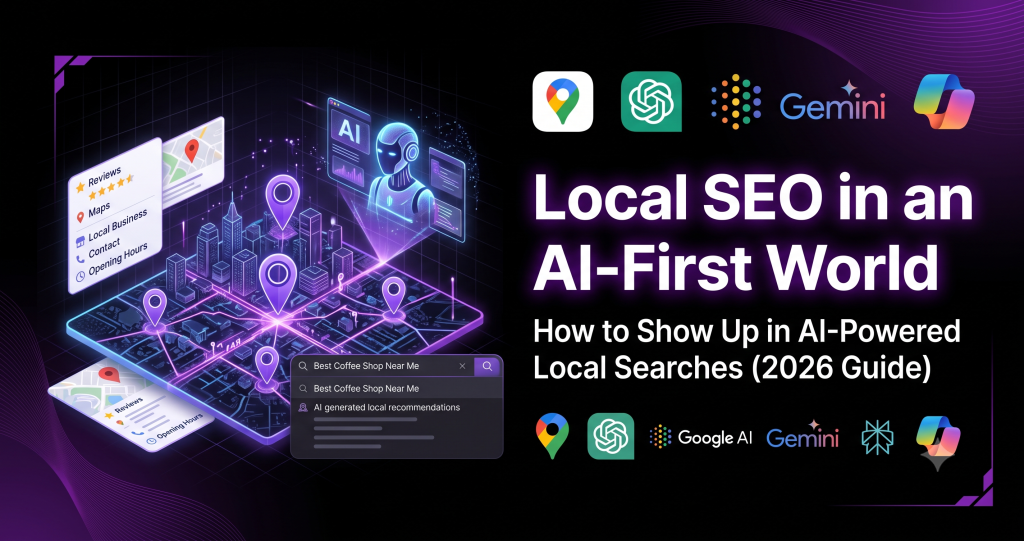
Local SEO in an AI-First World: How to Rank in AI-Powered Local Searches (2026 Guide)

A customer used to Google a business, scroll past a few ads, and click into the map pack. Now they might just ask ChatGPT Search “which Italian place near me is good for a first date” and get one confident answer — no scrolling required. That shift is what Local SEO in an AI-First World is really about. Google AI Overviews, ChatGPT Search, Gemini, and Perplexity AI aren’t just new places to show up — they’re new judges deciding which businesses even get mentioned. Add voice search and AI assistants booking appointments on someone’s behalf, and it’s clear why traditional Local SEO alone can’t carry a business through 2026. This doesn’t mean everything you already know is wrong. It means it’s incomplete. In this guide, you’ll learn what AI-powered local search actually looks like, how the major AI platforms decide which businesses to recommend, and the exact steps to make your business the one they choose. What is AI-Powered Local Search? AI-Powered Local Search is the shift from search engines returning a list of links to AI systems generating a direct, conversational answer — often naming just one or two businesses. A few concepts define this new environment: AI-generated answers that summarize and recommend, rather than simply list results Conversational search, where users ask full, natural-language questions Entity-based search, where your business is understood as a distinct, verifiable “thing” rather than just a webpage Personalized search, shaped by a user’s location, history, and stated preferences Context-aware recommendations, where intent matters — “quick bite” versus “date night” changes the answer AI citations, where the AI names its source, giving cited businesses direct visibility inside the answer itself The practical implication: your business needs to be machine-readable, not just human-appealing. AI systems need to quickly confirm what you do, where you are, who you serve, and whether you’re trustworthy. Pro Tip: Search your own business type and city inside ChatGPT Search or Perplexity. What comes back — or doesn’t — tells you exactly where your gaps are. How AI Search Engines Choose Local Businesses Each platform draws from different data, but they converge on the same principle: verify before recommending. ChatGPT Search browses live web data and favors businesses with consistent details across multiple trusted sources, plus solid review volume. Google AI Overviews leans heavily on Google’s own ecosystem — Business Profile data, Maps reviews, and structured data — so your existing Local SEO foundation carries real weight here. Gemini benefits from tight integration across Search, Maps, and Workspace, rewarding businesses with complete, accurate Google Business Profile information. Perplexity AI is citation-first, explicitly showing where its information came from, which means a strong, credible web presence directly increases your odds of being named. Microsoft Copilot draws from Bing’s index and local data partners, rewarding many of the same signals: consistency, structured data, and review strength. The pattern across all five: AI systems recommend what they can verify. A single glowing review isn’t enough — they’re looking for corroboration across your website, listings, and third-party mentions. Traditional Local SEO vs AI Search Optimization Aspect Traditional Local SEO AI Search Optimization (AISO/GEO) Primary Goal Rank in the map pack and organic results Get named directly inside an AI-generated answer Core Focus Keywords, backlinks, on-page SEO Entities, structured data, cross-platform trust Content Style City and service landing pages Conversational, question-answering content Data Sources Used Mostly Google Search and Maps Google, Bing, review platforms, directories, news Reviews A ranking factor among many A primary trust signal driving recommendations Visibility Outcome One listing among ten results Often a single named business Structured Data Beneficial, sometimes skipped Increasingly essential Success Metric Clicks and map pack position AI citations and direct mentions How to Rank in AI-Powered Local Searches 1. Optimize Your Google Business Profile This remains one of the strongest signals feeding Google AI Overviews and Gemini directly. Select the most precise primary category, plus relevant secondary categories List every service and product with clear, specific details Upload real, current photos regularly — skip the stock imagery Actively collect and respond to reviews Publish business posts for offers, updates, and events Complete the FAQs section with real customer questions Fill out all relevant attributes (wheelchair accessible, outdoor seating, women-owned, and so on) 2. Build Strong Local Entity Signals Entity SEO helps AI systems understand your business as a defined entity connected to a location, industry, and Knowledge Graph node — not just a random website. Keep your business name identical across every platform Clearly state your business identity and specialty on your “About” page Get mentioned consistently across industry directories and local press Align your messaging so every online mention reinforces the same identity 3. Maintain NAP Consistency Your Name, Address, and Phone Number must match exactly everywhere — website, Google Business Profile, social media, and every directory. Even small discrepancies (a suite number here, an abbreviated street name there) create doubt. If an AI system can’t confirm which version of your details is accurate, it’s more likely to skip you entirely and recommend a competitor with cleaner data. 4. Implement Local Schema Markup Structured data removes guesswork for AI systems reading your site. LocalBusiness Schema for business type, location, and hours Organization Schema to reinforce brand identity Review Schema to surface ratings directly FAQ Schema to help AI extract clean, direct answers Product Schema for anything you sell Event Schema for local events and promotions Breadcrumb Schema to clarify site structure and hierarchy A simple LocalBusiness JSON-LD example looks like this: { “@context”: “https://schema.org”, “@type”: “LocalBusiness”, “name”: “Your Business Name”, “address”: { “@type”: “PostalAddress”, “streetAddress”: “123 Main Street”, “addressLocality”: “Your City”, “addressRegion”: “State”, “postalCode”: “00000” }, “telephone”: “+1-000-000-0000”, “openingHours”: “Mo-Fr 09:00-18:00” } Best Practice: Validate every schema type you implement. Broken or incomplete markup can do more harm than having no markup at all. 5. Earn High-Quality Customer Reviews Reviews are one of the clearest trust signals AI platforms use. Google Reviews carry the most weight for Google AI Overviews and Gemini Trustpilot and industry-specific platforms

SEO

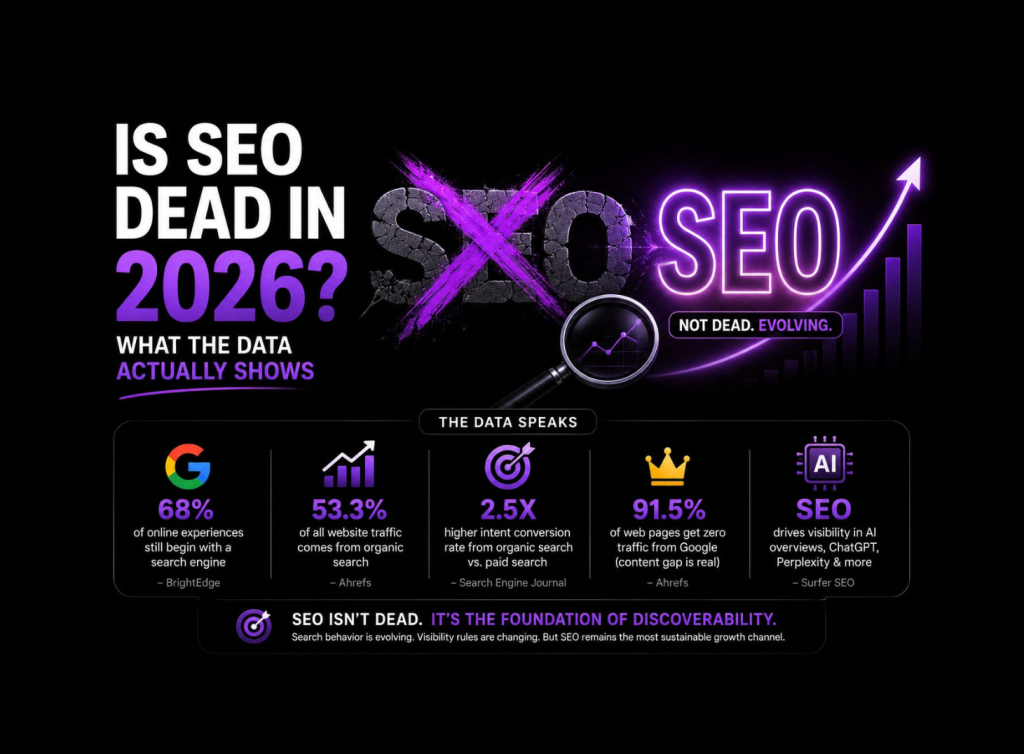
Is SEO Dead in 2026

Is SEO Dead in 2026? What the Data Actually Shows I’ve lost count of how many times a client has opened a call this year with some version of the same question: “Should we even bother with SEO anymore?” Usually it’s followed by a screenshot of a LinkedIn post declaring SEO officially dead, or a stat about ChatGPT eating Google’s lunch. Here’s my honest answer, the one I give every time: SEO isn’t dead. It’s going through the most significant identity crisis of its 25-year existence, and if you’re still measuring it the way you did in 2019, it’s going to feel like it’s dying. But the businesses quietly growing their organic visibility right now aren’t the ones who gave up. They’re the ones who figured out what changed and adjusted. This article is my attempt to cut through the noise with actual numbers — not vibes, not fear, not vendor hype. Let’s get into it. Why Everyone Thinks SEO Is Dying The “SEO is dead” narrative resurfaces every few years. It happened when mobile search took off. It happened when voice assistants arrived. It happened again when Google introduced featured snippets. Each time, traffic patterns shifted, some publishers panicked, and the obituaries got written a little early. This time feels different for a few real reasons, though: AI Overviews now appear across a meaningful share of Google searches, inserting a synthesized answer above the traditional blue links. Zero-click search has become the norm, not the exception. Multiple independent studies — SparkToro’s clickstream research chief among them — now put the share of Google searches ending without any click to an external site somewhere between 60% and 68% in the U.S., depending on methodology and time period. A growing share of people are starting their search journey in ChatGPT, Perplexity, or Google’s AI Mode instead of a traditional search bar. Content marketers are watching organic sessions decline even when their rankings haven’t moved, which feels counterintuitive and scary if you don’t understand why it’s happening.   Put those together and it’s easy to see why “SEO is dead” trends every few months. But dying and changing are two very different things, and the data backs up the second one, not the first. What the Real Data Shows Let’s separate signal from noise. A few data points worth sitting with: According to SparkToro’s ongoing zero-click research, the share of Google searches in the U.S. that end without a click to any website has climbed steadily for years and now sits somewhere in the mid-to-high 60% range as of early 2026, up sharply from roughly 50% back in 2019. Ahrefs’ analysis of AI Overview citations found that when an AI Overview appears above a page’s normal ranking position, click-through to that top organic result drops substantially — estimates across different studies range from roughly 35% to almost 60%, depending on query type and industry. Pew Research’s analysis found that users click through to a traditional result only about 8% of the time when an AI Overview is present, compared to roughly 15% when it isn’t.   None of that means organic search traffic has vanished. It means the relationship between ranking and clicking has become less direct. Google itself still handles the overwhelming majority of global search volume — by most estimates, north of 90% market share — and organic listings remain the backbone of how Google’s AI Overviews and AI Mode decide what to summarize in the first place. Multiple analyses, including Ahrefs’ review of AI Overview citations, have found that a large majority of cited sources in AI Overviews also rank in the top results for that query organically. In other words, ranking well is still the price of admission — it’s just no longer the finish line. What AI Search Actually Changed The shift isn’t that Google stopped valuing good content. It’s that a second discovery layer got built on top of traditional search: one where answers get synthesized and presented directly, and where new platforms are competing for the “front door” of the internet that Google used to own outright. McKinsey’s research on AI-powered search frames it well: the front door to information is diversifying. Where a search once meant typing into one box and scanning ten blue links, it now might mean asking ChatGPT a question conversationally, checking Perplexity for a sourced summary, or letting Google’s AI Overview answer the question before you ever see a traditional result. This is where terms like GEO (Generative Engine Optimization), AEO (Answer Engine Optimization), and LLM SEO come from. They’re not replacements for SEO — they’re extensions of it, aimed at a new set of surfaces. Term What It Optimizes For Example Platforms SEO Ranking position on traditional search results Google, Bing AEO Being selected as a direct answer or featured snippet Google featured snippets, voice assistants, People Also Ask GEO Being cited or referenced inside an AI-generated response ChatGPT, Perplexity, Google AI Overviews, Gemini The important thing to understand is that these three disciplines share the same foundation: authoritative, well-structured, genuinely useful content. You’re not building three separate strategies. You’re building one strategy that’s designed to perform across more surfaces than before. How Google AI Overviews Are Reshaping the SERP AI Overviews are the single biggest structural change to the Google results page since featured snippets arrived. They sit at the top of many search results, synthesizing an answer pulled from multiple sources before a user sees a single traditional listing. A few things matter here for anyone doing SEO in 2026: AI Overviews mostly cite pages that already rank well organically. Ahrefs’ large-scale analysis of AI Overview citations found the majority of cited URLs also appear somewhere in the top organic results for that query, which means traditional ranking signals still heavily influence who gets cited. Informational queries are hit hardest. Simple definitional or “what is” style searches now resolve almost entirely inside the AI Overview, while transactional and high-intent commercial searches retain much higher click-through rates.

SEO

Keyword Research Using AI

Keyword Research Using AI: The Complete 2026 Guide to Finding High-Ranking Keywords A few years ago, keyword research meant typing a phrase into a tool, scrolling through a list of search volumes, and picking whatever looked promising. That approach still works, sort of, but it’s no longer enough. Search itself has changed. Google now answers questions directly through AI Overviews. People ask ChatGPT, Perplexity, and Gemini for recommendations instead of typing into a search bar. The keywords that mattered in 2022 don’t carry the same weight in 2026, and the tools we use to find them have changed just as much as the search engines themselves. This is where keyword research using AI comes in. Instead of guessing which phrases might work, AI tools can now analyze search intent, group related keywords automatically, uncover gaps your competitors missed, and even predict which topics are about to trend, all in a fraction of the time manual research used to take. In this guide, you’ll learn what AI keyword research actually means, why it matters more than ever in 2026, and exactly how to use it step by step, even if you’ve never done keyword research before. By the end, you’ll have a complete, practical workflow you can apply to your own blog, website, or client projects today. What Is Keyword Research Using AI? Keyword research using AI is the process of using artificial intelligence tools, like ChatGPT, AI-powered SEO platforms, and machine learning algorithms, to discover, analyze, and prioritize keywords that have strong ranking potential. Unlike traditional keyword research, which relies mostly on search volume and keyword difficulty scores, AI keyword research adds a layer of understanding: it interprets search intent, recognizes semantic relationships between topics, and can generate hundreds of relevant keyword variations in seconds based on context rather than just matching words. In simple terms, traditional tools tell you what people are searching for. AI tools help you understand why they’re searching for it, and what kind of content will actually satisfy that search. Why AI Is Transforming Keyword Research in 2026 Search engines themselves have become AI-driven. Google’s AI Overviews now interpret entire questions and generate summarized answers, which means ranking for an exact keyword phrase matters less than being recognized as a relevant, trustworthy source for an entire topic. A few shifts are driving this transformation: Search has become conversational. People no longer search “best running shoes.” They ask, “What are the best running shoes for flat feet under $100?” AI tools are far better at uncovering these natural-language, long-tail variations than traditional keyword databases. Search intent matters more than search volume. A keyword with lower volume but clear buying intent can outperform a high-volume keyword with vague intent. AI models are trained to recognize this distinction quickly. AI search engines pull from topical authority, not isolated keywords. ChatGPT Search, Perplexity, and Gemini favor websites that comprehensively cover a topic, not just ones that happen to rank for a single phrase. Speed and scale have changed everything. What used to take hours of manual brainstorming and spreadsheet sorting can now be done in minutes, freeing up time for content creation and strategy. Benefits of AI Keyword Research Using AI for keyword research isn’t just faster, it genuinely produces better results when used correctly. Saves significant time by generating large keyword lists instantly instead of manual brainstorming Uncovers long-tail keywords that traditional tools often miss Improves search intent matching, increasing the likelihood your content satisfies what users actually want Identifies content gaps by comparing your existing content against competitors Groups keywords into clusters automatically, helping you build organized content structures Adapts to changing search behavior, including voice search and conversational AI queries Helps you rank in AI Overviews and AI search engines, not just traditional Google results Traditional Keyword Research vs AI Keyword Research Factor Traditional Keyword Research AI Keyword Research (2026) Process Manual searching and filtering Automated generation and analysis Focus Search volume and difficulty Search intent and topical relevance Speed Hours of manual work Minutes for hundreds of keyword ideas Long-Tail Discovery Limited, requires manual digging Extensive, generated through context Keyword Grouping Done manually in spreadsheets Automatic clustering by topic Content Gap Analysis Time-consuming comparison Instant competitor gap detection Search Engine Fit Optimized for traditional Google results Optimized for Google, AI Overviews, and AI search engines Scalability Difficult to scale across many topics Easily scalable across entire content calendars Step-by-Step Guide to Keyword Research Using AI Here’s a complete, practical workflow you can follow regardless of your experience level. Step 1: Understand Search Intent First Before generating a single keyword, get clear on the intent behind your topic. Is the searcher looking to learn something (informational), compare options (commercial), make a purchase (transactional), or find a specific website (navigational)? You can ask an AI tool directly: “What is the likely search intent behind the keyword ‘best email marketing software for small business’?” This single step shapes everything that follows, since content that doesn’t match intent rarely ranks, no matter how well-optimized it is. Step 2: Find Seed Keywords Seed keywords are the broad, core topics your content will branch out from. Start with 3-5 seed terms related to your niche. For example, a digital marketing blog might start with “SEO,” “content marketing,” and “social media strategy.” Ask AI tools to expand these seeds: “Generate 30 keyword ideas related to content marketing for small businesses.” This gives you a strong foundation to build from. Step 3: Generate Keyword Ideas with AI This is where AI truly shines. Tools like ChatGPT can generate keyword variations based on context, audience, and intent, not just word combinations. Prompt examples include: “List 20 long-tail keywords for a blog about home fitness equipment” “What questions do beginners ask about email marketing?” “Generate keyword ideas for a local bakery website targeting customers in [city]” Step 4: Find Long-Tail Keywords Long-tail keywords (longer, more specific phrases) typically have lower competition and higher conversion potential. AI tools excel at generating these because they understand

SEO

Zero-Click Searches in 2026

Zero-Click Searches in 2026: How to Get Website Traffic Despite Google AI Open Google right now and search for almost anything. Chances are, you’ll get your answer before you even scroll past the first screen. No click. No visit to a website. No traffic for the business that spent hours creating that content. This is the reality of search in 2026. Google’s AI Overviews, instant answers, and AI-powered summaries are answering questions directly on the results page, and millions of website owners are watching their organic traffic shrink even though their rankings haven’t dropped. If you’ve noticed your impressions staying steady while your clicks fall, you’re not imagining it. You’re experiencing the rise of zero-click searches, and it’s reshaping how SEO works. The good news? Zero-click searches aren’t the end of organic traffic. They’re a shift in the rules. Businesses and marketers who understand this shift, and adapt their strategy, are still growing their traffic, leads, and revenue. This guide will show you exactly how What Are Zero-Click Searches? A zero-click search happens when a user types a query into Google and gets their answer directly on the search results page, without clicking through to any website. This happens through features like: Featured snippets that pull a direct answer from a webpage Google AI Overviews that generate a summary using multiple sources Knowledge panels showing facts about people, places, or things Direct answer boxes for quick facts (weather, time, definitions, conversions) People Also Ask boxes that expand inline In each case, the user’s need is satisfied right there. There’s no reason to click further, and that means no website visit, no ad impression, and no chance to convert that visitor into a lead or customer. Why Zero-Click Searches Are Increasing in 2026 A few years ago, zero-click results were limited mostly to simple facts like “what time is it in Tokyo” or “how many ounces in a cup.” That’s no longer the case. Google’s AI Overview now answers complex, multi-part questions that used to require clicking through several websites to research. A query like “best project management software for small teams” or “how to improve credit score fast” now often returns a full AI-generated summary pulling information from multiple sources, organized and ready to read. Several factors are driving this increase: Google wants to keep users on its platform longer. Every click away from Google is a click Google doesn’t monetize directly. AI models have gotten dramatically better at summarizing information accurately. What used to require human research can now be synthesized in seconds. User behavior has shifted. People have gotten used to fast answers and increasingly expect them, training Google’s algorithms to deliver more of the same. Voice search and mobile search favor quick, spoken-friendly answers over lists of blue links.   The result is a search landscape where, according to multiple industry studies, a majority of searches now end without a click to any website at all. Why Traditional SEO Is No Longer Enough For nearly two decades, the SEO playbook was simple: target a keyword, write quality content, build backlinks, rank on page one, and traffic followed automatically. That formula is breaking down. Ranking #1 used to almost guarantee clicks. In 2026, ranking #1 might mean your content gets summarized in an AI Overview, and the user never scrolls down to your actual listing. Traditional SEO focused on keyword matching and technical optimization. AI-era SEO requires something deeper: becoming a source AI systems trust enough to cite, and building a brand strong enough that people seek you out directly, bypassing search altogether. This doesn’t mean SEO is dead. It means SEO has evolved, and the businesses that evolve with it will out-perform competitors stuck in the old playbook. Types of Zero-Click Searches You Should Know Understanding the different formats helps you optimize for each one strategically. 1. Featured Snippets A direct answer box pulled from a webpage, usually a paragraph, list, or table, shown above the organic results. 2. AI Overviews A generative summary combining information from multiple sources into one cohesive answer, often with linked citations. 3. Knowledge Panels Information boxes about entities (people, businesses, places) sourced from structured data and trusted databases. 4. People Also Ask (PAA) Expandable question boxes related to the search query, often pulling short answers from ranking pages. 5. Local Pack Results Map-based results for local searches that answer location-based queries without needing a website click. 6. Direct Answer Boxes Instant facts like definitions, conversions, sports scores, and calculations. Each of these formats rewards content structured for clarity, directness, and authority, which is very different from content written purely to “rank for a keyword.” Biggest SEO Challenges in 2026 Before getting into solutions, it’s worth being honest about what marketers are up against: Shrinking click-through rates even with top rankings AI Overviews summarizing content without sending traffic back Rising competition for “citation-worthy” content, not just ranking content Increased importance of E-E-A-T, making it harder for new or thin sites to compete Greater reliance on brand recognition, since people increasingly search for brands by name instead of generic queries More fragmented traffic sources, requiring diversification beyond Google search alone These challenges are real, but every one of them has a workaround. Let’s get into the strategy. How to Get Website Traffic Despite Google AI The businesses still growing their organic traffic in 2026 share a common trait: they stopped chasing rankings alone and started building authority, experience, and brand demand. Here’s how to do the same. 1. Create Experience-Based Content Google’s algorithms, and AI Overviews specifically, increasingly favor content that demonstrates first-hand experience, not just researched information. Show real photos, real data, real results, and real stories. Content written from genuine experience is harder for AI to fully replicate or summarize away, which keeps the click value with you. 2. Optimize for AI Overviews (Not Against Them) Instead of resisting AI Overviews, optimize to get cited inside them. Use clear, direct answers near the top of your content, structured data, and

SEO

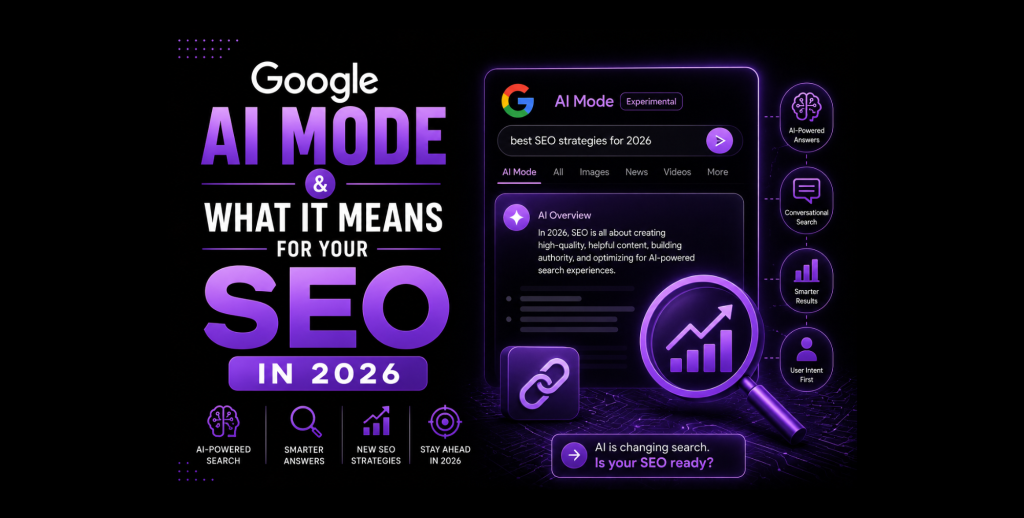
Google AI Mode & What It Means for Your SEO in 2026

Google AI Mode & What It Means for Your SEO in 2026 01 — Foundations What Is Google AI Mode, Really? Google AI Mode is a dedicated search experience — accessible via a tab on Google Search — that uses a custom version of Gemini to generate comprehensive, multi-part answers to your queries. Unlike the earlier AI Overviews (which appeared above regular results), AI Mode is a fully AI-native search interface.Think of it as the difference between a waiter who mentions “the fish is good tonight” and a personal chef who plans your entire meal. AI Mode doesn’t just skim the top results; it synthesizes information from across the web, follows up with clarifying questions, and builds out a whole research session on your behalf. Key distinction: AI Overviews still co-exist with traditional blue-link results. AI Mode is a separate tab that replaces the traditional SERP experience entirely for that session. Here’s what AI Mode actually does that’s new: Multi-step query decomposition Complex questions get broken into sub-questions, each researched in parallel — what Google calls “query fan-out.” Conversational follow-upsUsers can refine their answers in a chat-like thread without typing a new search. Cited sources with linksEvery AI-generated response includes inline citations — but you’re competing with hundreds of other pages to get cited. Personalized contextFor signed-in users, AI Mode can draw on your past searches, location, and preferences. 02 — Under the Hood How AI Mode Works Under The Hood The technical architecture of AI Mode matters for SEO because it changes how Google decides what gets surfaced. Here’s the simplified version of what’s happening every time someone uses AI Mode: Query Fan-Out: The Game Changer When a user types “what’s the best project management tool for a 10-person remote startup in 2026,” AI Mode doesn’t just match keywords. It breaks that into parallel sub-queries: “Best project management tools for small teams 2026” “Remote work software pricing comparison” “Startup tool budget constraints” “User reviews: Notion vs Asana vs Linear 2026” Gemini then synthesizes all of that into a single, coherent answer. Your page might rank for one of those sub-queries and still get cited — or it might not get cited at all if Gemini decides another source covers the topic more authoritatively. The Indexing Reality Here’s the uncomfortable truth: Googlebot still crawls and indexes your content exactly the same way. The underlying web index hasn’t changed. What’s changed is how that index gets used. AI Mode draws from the same pool — but applies a very different selection logic on top. The search engine is not dead. The search results page is dead. Those are two very different problems.— Rand Fishkin, SparkToro, April 2026 03 — The Numbers The Real SEO Impact: What the Data Says Alright, let’s talk about what actually matters to most of you reading this: traffic. What is AI Mode doing to organic visits? -34%avg. organic CTR drop for informational queries in AI Mode SERPs +22%increase in clicks for pages cited in AI-generated answers 61%of AI Mode queries have no click to any external website Source: Semrush Industry Report, April 2026 / BrightEdge AI Search Study, Q1 2026 The pattern is clear: zero-click searches are up, but high-intent clicks are also up. What’s dying is the middle — the casual informational browse where someone Googled “how to clean a cast iron pan” and clicked the first blog post. AI Mode answers that completely. The user never needs to leave Google. 04 — The Divide Who’s Winning & Who’s Losing Traffic patterns are diverging sharply — some sites are growing while others see dramatic drops Sites That Are Thriving Counterintuitively, some categories are doing better than ever. Sites that get cited as authoritative sources in AI Mode responses are seeing highly qualified traffic — people who’ve already had their question pre-answered by AI and are clicking through specifically to learn more, to trust the source, or to buy. Deep-expertise niche sitesIf you’ve built genuine authority on a specific topic, Gemini trusts you and cites you regularly. Original research publishersStudies, surveys, and proprietary data are extremely citation-worthy because AI can’t make them up. E-commerce with strong product pagesCommercial-intent searches still convert. AI Mode often links to product pages. Community platforms (Reddit, forums)AI Mode heavily cites user-generated discussions, especially for subjective/opinion queries. Sites That Are Struggling Generic how-to blogsStep-by-step tutorials for simple tasks are AI Mode’s favorite thing to answer without a click. News aggregatorsSummarization is exactly what AI does best. Original reporting still has value; curation does not. Thin affiliate content“Best X product” listicles with no original perspective are being entirely replaced by AI summaries. Definition/glossary pages“What is X?” pages are almost always answered entirely in AI Mode now. 05 — Action Plan 10 Things To Do Right Now Okay, here’s the section you actually came for. Based on what’s working for sites adapting successfully to AI Mode, here are the most impactful moves you can make: 01 Audit your traffic by query typeUse Google Search Console segmented by query intent. Identify which pages are losing clicks to AI Overviews vs. pages that are growing. This tells you what to protect vs. what to transform. 02 Build “AI-worthy” authority signalsStructured data (Schema.org), clear author bios with credentials, first-hand expertise, original data — these are what get you cited. Implement Article schema with author and expertise signals on every piece. 03 Create content AI cannot createInterviews, case studies, proprietary surveys, real user data, original photography, lived experience narratives. If AI could write your content in 3 seconds, it will also answer for you in 3 seconds. 04 Obsess over E-E-A-T signalsExperience, Expertise, Authoritativeness, Trustworthiness — Google’s own framework for what it surfaces. Emphasize real people, real credentials, real track records. Update your About pages and author profiles. 05 Target BOFU (bottom-of-funnel) queriesShift content investment toward queries where users are ready to act — buy, compare pricing, book a demo, hire someone. These get clicked even after an AI overview. 06 Build your email list aggressivelyOrganic search dependency is riskier than ever. Every piece

Scroll to Top