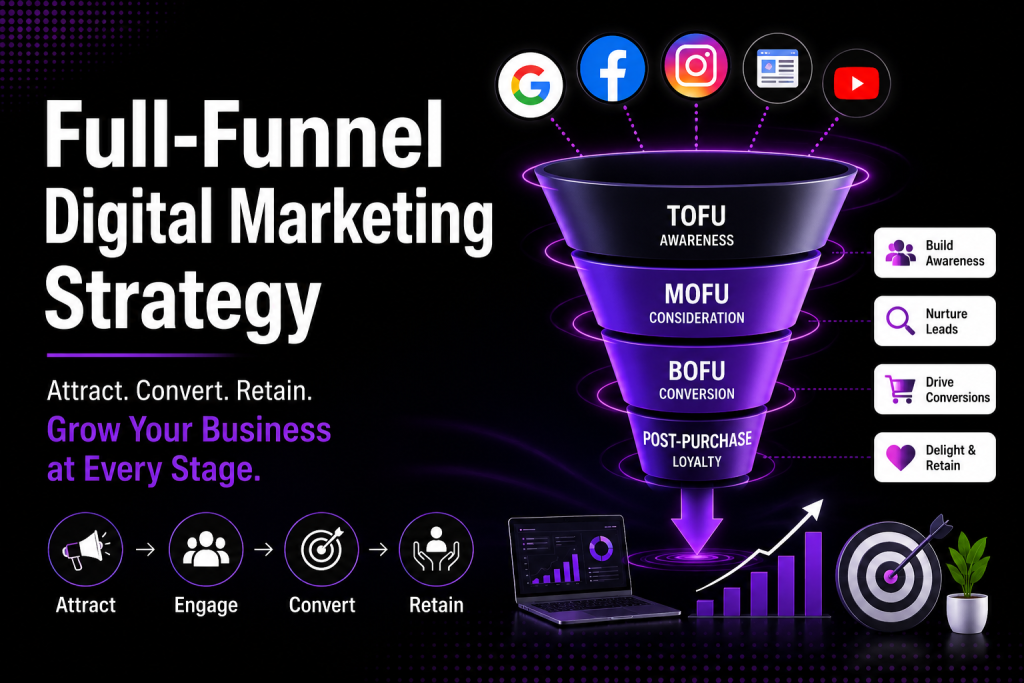
Full-Funnel Digital Marketing Strategy
Full-Funnel Digital Marketing Strategy: The Complete Guide to Attract, Convert, and Retain Customers in 2026 If you’re still running marketing campaigns that focus only on clicks or only on sales, you’re leaving money on the table. A full-funnel digital marketing strategy is no longer a “nice to have” for ambitious brands — it’s the difference between businesses that grow predictably and ones that chase random spikes in traffic with nothing to show for it. Here’s the problem with traditional marketing: it treats every visitor the same way. Someone who just discovered your brand gets the exact same message as someone who’s ready to buy. That mismatch is why so many campaigns burn budget without producing real revenue. A true full-funnel digital marketing strategy fixes this by meeting people exactly where they are in their customer journey — from the first time they hear about you, all the way through purchase, and long after, when they become repeat buyers and advocates for your brand. In this guide, you’ll learn what full-funnel marketing actually means, how the TOFU, MOFU, and BOFU stages work together, which channels perform best at each stage, how to measure results with real KPIs, and which AI tools are shaping digital marketing strategy 2026. Whether you’re a student, a freelancer, a startup founder, or an agency owner, you’ll walk away with a practical framework you can apply immediately. Let’s build a marketing funnel that actually works from top to bottom. What Is a Full-Funnel Digital Marketing Strategy? A full-funnel digital marketing strategy is an approach that addresses every stage of the buyer’s journey, rather than focusing only on one goal like traffic or sales. It combines brand awareness, lead generation, lead nurturing, conversion optimization, and customer retention into one connected system. Instead of treating SEO, paid ads, email, and social media as separate tactics, full-funnel marketing links them together so each channel supports the next. A blog post might attract a stranger through search. A retargeting ad might bring them back a week later. An email sequence might nurture them into a buyer. And a loyalty program might turn that buyer into a repeat customer. Pro Tip: Think of your funnel as a relationship, not a transaction. People rarely buy on the first visit — full-funnel marketing gives you a reason to stay in touch until they’re ready. Why Full-Funnel Marketing Matters in 2026 Consumer behavior has changed dramatically. Buyers now research across multiple devices, compare options using AI search tools, and expect personalized experiences at every touchpoint. A single-channel or single-stage approach simply can’t keep up. Rising ad costs mean businesses can’t rely on customer acquisition alone — retention has become just as important. AI-powered search (including AEO and GEO) is changing how people discover brands. Buyers expect omnichannel marketing experiences that feel consistent across every platform. Privacy changes mean marketers need first-party data strategies, not just cookies and pixels. Customers reward brands that nurture them, not just brands that sell to them. Businesses that master the entire digital marketing funnel — not just the bottom — build compounding growth. Every piece of content, every ad, and every email works together instead of competing for attention. Understanding the Customer Journey The customer journey is the path someone takes from first hearing about your brand to becoming a loyal customer. It typically includes awareness, consideration, decision, purchase, and loyalty stages. Full-funnel marketing maps specific content and channels to each of these stages. Difference Between Sales Funnel and Marketing Funnel These terms are often used interchangeably, but they’re not quite the same thing. Aspect Marketing Funnel Sales Funnel Focus Awareness, education, and lead nurturing Closing deals and driving revenue Owned by Marketing team Sales team Typical stages TOFU, MOFU, BOFU Qualified lead, proposal, negotiation, close Goal Generate and warm up leads Convert leads into paying customers A strong full-funnel digital marketing strategy aligns both funnels so marketing and sales aren’t working against each other. The Four Funnel Stages Explained Every effective conversion funnel is built around four connected stages. Let’s break each one down. Top of Funnel (TOFU) — Awareness This is where strangers discover your brand for the first time. The goal isn’t to sell — it’s to educate, entertain, or solve a small problem so people remember you. SEO-optimized blog content Social media posts and short-form video YouTube tutorials Influencer collaborations Top-of-funnel Google Ads and Meta Ads for brand awareness Middle of Funnel (MOFU) — Consideration Here, leads know who you are and are comparing options. Your job is to build trust and demonstrate expertise. Email marketing sequences (lead nurturing) Case studies and comparison guides Webinars and free tools Retargeting ads based on website behavior Lead magnets like checklists or templates Bottom of Funnel (BOFU) — Decision This is where conversion optimization matters most. Leads are ready to buy — your job is to remove friction. Product demos and free trials Customer testimonials and reviews Clear pricing pages Retargeting and remarketing campaigns with strong offers Live chat or chatbot support to answer last-minute questions Post-Purchase, Retention, and Advocacy Many businesses stop marketing once someone buys. That’s a mistake. Customer retention is often cheaper and more profitable than customer acquisition. Onboarding emails and tutorials Loyalty and rewards programs Personalized upsell and cross-sell offers Requesting reviews and referrals to build advocacy Ongoing value through newsletters or community access Expert Insight: A customer who refers three friends is often more valuable than a customer who never engages again. Advocacy is the most underused stage of the funnel. TOFU vs MOFU vs BOFU: Quick Comparison Stage Buyer Mindset Content Type Primary Goal TOFU “I have a problem” Blog posts, videos, social content Brand awareness MOFU “I’m comparing solutions” Emails, case studies, webinars Lead nurturing BOFU “I’m ready to decide” Demos, testimonials, offers Conversion Channels Used at Every Funnel Stage A well-built digital marketing funnel doesn’t rely on one channel. Here’s how the most important channels map to each stage. Channel Best Funnel Stage Purpose SEO TOFU / MOFU Organic visibility