Author name: iqra

Uncategorized

Generative Engine Optimization (GEO)

Generative Engine Optimization (GEO): The Future of AI Search in 2026 Search doesn’t look anything like it did five years ago. If you typed a question into Google in 2019, you got ten blue links and maybe a featured snippet if you were lucky. Today, you’re just as likely to get a fully written answer — assembled in real time, citing multiple sources, with no clicking required. That shift has a name: Generative Engine Optimization, or GEO. Whether you run a small business, manage marketing for a startup, or work at an agency juggling a dozen client websites, this shift affects you. Tools like ChatGPT, Google AI Overviews, Gemini, Perplexity, and Microsoft Copilot are no longer novelties — they’re becoming the front door to the internet for millions of people every single day. And the way these AI Search Engines find, understand, and cite content is fundamentally different from how traditional search engines rank a webpage. This guide breaks down exactly what GEO is, how it works, why it matters right now, and — most importantly — what you can actually do about it. No fluff, no recycled definitions. Just a practical, honest look at the future of search. Quick Definition: Generative Engine Optimization (GEO) is the practice of structuring, writing, and promoting content so that AI-powered answer engines — like ChatGPT, Google AI Overviews, Gemini, and Perplexity — can understand it, trust it, and cite it in their generated responses. What is Generative Engine Optimization (GEO)? Generative Engine Optimization (GEO) is the process of optimizing digital content so it gets discovered, understood, summarized, and cited by AI-driven search and answer engines rather than just ranked on a traditional search results page. Think of traditional SEO as trying to earn a spot on a shelf. GEO is different — you’re trying to become part of the answer itself. When someone asks ChatGPT, “What’s the best CRM for a small real estate agency?” the model doesn’t return a list of links. It generates a direct, conversational answer, often pulling in facts, comparisons, and sometimes citations from a handful of trusted sources. If your content isn’t structured or trusted in a way the AI model can use, you simply don’t exist in that answer — no matter how well you’d rank on page one of Google. What is GEO SEO? People often search “GEO SEO” wondering if it’s a separate discipline from regular SEO. It isn’t — GEO is best understood as an evolution and extension of SEO, not a replacement. Good technical SEO, strong content quality, and authoritative backlinks still matter. GEO simply adds a new layer on top: making sure your content is machine-readable, semantically clear, and citation-worthy for large language models (LLMs). Why the Name “Generative Engine Optimization”? The term comes from “generative engines” — AI systems that generate original answers instead of retrieving and ranking existing pages. This includes: ChatGPT (OpenAI) Google AI Overviews and Google Gemini Perplexity AI Microsoft Copilot Claude AI (Anthropic) Meta AI Each of these tools pulls from massive training data and, increasingly, live web results, to construct answers. GEO is about earning your place inside that generation process. How GEO Works GEO isn’t magic — it follows a logical pipeline. Here’s a simplified breakdown of how most generative search engines process a query and decide what to include in an answer. Step 1: Query Understanding The AI model interprets the user’s intent, not just their keywords. It considers context, prior conversation history, and semantic meaning. Step 2: Retrieval Many AI engines (especially Perplexity, Gemini, and Google AI Overviews) perform real-time web retrieval, pulling in current, relevant pages using search indexes and Retrieval-Augmented Generation (RAG) techniques. Step 3: Evaluation and Ranking of Sources The engine evaluates which sources are trustworthy, relevant, and well-structured enough to use. This is where entity clarity, topical authority, and EEAT (Experience, Expertise, Authoritativeness, Trustworthiness) come into play heavily. Step 4: Synthesis The model synthesizes information from multiple sources into a single, coherent, conversational answer — often blending facts from several pages rather than quoting just one. Step 5: Citation (Sometimes) Depending on the platform, the AI may cite sources directly (Perplexity and Google AI Overviews do this consistently; ChatGPT does this more selectively, especially when browsing is active).   Step 6: Delivery The final answer is presented to the user — often with no need to click through to a website at all. Why GEO Matters in 2026 By 2026, AI-powered search isn’t a side experiment anymore — it’s mainstream behavior. Here’s why ignoring GEO is a genuinely risky business decision. 1. Zero-click search is accelerating. More users get their answer directly inside the AI response and never visit a website. If your content isn’t part of that answer, you’re invisible for that entire segment of searchers. 2. AI search usage is growing fast. Millions of people now start their research on ChatGPT or Perplexity instead of Google, especially for comparison shopping, technical questions, and B2B research. 3. Google itself is going generative. Google AI Overviews now appear across a large share of informational queries, meaning even “regular” Google search is becoming an AI search experience. 4. Trust and citations are the new currency. Being cited by an AI engine builds brand visibility and credibility in a way a buried page-two ranking never could. 5. Early movers will dominate. Just like early SEO adopters in the 2000s built massive authority advantages, businesses optimizing for GEO now will have a significant head start as AI search becomes the default. Industry Insight: Analysts across the SEO and digital marketing industry widely agree that AI Overviews and chat-based search assistants are reshaping click-through behavior, with many informational queries now resolved without a single website visit. Brands that fail to adapt risk losing visibility precisely where their future customers are looking. Difference Between SEO, AEO and GEO These three terms get thrown around interchangeably, but they’re not the same thing. Here’s a clear breakdown. Factor Traditional SEO AEO (Answer Engine Optimization) GEO
SEO

Keyword Research Using AI

Keyword Research Using AI: The Complete 2026 Guide to Finding High-Ranking Keywords A few years ago, keyword research meant typing a phrase into a tool, scrolling through a list of search volumes, and picking whatever looked promising. That approach still works, sort of, but it’s no longer enough. Search itself has changed. Google now answers questions directly through AI Overviews. People ask ChatGPT, Perplexity, and Gemini for recommendations instead of typing into a search bar. The keywords that mattered in 2022 don’t carry the same weight in 2026, and the tools we use to find them have changed just as much as the search engines themselves. This is where keyword research using AI comes in. Instead of guessing which phrases might work, AI tools can now analyze search intent, group related keywords automatically, uncover gaps your competitors missed, and even predict which topics are about to trend, all in a fraction of the time manual research used to take. In this guide, you’ll learn what AI keyword research actually means, why it matters more than ever in 2026, and exactly how to use it step by step, even if you’ve never done keyword research before. By the end, you’ll have a complete, practical workflow you can apply to your own blog, website, or client projects today. What Is Keyword Research Using AI? Keyword research using AI is the process of using artificial intelligence tools, like ChatGPT, AI-powered SEO platforms, and machine learning algorithms, to discover, analyze, and prioritize keywords that have strong ranking potential. Unlike traditional keyword research, which relies mostly on search volume and keyword difficulty scores, AI keyword research adds a layer of understanding: it interprets search intent, recognizes semantic relationships between topics, and can generate hundreds of relevant keyword variations in seconds based on context rather than just matching words. In simple terms, traditional tools tell you what people are searching for. AI tools help you understand why they’re searching for it, and what kind of content will actually satisfy that search. Why AI Is Transforming Keyword Research in 2026 Search engines themselves have become AI-driven. Google’s AI Overviews now interpret entire questions and generate summarized answers, which means ranking for an exact keyword phrase matters less than being recognized as a relevant, trustworthy source for an entire topic. A few shifts are driving this transformation: Search has become conversational. People no longer search “best running shoes.” They ask, “What are the best running shoes for flat feet under $100?” AI tools are far better at uncovering these natural-language, long-tail variations than traditional keyword databases. Search intent matters more than search volume. A keyword with lower volume but clear buying intent can outperform a high-volume keyword with vague intent. AI models are trained to recognize this distinction quickly. AI search engines pull from topical authority, not isolated keywords. ChatGPT Search, Perplexity, and Gemini favor websites that comprehensively cover a topic, not just ones that happen to rank for a single phrase. Speed and scale have changed everything. What used to take hours of manual brainstorming and spreadsheet sorting can now be done in minutes, freeing up time for content creation and strategy. Benefits of AI Keyword Research Using AI for keyword research isn’t just faster, it genuinely produces better results when used correctly. Saves significant time by generating large keyword lists instantly instead of manual brainstorming Uncovers long-tail keywords that traditional tools often miss Improves search intent matching, increasing the likelihood your content satisfies what users actually want Identifies content gaps by comparing your existing content against competitors Groups keywords into clusters automatically, helping you build organized content structures Adapts to changing search behavior, including voice search and conversational AI queries Helps you rank in AI Overviews and AI search engines, not just traditional Google results Traditional Keyword Research vs AI Keyword Research Factor Traditional Keyword Research AI Keyword Research (2026) Process Manual searching and filtering Automated generation and analysis Focus Search volume and difficulty Search intent and topical relevance Speed Hours of manual work Minutes for hundreds of keyword ideas Long-Tail Discovery Limited, requires manual digging Extensive, generated through context Keyword Grouping Done manually in spreadsheets Automatic clustering by topic Content Gap Analysis Time-consuming comparison Instant competitor gap detection Search Engine Fit Optimized for traditional Google results Optimized for Google, AI Overviews, and AI search engines Scalability Difficult to scale across many topics Easily scalable across entire content calendars Step-by-Step Guide to Keyword Research Using AI Here’s a complete, practical workflow you can follow regardless of your experience level. Step 1: Understand Search Intent First Before generating a single keyword, get clear on the intent behind your topic. Is the searcher looking to learn something (informational), compare options (commercial), make a purchase (transactional), or find a specific website (navigational)? You can ask an AI tool directly: “What is the likely search intent behind the keyword ‘best email marketing software for small business’?” This single step shapes everything that follows, since content that doesn’t match intent rarely ranks, no matter how well-optimized it is. Step 2: Find Seed Keywords Seed keywords are the broad, core topics your content will branch out from. Start with 3-5 seed terms related to your niche. For example, a digital marketing blog might start with “SEO,” “content marketing,” and “social media strategy.” Ask AI tools to expand these seeds: “Generate 30 keyword ideas related to content marketing for small businesses.” This gives you a strong foundation to build from. Step 3: Generate Keyword Ideas with AI This is where AI truly shines. Tools like ChatGPT can generate keyword variations based on context, audience, and intent, not just word combinations. Prompt examples include: “List 20 long-tail keywords for a blog about home fitness equipment” “What questions do beginners ask about email marketing?” “Generate keyword ideas for a local bakery website targeting customers in [city]” Step 4: Find Long-Tail Keywords Long-tail keywords (longer, more specific phrases) typically have lower competition and higher conversion potential. AI tools excel at generating these because they understand

SEO

Zero-Click Searches in 2026

Zero-Click Searches in 2026: How to Get Website Traffic Despite Google AI Open Google right now and search for almost anything. Chances are, you’ll get your answer before you even scroll past the first screen. No click. No visit to a website. No traffic for the business that spent hours creating that content. This is the reality of search in 2026. Google’s AI Overviews, instant answers, and AI-powered summaries are answering questions directly on the results page, and millions of website owners are watching their organic traffic shrink even though their rankings haven’t dropped. If you’ve noticed your impressions staying steady while your clicks fall, you’re not imagining it. You’re experiencing the rise of zero-click searches, and it’s reshaping how SEO works. The good news? Zero-click searches aren’t the end of organic traffic. They’re a shift in the rules. Businesses and marketers who understand this shift, and adapt their strategy, are still growing their traffic, leads, and revenue. This guide will show you exactly how What Are Zero-Click Searches? A zero-click search happens when a user types a query into Google and gets their answer directly on the search results page, without clicking through to any website. This happens through features like: Featured snippets that pull a direct answer from a webpage Google AI Overviews that generate a summary using multiple sources Knowledge panels showing facts about people, places, or things Direct answer boxes for quick facts (weather, time, definitions, conversions) People Also Ask boxes that expand inline In each case, the user’s need is satisfied right there. There’s no reason to click further, and that means no website visit, no ad impression, and no chance to convert that visitor into a lead or customer. Why Zero-Click Searches Are Increasing in 2026 A few years ago, zero-click results were limited mostly to simple facts like “what time is it in Tokyo” or “how many ounces in a cup.” That’s no longer the case. Google’s AI Overview now answers complex, multi-part questions that used to require clicking through several websites to research. A query like “best project management software for small teams” or “how to improve credit score fast” now often returns a full AI-generated summary pulling information from multiple sources, organized and ready to read. Several factors are driving this increase: Google wants to keep users on its platform longer. Every click away from Google is a click Google doesn’t monetize directly. AI models have gotten dramatically better at summarizing information accurately. What used to require human research can now be synthesized in seconds. User behavior has shifted. People have gotten used to fast answers and increasingly expect them, training Google’s algorithms to deliver more of the same. Voice search and mobile search favor quick, spoken-friendly answers over lists of blue links.   The result is a search landscape where, according to multiple industry studies, a majority of searches now end without a click to any website at all. Why Traditional SEO Is No Longer Enough For nearly two decades, the SEO playbook was simple: target a keyword, write quality content, build backlinks, rank on page one, and traffic followed automatically. That formula is breaking down. Ranking #1 used to almost guarantee clicks. In 2026, ranking #1 might mean your content gets summarized in an AI Overview, and the user never scrolls down to your actual listing. Traditional SEO focused on keyword matching and technical optimization. AI-era SEO requires something deeper: becoming a source AI systems trust enough to cite, and building a brand strong enough that people seek you out directly, bypassing search altogether. This doesn’t mean SEO is dead. It means SEO has evolved, and the businesses that evolve with it will out-perform competitors stuck in the old playbook. Types of Zero-Click Searches You Should Know Understanding the different formats helps you optimize for each one strategically. 1. Featured Snippets A direct answer box pulled from a webpage, usually a paragraph, list, or table, shown above the organic results. 2. AI Overviews A generative summary combining information from multiple sources into one cohesive answer, often with linked citations. 3. Knowledge Panels Information boxes about entities (people, businesses, places) sourced from structured data and trusted databases. 4. People Also Ask (PAA) Expandable question boxes related to the search query, often pulling short answers from ranking pages. 5. Local Pack Results Map-based results for local searches that answer location-based queries without needing a website click. 6. Direct Answer Boxes Instant facts like definitions, conversions, sports scores, and calculations. Each of these formats rewards content structured for clarity, directness, and authority, which is very different from content written purely to “rank for a keyword.” Biggest SEO Challenges in 2026 Before getting into solutions, it’s worth being honest about what marketers are up against: Shrinking click-through rates even with top rankings AI Overviews summarizing content without sending traffic back Rising competition for “citation-worthy” content, not just ranking content Increased importance of E-E-A-T, making it harder for new or thin sites to compete Greater reliance on brand recognition, since people increasingly search for brands by name instead of generic queries More fragmented traffic sources, requiring diversification beyond Google search alone These challenges are real, but every one of them has a workaround. Let’s get into the strategy. How to Get Website Traffic Despite Google AI The businesses still growing their organic traffic in 2026 share a common trait: they stopped chasing rankings alone and started building authority, experience, and brand demand. Here’s how to do the same. 1. Create Experience-Based Content Google’s algorithms, and AI Overviews specifically, increasingly favor content that demonstrates first-hand experience, not just researched information. Show real photos, real data, real results, and real stories. Content written from genuine experience is harder for AI to fully replicate or summarize away, which keeps the click value with you. 2. Optimize for AI Overviews (Not Against Them) Instead of resisting AI Overviews, optimize to get cited inside them. Use clear, direct answers near the top of your content, structured data, and

Digital Marketing

Digital Marketing Trends 2026

Top Digital Marketing Trends 2026: What Actually Matters This Year Let’s be honest — “digital marketing trends” posts have become a bit of a punchline. Every December, the internet floods with listicles predicting that “personalization is key” and “video will dominate,” as if that wasn’t true in 2019 too. This isn’t going to be that post. 2026 is shaping up to be one of the strangest, most disruptive years digital marketing has seen in over a decade — not because of one big trend, but because the ground rules of how people find brands are being rewritten in real time. Search is splitting into two systems. AI agents are starting to act on behalf of consumers instead of just answering their questions. And ironically, in a year dominated by automation, the brands winning the most are the ones leaning hardest into being unmistakably, authentically human. Here’s what’s actually happening — and what to do about it. 1. Generative Engine Optimization (GEO) Is No Longer Optional If you’ve never heard the term GEO, you’re already behind — but not by much, since most of the industry is in the same boat. Here’s the shift in plain terms: people are increasingly asking ChatGPT, Perplexity, Gemini, and Google’s AI Overviews for answers instead of clicking through ten blue links. Roughly 60% of searches now end without a click, and the click-through rate for the first organic position has fallen to around 2.6% when an AI Overview is present. That’s not a small dip — that’s a fundamentally different internet. Generative Engine Optimization is the practice of structuring your content so AI engines actually cite you when they generate an answer, rather than just trying to rank you in a list. The term was coined back in 2023 by Princeton researchers, but by 2026 it’s become a genuine boardroom priority rather than an academic curiosity. What makes this trend tricky is that the rules of GEO aren’t the same as the rules of SEO. A foundational Princeton, Georgia Tech, and IIT Delhi study found that techniques like adding statistics, citing sources, and including quotations can lift content visibility in AI answers by as much as 40% — while old-school keyword stuffing actually performs worse than doing nothing at all. And here’s the part that should really get your attention: AI-referred traffic, while smaller in volume, converts dramatically better than traditional search traffic. One analysis found that AI search visitors generated 12.1% of signups despite making up only 0.5% of total visitors — a 24-to-1 conversion advantage over standard organic traffic. People arriving from an AI answer have already done their research and arrived with intent; they’re not browsing, they’re deciding. What to actually do about it: Lead every section of your content with a direct, extractable answer in the first couple of sentences — AI systems pull passages, they don’t read your whole page top to bottom. Add real statistics, named sources, and direct quotes wherever relevant. Implement FAQ, Article, and Author schema markup so machines can parse who you are and what you know. Don’t abandon traditional SEO. The vast majority of AI Overview citations still come from pages that already rank in the organic top 10 — GEO builds on SEO, it doesn’t replace it. 2. Agentic AI Moves From Hype to Actual Workflow For the last couple of years, “AI in marketing” mostly meant chatbots and content generators. In 2026, it means something more significant: AI systems that can plan, execute, and adjust multi-step campaigns largely on their own. The industry is shifting from simple automation to genuinely agentic AI — autonomous systems capable of making multi-step decisions and executing complex campaign workflows without constant human oversight. This isn’t a “nice to have” anymore; it’s becoming the answer to a real structural problem. More than half of marketers cite a lack of resources as their biggest obstacle to execution, and nearly half point to the absence of a scalable operating model as a major hurdle. In practice, this looks like AI that can generate dozens of creative variations, test them, and reallocate budget toward what’s working — without a human manually flipping the switch each time. Close to half of marketers already use AI to streamline creative output in some form. Interestingly, this is reshaping what marketing teams look like, not just what marketing tools look like. As AI takes on more execution work, marketing organizations are flattening and reorganizing around modular, flexible structures, with human-AI hybrid roles emerging and individual contributors operating with more autonomy. One caveat worth sitting with: consumers themselves aren’t fully on board with AI making decisions for them. Even AI-enthusiastic shoppers remain hesitant to let digital agents make autonomous purchase decisions, which means generative AI is likely to drive early-stage discovery and research far more than it drives actual transactions in the near term. Agentic AI is transforming the back office of marketing faster than it’s transforming the front-of-store customer experience — at least for now. What to actually do about it: Pick one or two workflows (email variant testing, ad creative iteration, lead scoring) and automate them end-to-end rather than partially. Reserve human review for the genuinely high-stakes decisions: final client-facing copy, regulatory claims, brand-risk calls. Treat “directing the AI well” as the new core marketing skill, not “using the AI” — the value has shifted to strategy and judgment. 3. Human-First, Employee-Led Content Is Outperforming Polished Brand Content Here’s a trend that feels almost contrarian in an AI-saturated year: the content winning the most attention right now is the stuff that looks the least AI-made. After a couple of years dominated by contracted influencers and UGC creators, more companies are now turning their own employees into the face of their brand on social platforms — and it’s working for two clear reasons: it’s cheaper than hiring external talent, and the message lands harder because it comes from someone who genuinely understands the product. This resonates especially well with Gen Z audiences, who tend

AI Search & AEO

How to Rank in ChatGPT Search Results

Introduction Ranking #1 on Google used to be the finish line. In 2026, it’s barely the starting line. ChatGPT now processes more than 1 billion queries every day, and a huge share of its users — 77% of Americans who use it, according to recent research — treat it less like a chatbot and more like a search engine. Here’s the number that should really change how you think about content strategy: roughly 80% of the URLs ChatGPT cites don’t even rank in Google’s top 100.Read that again. Your traditional SEO footprint predicts almost nothing about whether ChatGPT will ever mention you. So if you’ve been wondering why your well-ranked blog never seems to get quoted when someone asks ChatGPT the exact same question, this guide is for you. We’re going to break down exactly how ChatGPT decides what to cite, what actually moves the needle, and a step-by-step framework you can start using today. What Is ChatGPT Search Ranking Let’s clear up a common misunderstanding first.ChatGPT doesn’t “rank” content the way Google does. Google returns a list of links in order of relevance. ChatGPT generates one synthesized answer and decides, source by source, whether something is worth citing inside that answer.That distinction matters enormously. As one technical breakdown of the process put it, the distinction between retrieval and citation is the most important thing to understand about ChatGPT optimization in 2026. In simple terms, there are two separate steps:           Retrieval — ChatGPT pulls a set of candidate pages that might be relevant to the question           Citation — ChatGPT decides which of those retrieved pages are actually trustworthy and clear enough to quote or reference in its answer An AirOps study that analyzed over half a million pages across 15,000 prompts found that ChatGPT only ends up citing about 15% of the pages it initially retrieves. The other 85% get pulled in, evaluated, and quietly discarded. That’s the real competition you’re up against — not other pages on a results page, but a silent filtering process happening inside the model itself. Why It Matters In 2026 The stakes here are bigger than they might first appear.ChatGPT now commands over 80% of the AI chatbot market and reached 900 million weekly active users by February 2026.AI referral traffic converts roughly twice as well as traditional organic search traffic, in about one-third the number of sessions.The AI’s top recommendation becomes the user’s final choice 74% of the time, according to Growth Memo’s April 2026 research.In 88% of AI Mode sessions, users never leave the AI interface to check any external source at all.That last stat is the one to sit with for a second. If ChatGPT doesn’t mention you, in most cases the user simply never finds out you exist — not because they rejected you, but because you were never part of the conversation. This is exactly why GEO (Generative Engine Optimization) has shifted, in the words of one 2026 industry survival guide, from an experimental marketing tactic to a core brand survival strategy. Key Benefits Of Ranking Well In ChatGPT Higher-converting traffic. Visitors who arrive via an AI citation already trust the recommendation, so they convert at a noticeably higher rate.Brand visibility without the click. Even in the 88% of sessions where users never leave the chat, being named builds awareness and trust.Lower competition from new domains. Backlinks explain only about 2.8% of AI citations, according to current research, meaning brand-new websites with strong content structure can compete with established domains far faster than in traditional SEO.Compounding authority. Once you’re established as a trusted source on a topic, you tend to keep getting cited for related questions too. Detailed Explanation: How ChatGPT Actually Decides What To Cite This is where most guides get too vague. Let’s get specific. How ChatGPT Search Works When ChatGPT Search is active and a user’s question requires current information, the model issues queries to its retrieval layer — built on Microsoft Bing, not Google — pulls back a set of candidate pages, and then a reranking step selects which passages actually get quoted or paraphrased in the final answer. There’s also a second, separate layer to understand: ChatGPT’s training data. Sources that appear repeatedly across high-trust domains — Wikipedia, Reddit, mainstream news outlets, .edu and .gov sites, and major industry publishers — become facts the model can state confidently without needing to search the live web at all. In practice, this means ChatGPT visibility happens on two levels:Does the model already “know” about you from training data?Does the live retrieval and citation process surface you when it searches in real time?Winning both matters. Winning just one isn’t enough. Ranking Factors That Actually Influence Citations Based on converging research from multiple 2025-2026 studies, three factors dominate: Content structure — clear headings, direct answers placed early, scannable formattingSource authority — domain trust signals, especially backlink and referring-domain profilesContent freshness — how recently the page was meaningfully updated On authority specifically, the data shows a sharp cutoff effect. Sites with more than 32,000 referring domains are roughly 3.5 times more likely to be cited by ChatGPT than sites with fewer than 200 referring domains. Researchers have started calling this the authority “trust cliff” — unlike classic Google SEO, where a moderately authoritative site could still rank for a specific long-tail keyword, ChatGPT tends to be more risk-averse. It prefers sources it can confidently attribute, which means your backlink profile functions more like a credibility signal than a simple ranking input. On freshness, the numbers are equally striking: content updated within the last 30 days receives roughly 3.2 times more citations than older material. AI Citations: What Gets Quoted and Why Not all content types earn citations equally. A recent citation-rate study found meaningful differences by query type: Product discovery queries: 18.3% citation rateHow-to queries: 16.9% citation rateValidation/comparison queries: 11.3% citation rateThe pattern is clear — content that helps someone decide or do something earns more citations than content that

AI Search & AEO

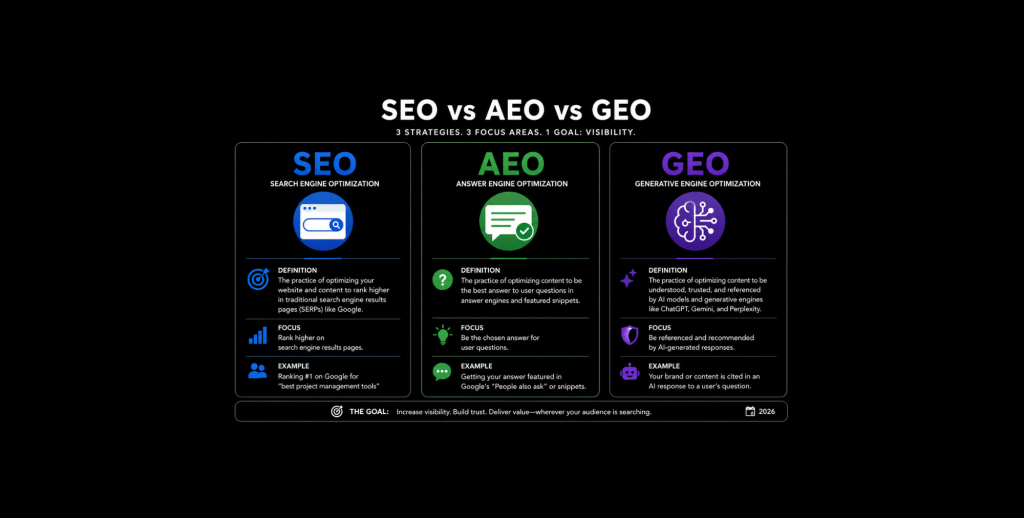
SEO vs AEO vs GEO: Complete Guide 2026

Introduction If you’ve felt like the rules of search just changed under your feet, you’re not imagining it.For almost two decades, “ranking on Google” meant one thing: get your blue link onto page one. That’s no longer the full picture.In 2026, people don’t just search. They ask. They ask ChatGPT, Gemini, Perplexity, and Google’s own AI Overviews — and very often, they never click a single link.This is exactly why three acronyms have taken over marketing meetings everywhere: SEO, AEO, and GEO.They sound similar. They’re often confused with each other. But they are not the same thing, and treating them as interchangeable is one of the fastest ways to lose visibility this year.In this guide, you’ll learn exactly what each one means, how they’re different, how they work together, and which one your business should prioritize right now.Let’s break it down in plain language — no jargon, no fluff. What Is SEO, AEO, and GEO Let’s start with quick, simple definitions before we go deeper.SEO (Search Engine Optimization) is the practice of optimizing your website so it ranks higher in traditional search engine results pages, like Google’s classic ten blue links.AEO (Answer Engine Optimization) is the practice of structuring your content so AI systems and voice assistants can pull it out and present it as a direct, ready-made answer — think featured snippets, voice search responses, and AI Overview boxes.GEO (Generative Engine Optimization) is the practice of optimizing your brand and content so that generative AI tools like ChatGPT, Gemini, and Perplexity mention, cite, or recommend you inside the answers they generate.Here’s the simplest way to remember the difference:SEO gets you ranked.AEO gets you answered.GEO gets you recommended.One industry FAQ on the topic put it well: generative engine optimization is the practice of structuring content and digital presence so that AI-powered platforms cite, recommend, or mention a brand when users ask questions, across platforms including ChatGPT, Google AI Overviews, Google Gemini, and Perplexity. Why It Matters In 2026 Here’s why this isn’t just theory — it’s survival.The way people search has fundamentally changed, and the numbers back it up.Google AI Overviews now appear in over 25% of all searches as of March 2026.AI Overviews appear on roughly 48% of all Google search queries as of March 2026, up sharply from about 34.5% in December 2025.Nearly all CMOs — 98% — are now investing in AEO strategies.ChatGPT alone has surpassed 900 million weekly active users.And here’s the part that should really get your attention: traffic doesn’t behave the way it used to.When an AI Overview appears, 83% of those searches end without a click, compared to 60% for searches without one.In Google’s full AI Mode, where AI replaces the traditional results page entirely, the zero-click rate climbs to 93%.That sounds discouraging at first. But here’s the twist that matters most for your strategy: visibility inside the AI answer is becoming more valuable than the click itself.Brands that get cited inside AI Overviews are actually gaining traffic — seeing 35% more organic clicks and 91% more paid clicks than the page sitting in position one below the AI answer.In other words, being the source the AI trusts is now worth more than being “ranked first” the old-fashioned way. Key Benefits Why should you care about all three frameworks instead of picking just one? Because each one protects a different part of your visibility. Benefits of SEO: Drives consistent, compounding organic traffic over timeBuilds long-term domain authority and trustStill the foundation that AEO and GEO are built on top of Benefits of AEO: Captures voice search and “quick answer” queriesIncreases your chances of appearing in featured snippets and AI Overview boxesBuilds trust through clear, structured, easy-to-extract content Benefits of GEO: Gets your brand mentioned even when the user never visits your siteBuilds brand awareness inside AI-generated recommendationsPositions you for an internet where AI agents do much of the “browsing” on a person’s behalf Together, these three create what most strategists now call a hybrid optimization strategy — and that’s no longer optional. Detailed Explanation Let’s go deeper into how each of these actually works, and how the search landscape evolved to get here. Evolution of Search: From Keywords to Conversations Search used to be transactional. You typed two or three words, scanned ten blue links, and clicked the one that looked most relevant.That model is dying — not overnight, but steadily.Search today looks more like a conversation. People type (or speak) full questions. They expect a direct answer, not a list of options to dig through.Nearly a third of the US population — 31.3% — is expected to use generative AI search in 2026, according to an EMARKETER forecast.This shift didn’t happen because Google decided to change things on a whim. It happened because AI models got good enough to read the web, synthesize it, and hand back a single, confident-sounding answer. Users liked that. A lot. Traditional Search vs AI Search Here’s the practical difference between the two systems, side by side. Traditional search (classic Google): Returns a ranked list of linksUser decides which result to trustSuccess metric: ranking position and click-through rateContent competes on keywords, backlinks, and on-page SEO AI search (ChatGPT, Gemini, AI Overviews, Perplexity): Returns one synthesized answer, often with a few citationsThe AI decides which sources to trust and surfaceSuccess metric: being cited, mentioned, or recommendedContent competes on clarity, structure, authority, and “extractability” Returns one synthesized answer, often with a few citationsThe AI decides which sources to trust and surfaceSuccess metric: being cited, mentioned, or recommendedContent competes on clarity, structure, authority, and “extractability” How Search Engnies Works In 2026 Google hasn’t disappeared — far from it. But it has changed shape.Google now blends classic organic results with AI Overviews sitting right at the top of the page, and a separate, fully conversational “AI Mode” for users who want it.SparkToro’s research found that when AI Overviews appear, click-through rates drop by nearly 60%, though AI Mode itself still plays a comparatively limited role in overall search volume.The practical

Digital Marketing

The Future of Digital Marketing After AI

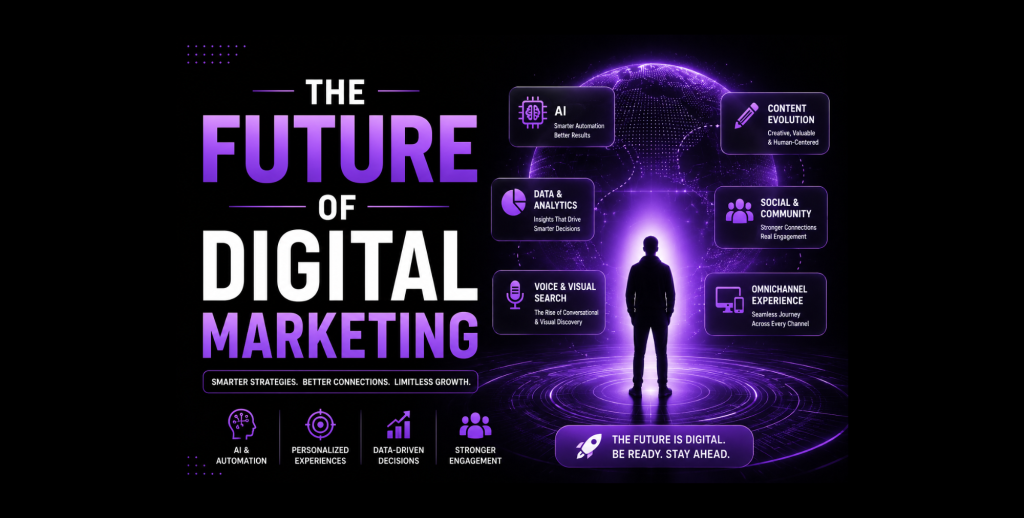
The Future of Digital Marketing After AI AI didn’t kill digital marketing — it reinvented it. Here’s what every marketer, brand strategist, and content creator needs to know about the world we’re already living in. When ChatGPT landed in late 2022, a collective panic swept through marketing departments worldwide. Would AI make copywriters redundant? Would algorithms replace strategists? Would brands lose their voice? Two years on, we have our answer — and it’s far more nuanced, and far more exciting, than anyone imagined. The truth is, AI didn’t arrive to take jobs from marketers. It arrived to transform what marketers do — eliminating the repetitive, amplifying the creative, and raising the stakes on everything that machines still can’t touch: strategy, empathy, and genuine human connection. In this deep-dive, we explore how digital marketing is evolving across every major discipline — from search and content to data analytics and customer personalization — and what it means for every person who builds brands for a living. We Are Living Through a Marketing Renaissance There’s a certain irony at the heart of this AI moment: the technology that many feared would commoditize marketing has actually made great marketing more valuable than ever before. When every brand has access to the same AI tools, the differentiator is no longer access to information — it’s wisdom, taste, and the ability to build genuine relationships. Think about what AI has actually done to the marketing stack. It’s automated keyword research that used to take days. It’s made A/B testing near-instantaneous. It’s enabled brands with small teams to produce content at a scale that was previously impossible. And it’s given data analysts superpowers they barely knew they needed. AI doesn’t replace the marketer’s mind. It frees it — stripping away the mechanical so the creative can breathe. But here’s what the doom-and-gloom narratives missed: all of that automation creates a vacuum at the top. A vacuum that only deeply skilled, emotionally intelligent, strategically sharp humans can fill. The Five Pillars of AI-Transformed Marketing Understanding the future of digital marketing means understanding five core areas where AI has fundamentally shifted how brands operate — and what human marketers must bring to the table in each. Search Is No Longer Just Keywords For over two decades, SEO was essentially a game of keywords and backlinks. Brands would research what people searched for, create content around those terms, and fight for positions on a list of ten blue links. AI has torn that entire model apart — gently, but thoroughly. Search engines now understand intent, context, and conversation. Google’s Search Generative Experience (SGE) and similar AI-powered answer engines don’t just match keywords — they synthesize information to answer questions directly. For marketers, this changes everything about how we think about discoverability. The brands winning in this new search landscape aren’t chasing keywords. They’re building genuine authority — creating content so thorough, so trustworthy, and so well-structured that AI systems cite them when generating answers. This is called Answer Engine Optimization (AEO), and it demands a depth of expertise that goes well beyond filling a content calendar. Content Has Quantity. What It Needs Is Quality. AI has made content production almost frictionless. A small team can now generate blog posts, social captions, email sequences, and product descriptions at a scale that would have required a small army just three years ago. That’s genuinely remarkable — and it’s also precisely why quality has become the scarcest and most valuable commodity in content marketing. We’ve entered what some researchers are calling the “Great Content Glut” — an internet flooded with AI-generated, technically accurate, but ultimately forgettable material. In this environment, content that carries a real point of view, real experience, and real personality cuts through like a signal in noise. The marketers thriving today aren’t the ones racing to produce the most content. They’re the ones using AI to handle the scaffolding — the outlines, the research, the first drafts — while they invest their finite human energy in the stuff that actually makes readers stop scrolling: original insight, emotional honesty, and stories that feel genuinely lived in. Personalization at an Unprecedented Scale For years, “personalization” in marketing meant putting someone’s first name in an email subject line and calling it a day. AI has made that feel embarrassingly quaint. Today’s AI-powered marketing systems can analyze thousands of behavioral signals — browsing history, purchase patterns, device usage, time of engagement — and deliver experiences tailored to individual customers in real time. We’re talking about dynamically generated web pages that show different products to different visitors. Email campaigns where every subscriber receives a different version of the message based on their predicted preferences. Chatbots that don’t just answer FAQs but actually understand a customer’s journey and respond accordingly. The Personalization Paradox: The more personalized you make an experience, the more human it needs to feel. AI can optimize the what — the right product, the right time, the right channel. But the tone, the warmth, the sense that a brand actually sees you as a person? That still has to come from human-led brand strategy. The Rise of Predictive Marketing One of the most underappreciated shifts AI has triggered is the move from reactive to predictive marketing. Traditional analytics told you what happened. AI-powered analytics increasingly tells you what’s about to happen — and gives you time to act. Predictive lead scoring, churn probability models, dynamic pricing engines, next-best-action recommendations — these tools have moved from enterprise-only luxuries to accessible features in mainstream marketing platforms. For brands willing to learn how to read and act on predictive signals, this represents a genuine competitive advantage. So, Is Digital Marketing Dead? Not even close. But it has graduated. The entry-level work — the templated posts, the spray-and-pray email blasts, the keyword-stuffed articles — that’s going away, or at minimum being absorbed into AI workflows. What remains, and what commands a premium, is judgment. Strategy. Creative direction. The ability to look at what AI produces and

SEO

Google AI Mode & What It Means for Your SEO in 2026

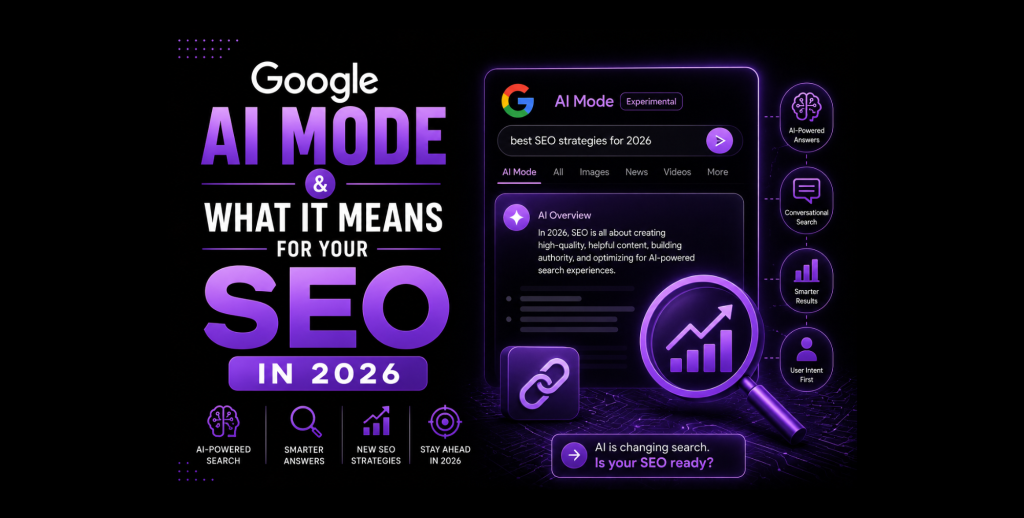
Google AI Mode & What It Means for Your SEO in 2026 01 — Foundations What Is Google AI Mode, Really? Google AI Mode is a dedicated search experience — accessible via a tab on Google Search — that uses a custom version of Gemini to generate comprehensive, multi-part answers to your queries. Unlike the earlier AI Overviews (which appeared above regular results), AI Mode is a fully AI-native search interface.Think of it as the difference between a waiter who mentions “the fish is good tonight” and a personal chef who plans your entire meal. AI Mode doesn’t just skim the top results; it synthesizes information from across the web, follows up with clarifying questions, and builds out a whole research session on your behalf. Key distinction: AI Overviews still co-exist with traditional blue-link results. AI Mode is a separate tab that replaces the traditional SERP experience entirely for that session. Here’s what AI Mode actually does that’s new: Multi-step query decomposition Complex questions get broken into sub-questions, each researched in parallel — what Google calls “query fan-out.” Conversational follow-upsUsers can refine their answers in a chat-like thread without typing a new search. Cited sources with linksEvery AI-generated response includes inline citations — but you’re competing with hundreds of other pages to get cited. Personalized contextFor signed-in users, AI Mode can draw on your past searches, location, and preferences. 02 — Under the Hood How AI Mode Works Under The Hood The technical architecture of AI Mode matters for SEO because it changes how Google decides what gets surfaced. Here’s the simplified version of what’s happening every time someone uses AI Mode: Query Fan-Out: The Game Changer When a user types “what’s the best project management tool for a 10-person remote startup in 2026,” AI Mode doesn’t just match keywords. It breaks that into parallel sub-queries: “Best project management tools for small teams 2026” “Remote work software pricing comparison” “Startup tool budget constraints” “User reviews: Notion vs Asana vs Linear 2026” Gemini then synthesizes all of that into a single, coherent answer. Your page might rank for one of those sub-queries and still get cited — or it might not get cited at all if Gemini decides another source covers the topic more authoritatively. The Indexing Reality Here’s the uncomfortable truth: Googlebot still crawls and indexes your content exactly the same way. The underlying web index hasn’t changed. What’s changed is how that index gets used. AI Mode draws from the same pool — but applies a very different selection logic on top. The search engine is not dead. The search results page is dead. Those are two very different problems.— Rand Fishkin, SparkToro, April 2026 03 — The Numbers The Real SEO Impact: What the Data Says Alright, let’s talk about what actually matters to most of you reading this: traffic. What is AI Mode doing to organic visits? -34%avg. organic CTR drop for informational queries in AI Mode SERPs +22%increase in clicks for pages cited in AI-generated answers 61%of AI Mode queries have no click to any external website Source: Semrush Industry Report, April 2026 / BrightEdge AI Search Study, Q1 2026 The pattern is clear: zero-click searches are up, but high-intent clicks are also up. What’s dying is the middle — the casual informational browse where someone Googled “how to clean a cast iron pan” and clicked the first blog post. AI Mode answers that completely. The user never needs to leave Google. 04 — The Divide Who’s Winning & Who’s Losing Traffic patterns are diverging sharply — some sites are growing while others see dramatic drops Sites That Are Thriving Counterintuitively, some categories are doing better than ever. Sites that get cited as authoritative sources in AI Mode responses are seeing highly qualified traffic — people who’ve already had their question pre-answered by AI and are clicking through specifically to learn more, to trust the source, or to buy. Deep-expertise niche sitesIf you’ve built genuine authority on a specific topic, Gemini trusts you and cites you regularly. Original research publishersStudies, surveys, and proprietary data are extremely citation-worthy because AI can’t make them up. E-commerce with strong product pagesCommercial-intent searches still convert. AI Mode often links to product pages. Community platforms (Reddit, forums)AI Mode heavily cites user-generated discussions, especially for subjective/opinion queries. Sites That Are Struggling Generic how-to blogsStep-by-step tutorials for simple tasks are AI Mode’s favorite thing to answer without a click. News aggregatorsSummarization is exactly what AI does best. Original reporting still has value; curation does not. Thin affiliate content“Best X product” listicles with no original perspective are being entirely replaced by AI summaries. Definition/glossary pages“What is X?” pages are almost always answered entirely in AI Mode now. 05 — Action Plan 10 Things To Do Right Now Okay, here’s the section you actually came for. Based on what’s working for sites adapting successfully to AI Mode, here are the most impactful moves you can make: 01 Audit your traffic by query typeUse Google Search Console segmented by query intent. Identify which pages are losing clicks to AI Overviews vs. pages that are growing. This tells you what to protect vs. what to transform. 02 Build “AI-worthy” authority signalsStructured data (Schema.org), clear author bios with credentials, first-hand expertise, original data — these are what get you cited. Implement Article schema with author and expertise signals on every piece. 03 Create content AI cannot createInterviews, case studies, proprietary surveys, real user data, original photography, lived experience narratives. If AI could write your content in 3 seconds, it will also answer for you in 3 seconds. 04 Obsess over E-E-A-T signalsExperience, Expertise, Authoritativeness, Trustworthiness — Google’s own framework for what it surfaces. Emphasize real people, real credentials, real track records. Update your About pages and author profiles. 05 Target BOFU (bottom-of-funnel) queriesShift content investment toward queries where users are ready to act — buy, compare pricing, book a demo, hire someone. These get clicked even after an AI overview. 06 Build your email list aggressivelyOrganic search dependency is riskier than ever. Every piece

AI Search & AEO

What is Answer Engine Optimization (AEO)?

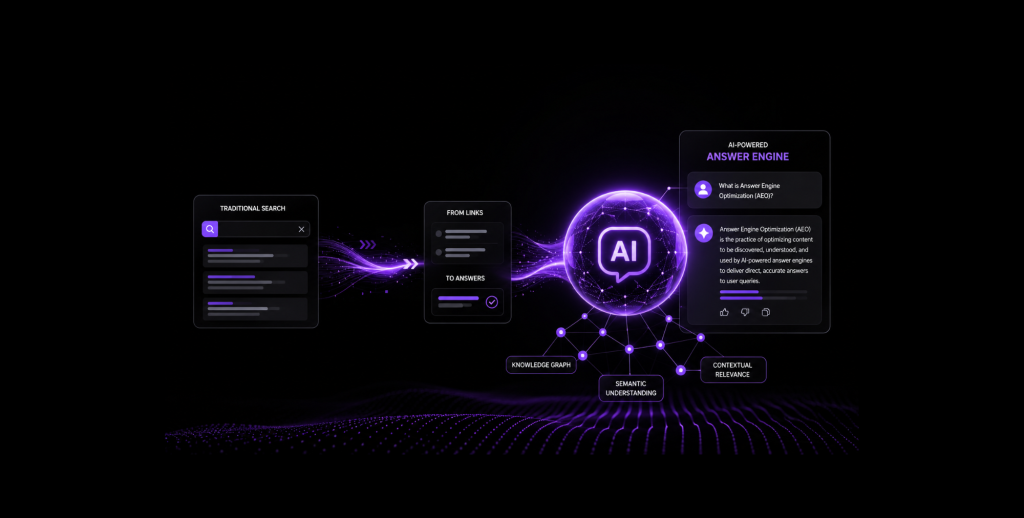
Explore More The Rise of Answer Engine Optimization (AEO) 01 — Introduction What is Answer Engine Optimization? Okay, let’s start simple. You know how when you type a question into Google these days, you sometimes get the answer right at the top — no need to click any website? That box of information, that voice assistant reply, that AI-generated summary — that’s an answer engine at work. Answer Engine Optimization (AEO) is the process of creating your content so that these answer engines choose YOUR information to show directly to users. It’s about being the source. Being the answer. Not just ranking on page one, but being the one who gets quoted at the top. Think about it this way. When someone asks Siri “What’s the capital of France?”, Siri doesn’t say “here are 10 websites about France.” Siri says “Paris.” That one clean, direct answer came from somewhere. AEO is how you make sure that somewhere is you. Simple Definition AEO is optimizing your content so that AI systems, voice assistants, and search engines can easily pull your content as the direct answer to a user’s question — without them needing to click further. AEO has grown out of the collision between traditional SEO and artificial intelligence. As search engines got smarter, they stopped just matching keywords. They started understanding intent. They started asking: “What does this user actually want to know?” And then — more importantly — “Which piece of content answers that best?”That shift changed everything. And if you’re still doing SEO the old way — stuffing keywords, building backlinks and hoping for a high rank — you’re missing the bigger opportunity sitting right in front of you. 40%of all Google searches now produce zero-click results 58%of consumer use voice search to find local business info in 2024 3xMore likely to be featured when using structured fomat content 2027Projected year when AI answer engine overtake traditional search  02 — Why It Matters Why AEO Matters in 2026 Here’s the honest truth: the way people search online has completely changed in the last 3 years. And it’s not slowing down. With tools like ChatGPT, Google’s AI Overviews, Microsoft Copilot, and voice assistants like Alexa and Siri becoming part of daily life, people aren’t searching for pages anymore — they’re searching for answers. Let’s put it in everyday terms. Imagine you’re cooking dinner and your hands are messy. You’re not going to type something into Google, scroll through 10 results, and read three articles. You’re going to say “Hey Google, how long do I roast chicken at 375°F?” and you want ONE answer. Right now. No fuss. This isn’t a niche behavior. This is how billions of people are using the internet today — and it’s only growing. The brands that win in AI-search aren’t the ones who rank #1 anymore. They’re the ones whose content is clear, structured, and trustworthy enough to become the answer itself. — SEO Research Report, BrightEdge 2025 The Business Case for AEO From a business standpoint, AEO is no longer optional — it’s competitive survival. Here’s why every marketer, content creator, and business owner needs to understand it: Zero-Click Traffic Is Real When Google shows your content as a featured snippet or AI overview, users trust you more — even if they don’t click. Brand recall goes up, trust goes up, and conversions follow. Voice Search Is Exploding Over 1 billion voice searches happen every month. Voice devices ONLY give one answer. If you’re not optimized for that answer, you don’t exist on voice. AI Overviews Now Dominate Page 1 Google’s AI Overviews appear above organic results for over 84% of searches in some niches. Being cited in those summaries is the new “ranking #1.” Chatbots Are the New Search Bar Millions of people now ask ChatGPT, Gemini, and Perplexity questions directly. These AI tools pull answers from trustworthy, well-structured content — AEO determines if that content is yours. 03 — SEO vs AEO SEO vs AEO: What’s the Real Difference? A lot of people hear “AEO” and think it’s just a fancy new name for SEO. It’s not. While they overlap in many ways, the goals, tactics, and mindset behind them are quite different. Let’s break it down clearly. Traditional SEO is about getting your page to rank high on a search results page. You want to show up on page one, above your competitors. The user sees your link, clicks it, lands on your site. That’s the game. AEO plays a different game. The goal is to have your content — not just your page — selected as the definitive answer. It’s less about ranking and more about being chosen as the source. The AI doesn’t care if you’re #1 or #5 in rankings — it cares if your content is the most direct, accurate, well-structured answer to the question. Factor Traditional SEO Answer Engine Optimization (AEO) Primary Goal Key OutputContent styleTechnical focusUser behaviour Optimize ForVoice search High Search RankingWebsite traffic & clicksLong-form, keyword-richBacklinks, page speedSearch → Click → ReadSearch engine crawlersMinimal focus Be the direct answerFeatured snippets Clear, concise Q&A formatSchema markupSearch → Get Answer AI understanding Core strategy The good news? You don’t have to choose between them. The best digital strategy in 2025 combines both. You still want to rank well for traditional SEO, but you layer AEO tactics on top to capture the growing audience that never leaves the search results page. Key TakeawaySEO gets you ranked. AEO gets you quoted. In an AI-first search world, being quoted is worth more than being ranked #1. 04 — How It Works How Answer Engines Actually Work To optimize for answer engines, you need to understand how they think. And yes, they do “think” — well, they process language in a way that mimics understanding. Here’s the simple version of what’s happening behind the scenes. Step 1: Understanding the Question When a user types (or speaks) a query, the answer engine doesn’t just look for matching keywords. It uses Natural Language Processing (NLP)

Scroll to Top