July 8, 2026

Digital Marketing, Uncategorized

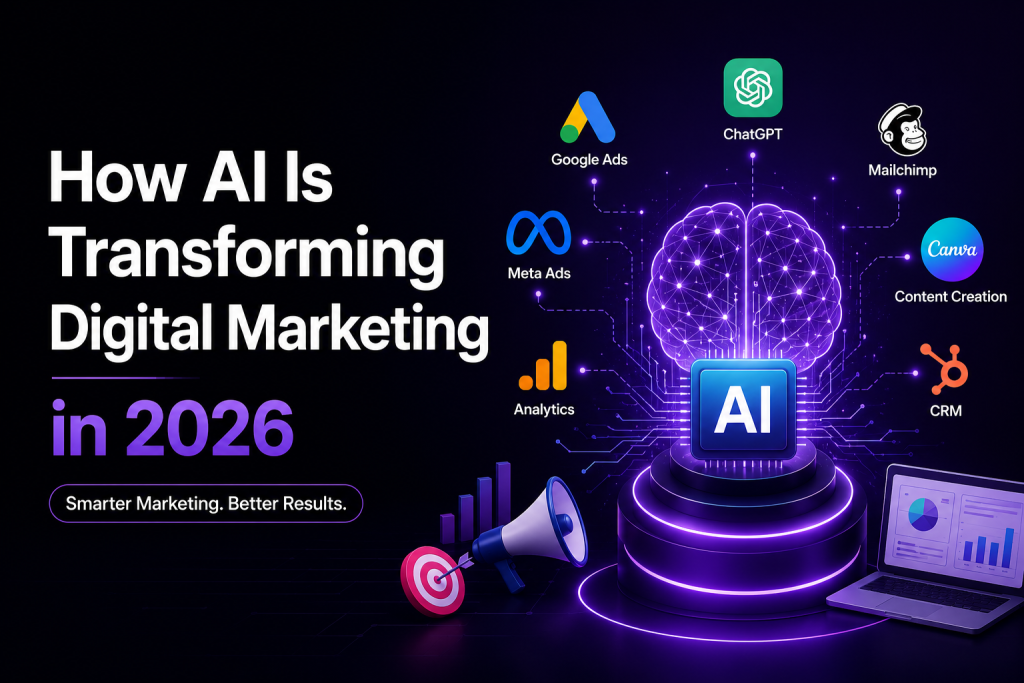
How ai is transforming digital marketing 2026 

Introduction If you’ve worked in marketing for more than a few years, you’ve probably noticed something: the pace of change has never felt this fast. Every quarter brings a new AI feature, a new tool, a new “must-adopt” workflow. It’s easy to feel like you’re constantly catching up. Here’s the honest truth, though. How AI is transforming digital marketing in 2026 isn’t really about chasing every new tool that launches. It’s about understanding which shifts are structural — the ones reshaping how customers discover brands, how campaigns get built, and how decisions get made — and which are just noise. This guide walks through exactly that. Whether you’re a business owner trying to figure out where to invest, a marketer wondering if your job is changing (it is, but maybe not the way you think), or a student trying to understand where the industry is headed, you’ll find a grounded, practical breakdown here — not hype. What Is AI in Digital Marketing? AI in digital marketing refers to the use of machine learning, natural language processing, and automation systems to plan, execute, and optimize marketing activities — often with far less manual effort than traditional methods required. In practice, this covers things like: Writing and editing content Predicting which customers are likely to convert Personalizing website and email experiences in real time Automatically adjusting ad bids and budgets Powering chatbots that handle customer questions Analyzing performance data to surface insights humans would take days to find   The key distinction from older marketing tech: AI tools don’t just execute rules you set. They learn from patterns and improve their own outputs over time, often adapting to individual users rather than broad audience segments. Why AI Is Reshaping Marketing in 2026 A few forces have converged to make this the year AI stopped being optional: 1. AI-generated content is now genuinely usable. Output quality has crossed a threshold where AI-assisted content can go straight to customers with light human editing, rather than needing a full rewrite. 2. Search itself has changed. With AI-powered search summaries and chat-based discovery becoming a normal part of how people find information, marketers now have to think about visibility inside AI answers — not just traditional blue-link rankings. 3. Budgets are under pressure. Teams are being asked to do more with the same (or smaller) headcount, and AI is the most direct lever for that. 4. Consumers expect personalization. A generic email blast or one-size-fits-all landing page increasingly feels out of step with what audiences expect from brands they trust. 5. Agentic AI has arrived. Instead of just assisting with individual tasks, AI systems are now capable of executing multi-step workflows — testing ad creative, reallocating budget, and adjusting targeting with minimal manual input. Top Ways AI Is Transforming Digital Marketing AI Content Creation AI content creation has moved well past generic blog drafts. Modern tools can now match brand voice, incorporate SEO structure, and generate first drafts for blogs, ad copy, product descriptions, and even video scripts. Practical example: A small e-commerce brand can now generate dozens of product description variations in the time it used to take to write three — then let a human editor polish the best ones for tone and accuracy. The smartest teams treat AI as a first-draft engine, not a replacement for editorial judgment. Content that’s purely AI-generated and unedited tends to read flat — audiences notice, and so do search engines. Personalized Customer Experiences AI personalization allows websites, apps, and emails to adapt in real time based on a visitor’s behavior, past purchases, or browsing patterns — rather than showing every visitor the same experience. A returning shopper might see different homepage banners than a first-time visitor. An email subject line might change based on a subscriber’s engagement history. This level of granularity was previously reserved for large enterprises with dedicated data science teams; it’s now accessible through mid-market marketing platforms. Marketing Automation Marketing automation has existed for years, but AI has made it far more adaptive. Instead of static “if this, then that” workflows, modern automation platforms can adjust send times, messaging, and next-best-actions based on live customer signals. This means fewer manual campaign builds and more systems that quietly optimize themselves in the background. AI Chatbots & Customer Support AI chatbots now handle a large share of routine customer service — answering FAQs, tracking orders, and even recommending products — freeing human support teams to focus on complex, high-value conversations. The best implementations feel conversational rather than scripted, and they know when to hand off to a human instead of trapping a frustrated customer in a loop. Predictive Analytics Predictive analytics uses historical data to forecast future outcomes — which customers are likely to churn, which leads are most likely to convert, and which products are about to trend. Example: A subscription business can flag at-risk customers weeks before they cancel, giving the retention team time to intervene with a targeted offer. AI in SEO AI has reshaped SEO research and execution — analyzing search intent, identifying content gaps, and recommending structural improvements far faster than manual audits ever could. It’s also pushed marketers to optimize for visibility inside AI-generated search summaries, not just traditional rankings. AI in Email Marketing From subject-line testing to send-time optimization to dynamic content blocks, AI now handles much of the fine-tuning that used to require weeks of A/B testing — compressing that learning curve into days. AI in Social Media Marketing AI tools now assist with caption writing, optimal posting times, trend detection, and even generating short-form video variations for testing across platforms. AI Advertising AI advertising platforms — including automated bidding and creative optimization systems — now handle much of the manual work that used to sit with a paid media specialist, testing dozens of ad variations and shifting budget toward top performers automatically. Benefits of AI for Businesses Benefit What It Looks Like in Practice Time savings Faster content drafts, automated reporting Better targeting Precise audience segmentation
Content & Social, Uncategorized

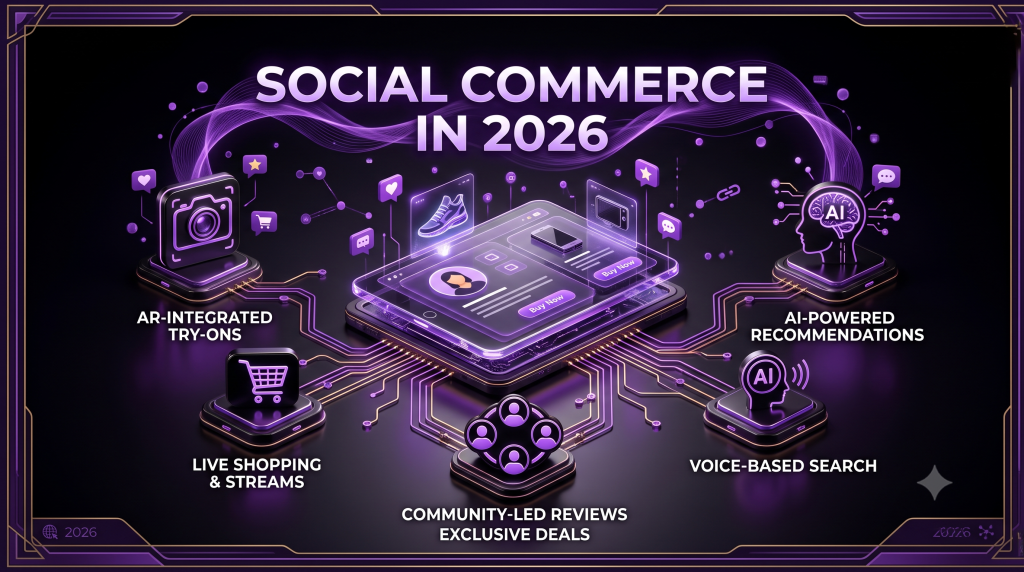
Social Commerce in 2026

Introduction A decade ago, social media was a place to build awareness. Today, it’s a fully functioning storefront. Social commerce — the practice of discovering, evaluating, and buying products without ever leaving a social app — has become one of the fastest-growing corners of digital retail, with global spending now measured in the trillions of dollars. For brands and creators, this shift changes the math. A follower isn’t just a vanity metric anymore; they’re a potential customer sitting a few taps away from checkout. But turning attention into revenue takes more than posting product photos and hoping for the best. It requires a deliberate strategy across Instagram Shopping, TikTok Shop, live selling, and creator partnerships — backed by content marketing that earns trust before it asks for a sale.   This guide breaks down exactly how social commerce works in 2026, why it’s growing so fast, and the specific tactics you can use to convert followers into loyal, paying customers. What is Social Commerce? Social commerce is the fusion of e-commerce and social media: product discovery, engagement, and checkout all happen inside the same app, with no redirect to an external website required. It’s different from traditional social media marketing, which typically drives traffic toward a separate online store, and it’s different from ordinary e-commerce, which relies on people arriving at your site with intent already formed. In practice, social commerce includes: Shoppable posts and stories (Instagram, Facebook) In-app storefronts (TikTok Shop, Instagram Shop) Live shopping events with real-time purchasing Creator and affiliate selling, where influencers earn commission on sales they generate Social selling, where individual sellers or small businesses build relationships and close sales through DMs and comments The common thread is friction removal. The shorter the distance between “I want that” and “I bought that,” the higher the conversion rate. Why Social Commerce Is Booming Several forces are converging to make 2026 a landmark year for the channel: Platform investment. Instagram, TikTok, and Facebook have all built native checkout, fulfillment, and payment infrastructure directly into their apps, reducing dependence on external websites. Video-first discovery. Short-form video now drives a larger share of product discovery than static posts, and it converts at meaningfully higher rates. Trust through creators. Consumers increasingly trust peer and creator recommendations over traditional advertising, even when they’re aware the content is sponsored. Mobile-native generations. Gen Z and Millennials treat their social feeds as a primary shopping destination, not just an entertainment source. AI-powered personalization. Recommendation engines and AI shopping assistants are getting better at surfacing the right product to the right person at the right moment.   The result: live shopping, creator storefronts, and in-app checkout are no longer experimental features — they’re core revenue channels for brands of every size. Instagram Shopping Strategy Instagram remains one of the most versatile platforms for social commerce because it blends visual storytelling with a mature shopping infrastructure. To build an effective Instagram Shopping strategy: Set up your Shop properly. Tag products in every post, Reel, and Story where relevant. Lead with Reels. Short-form video consistently outperforms static images for reach and product discovery. Use Collections to organize products by use case, season, or bundle — this mimics the browsing experience of a website. Leverage user-generated content (UGC). Reposting customer photos and reviews builds social proof and reduces purchase hesitation. Run shoppable ads that link directly to product pages inside the app.   Checklist: Instagram Shopping Setup Business or Creator account connected to a product catalog Product tags enabled on Reels, Stories, and posts Collections organized by category At least 3 UGC posts reshared per week Instagram Checkout enabled where available Example: A skincare brand that shifts from static product photos to before-and-after Reels, tagged with products and paired with customer testimonials, typically sees a sharp lift in saves, shares, and add-to-cart actions — because the format matches how people actually browse for skincare advice. TikTok Shop Strategy TikTok Shop has grown into one of the largest social commerce channels in the U.S., with tens of millions of active buyers and conversion rates that outperform most other platforms. A strong TikTok Shop strategy includes: Native, unpolished content. TikTok users respond to authenticity, not studio-quality ads. Affiliate program participation. Recruiting creators to promote your products for commission is often more effective than paid ads alone. TikTok Shop tabs and product links embedded directly in videos. Trend-responsive content. Tying products to trending sounds, formats, or challenges increases discoverability. Bundling for impulse buys. Lower-priced, easy-to-understand products tend to convert fastest on TikTok.   Case Study: A mid-size beauty brand launching on TikTok Shop partnered with a network of micro-creators (10,000–50,000 followers) instead of a single celebrity influencer. The distributed approach generated a steady stream of authentic “unboxing” and “get ready with me” content, driving a multi-week sales spike during a single promotional event — a pattern now common among TikTok Shop’s top-performing sellers. Live Shopping Live shopping — real-time video where hosts demonstrate products and viewers buy instantly — has become one of the highest-converting formats in social commerce, with conversion rates far above standard e-commerce averages. Why it works: Real-time Q&A removes purchase hesitation Limited-time offers create urgency The format feels more like shopping with a friend than watching an ad Tips for running effective live shopping events: Promote the event in advance across all channels Offer an exclusive discount only available during the live stream Feature 3–5 products, not your entire catalog Have a co-host or creator to keep energy and pacing natural Creator Selling Creator-led selling — sometimes called influencer commerce — has evolved past one-off sponsored posts into long-term partnerships and affiliate storefronts. Model Best For Payment Structure Flat-fee sponsorship Brand awareness Fixed payment per post Affiliate commission Direct sales Percentage of revenue generated Creator storefront Ongoing sales Revenue share on all storefront purchases Hybrid deal Established creators Base fee plus commission Brands that build ongoing relationships with a smaller group of creators — rather than one-off campaigns with many — tend to see stronger long-term

Scroll to Top