
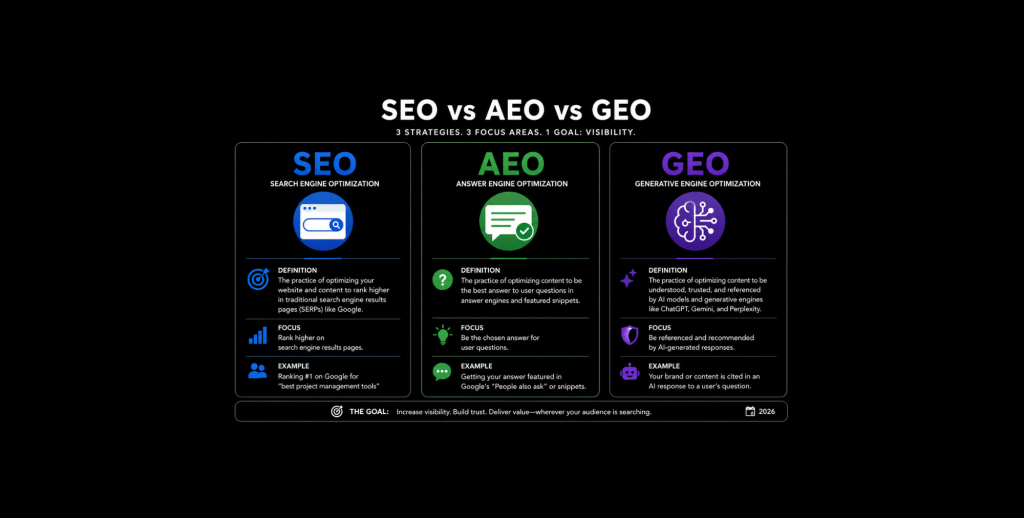
SEO vs AEO vs GEO: Complete Guide 2026
Introduction If you’ve felt like the rules of search just changed under your feet, you’re not imagining it.For almost two decades, “ranking on Google” meant one thing: get your blue link onto page one. That’s no longer the full picture.In 2026, people don’t just search. They ask. They ask ChatGPT, Gemini, Perplexity, and Google’s own AI Overviews — and very often, they never click a single link.This is exactly why three acronyms have taken over marketing meetings everywhere: SEO, AEO, and GEO.They sound similar. They’re often confused with each other. But they are not the same thing, and treating them as interchangeable is one of the fastest ways to lose visibility this year.In this guide, you’ll learn exactly what each one means, how they’re different, how they work together, and which one your business should prioritize right now.Let’s break it down in plain language — no jargon, no fluff. What Is SEO, AEO, and GEO Let’s start with quick, simple definitions before we go deeper.SEO (Search Engine Optimization) is the practice of optimizing your website so it ranks higher in traditional search engine results pages, like Google’s classic ten blue links.AEO (Answer Engine Optimization) is the practice of structuring your content so AI systems and voice assistants can pull it out and present it as a direct, ready-made answer — think featured snippets, voice search responses, and AI Overview boxes.GEO (Generative Engine Optimization) is the practice of optimizing your brand and content so that generative AI tools like ChatGPT, Gemini, and Perplexity mention, cite, or recommend you inside the answers they generate.Here’s the simplest way to remember the difference:SEO gets you ranked.AEO gets you answered.GEO gets you recommended.One industry FAQ on the topic put it well: generative engine optimization is the practice of structuring content and digital presence so that AI-powered platforms cite, recommend, or mention a brand when users ask questions, across platforms including ChatGPT, Google AI Overviews, Google Gemini, and Perplexity. Why It Matters In 2026 Here’s why this isn’t just theory — it’s survival.The way people search has fundamentally changed, and the numbers back it up.Google AI Overviews now appear in over 25% of all searches as of March 2026.AI Overviews appear on roughly 48% of all Google search queries as of March 2026, up sharply from about 34.5% in December 2025.Nearly all CMOs — 98% — are now investing in AEO strategies.ChatGPT alone has surpassed 900 million weekly active users.And here’s the part that should really get your attention: traffic doesn’t behave the way it used to.When an AI Overview appears, 83% of those searches end without a click, compared to 60% for searches without one.In Google’s full AI Mode, where AI replaces the traditional results page entirely, the zero-click rate climbs to 93%.That sounds discouraging at first. But here’s the twist that matters most for your strategy: visibility inside the AI answer is becoming more valuable than the click itself.Brands that get cited inside AI Overviews are actually gaining traffic — seeing 35% more organic clicks and 91% more paid clicks than the page sitting in position one below the AI answer.In other words, being the source the AI trusts is now worth more than being “ranked first” the old-fashioned way. Key Benefits Why should you care about all three frameworks instead of picking just one? Because each one protects a different part of your visibility. Benefits of SEO: Drives consistent, compounding organic traffic over timeBuilds long-term domain authority and trustStill the foundation that AEO and GEO are built on top of Benefits of AEO: Captures voice search and “quick answer” queriesIncreases your chances of appearing in featured snippets and AI Overview boxesBuilds trust through clear, structured, easy-to-extract content Benefits of GEO: Gets your brand mentioned even when the user never visits your siteBuilds brand awareness inside AI-generated recommendationsPositions you for an internet where AI agents do much of the “browsing” on a person’s behalf Together, these three create what most strategists now call a hybrid optimization strategy — and that’s no longer optional. Detailed Explanation Let’s go deeper into how each of these actually works, and how the search landscape evolved to get here. Evolution of Search: From Keywords to Conversations Search used to be transactional. You typed two or three words, scanned ten blue links, and clicked the one that looked most relevant.That model is dying — not overnight, but steadily.Search today looks more like a conversation. People type (or speak) full questions. They expect a direct answer, not a list of options to dig through.Nearly a third of the US population — 31.3% — is expected to use generative AI search in 2026, according to an EMARKETER forecast.This shift didn’t happen because Google decided to change things on a whim. It happened because AI models got good enough to read the web, synthesize it, and hand back a single, confident-sounding answer. Users liked that. A lot. Traditional Search vs AI Search Here’s the practical difference between the two systems, side by side. Traditional search (classic Google): Returns a ranked list of linksUser decides which result to trustSuccess metric: ranking position and click-through rateContent competes on keywords, backlinks, and on-page SEO AI search (ChatGPT, Gemini, AI Overviews, Perplexity): Returns one synthesized answer, often with a few citationsThe AI decides which sources to trust and surfaceSuccess metric: being cited, mentioned, or recommendedContent competes on clarity, structure, authority, and “extractability” Returns one synthesized answer, often with a few citationsThe AI decides which sources to trust and surfaceSuccess metric: being cited, mentioned, or recommendedContent competes on clarity, structure, authority, and “extractability” How Search Engnies Works In 2026 Google hasn’t disappeared — far from it. But it has changed shape.Google now blends classic organic results with AI Overviews sitting right at the top of the page, and a separate, fully conversational “AI Mode” for users who want it.SparkToro’s research found that when AI Overviews appear, click-through rates drop by nearly 60%, though AI Mode itself still plays a comparatively limited role in overall search volume.The practical